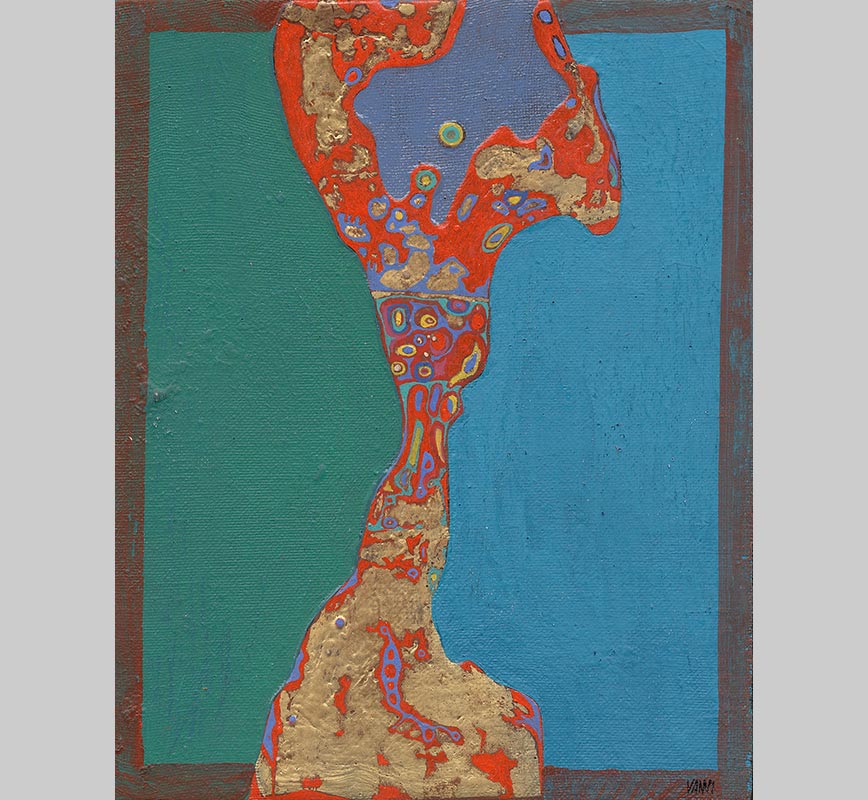
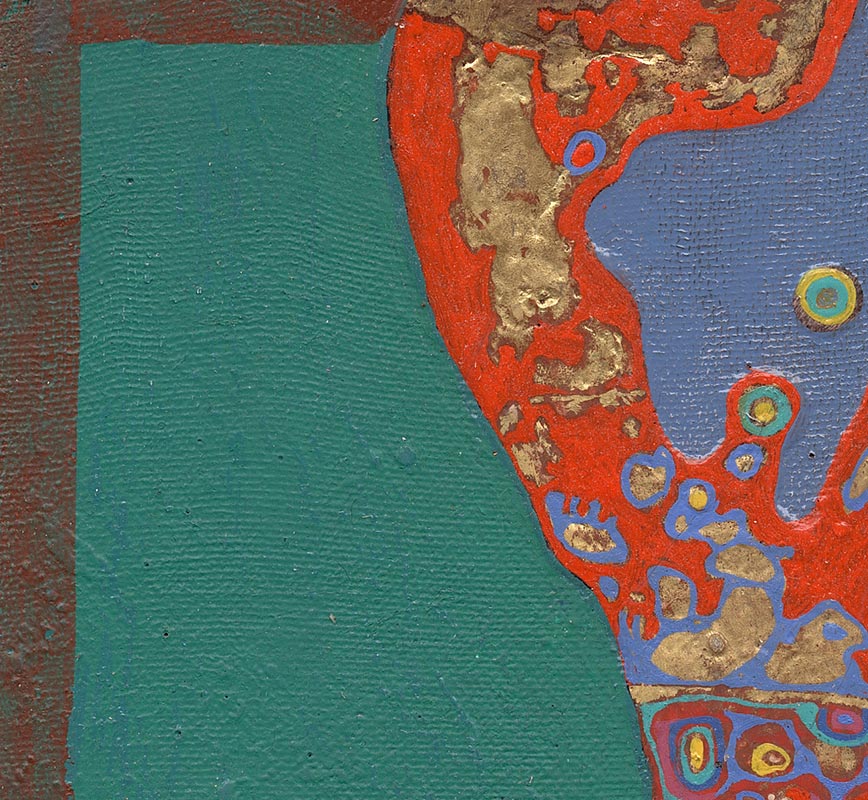
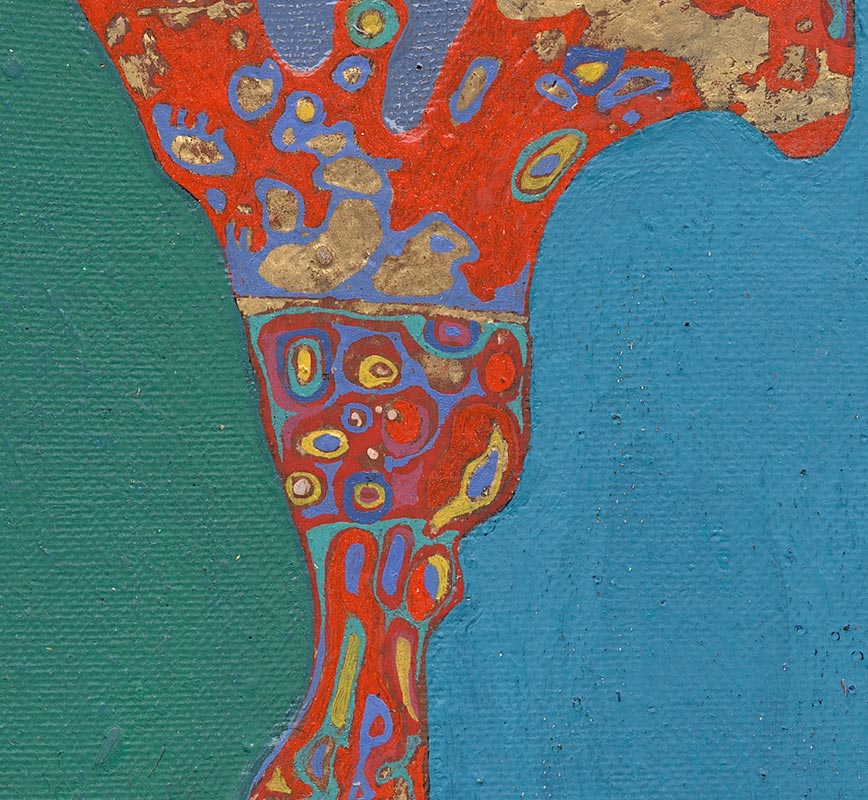
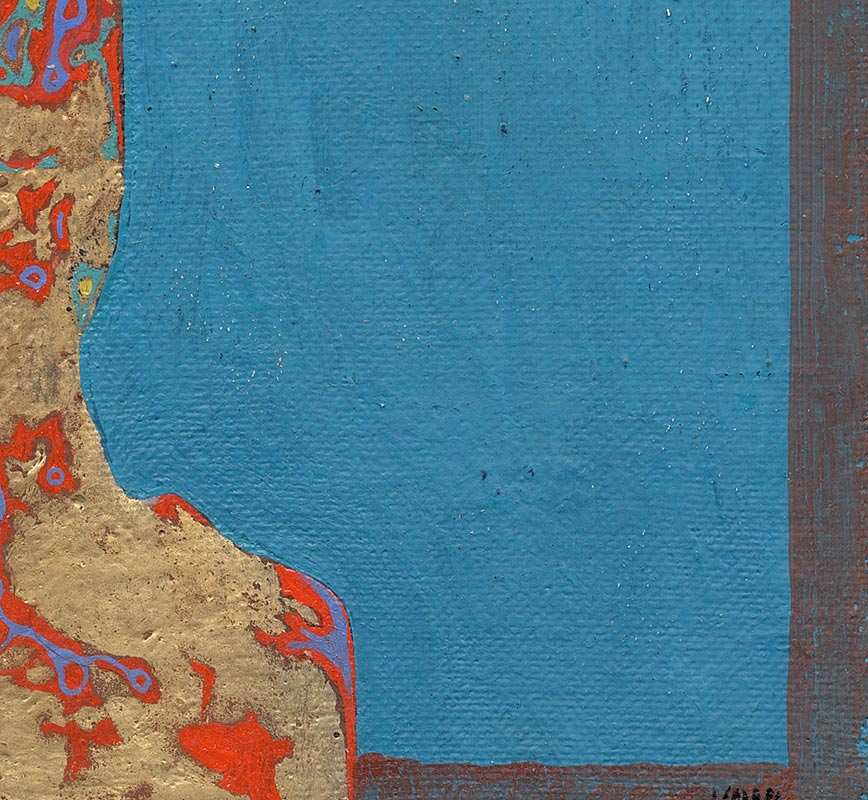
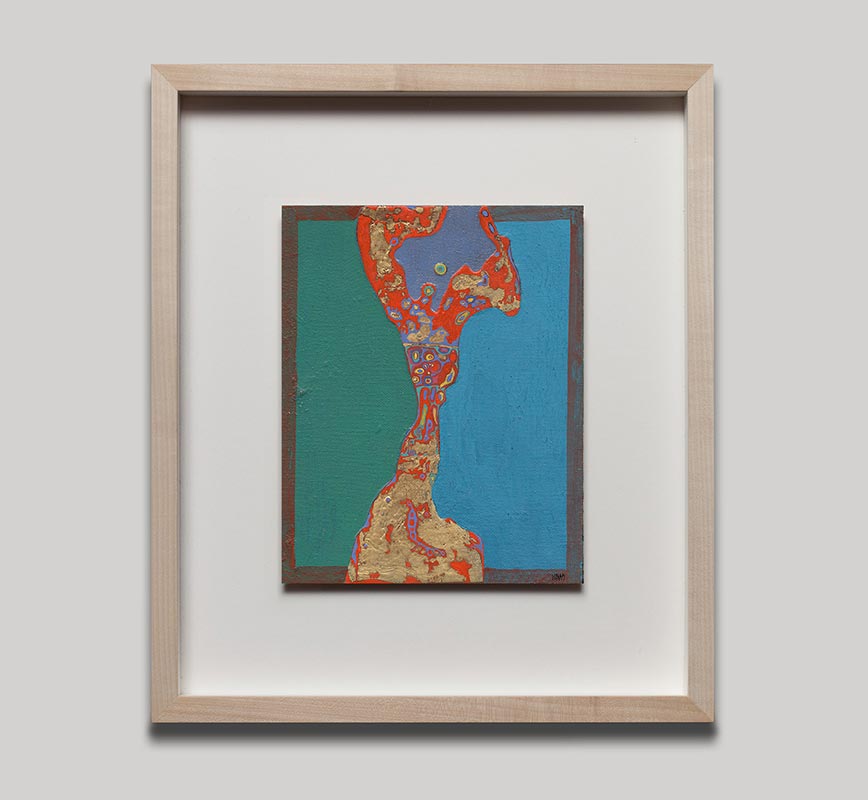
Silver light pours through this canvas the way it falls through shallow water at dusk: everywhere at once, shifting with each viewing angle, settling nowhere. The silver leaf is not a decorative material but a geological one, transforming the canvas into a porous mineral crust on which teal, purple, and green life-forms gather. Suggestive of organisms, forms appear and dissolve across this luminous field. The oscillation between microscopic and macroscopic is not metaphor; it is the formal structure of the work.
Silver light pours through this canvas the way it falls through shallow water at dusk: everywhere at once, shifting with each viewing angle, settling nowhere. The silver leaf is not a decorative material but a geological one, transforming the canvas into a porous mineral crust on which teal, purple, and green life-forms gather. Suggestive of organisms, forms appear and dissolve across this luminous field. The oscillation between microscopic and macroscopic is not metaphor; it is the formal structure of the work.
The formation of this visual language has a specific biographical source. Vanni grew up watching his father, a professor of parasitology at the University of Rome, prepare slides for teaching: hours at the microscope, observing cells and micro-organisms whose forms, colorfully revealed by reagents and in continuous metamorphosis, lodged permanently in his visual imagination. His later rediscovery of Ernst Haeckel's Art Forms in Nature (Dover, 1974) gave those childhood forms a scientific grammar and confirmed that natural structure, observed at scale, generates the same visual logic whether it belongs to the mineral or the biological world.
In this work, that logic becomes indistinguishable from the material itself. The silver field is simultaneously lake surface and microscope slide, the biomorphic forms simultaneously organisms and mineral depositions. The metallic ground functions not as ornament but as matter: one stratum among several, carrying in its oxidation the same record of accumulation that geological strata carry in stone.
The biomorphic forms move within a philosophical territory whose outlines were first drawn by Jean Arp: the organic shape as a self-sufficient visual unit, independent of representation. But the ground here is not Arp's smooth, refined surfaces. This is rough, ancient, chemically active matter, and the organisms it carries could only have grown from something as dense and particular as itself.