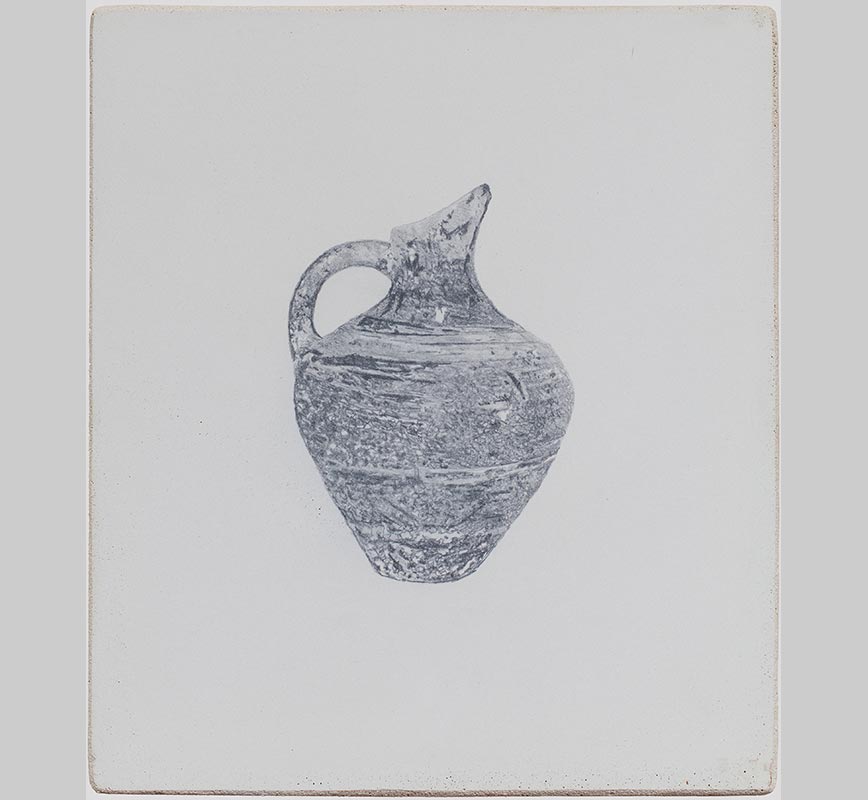
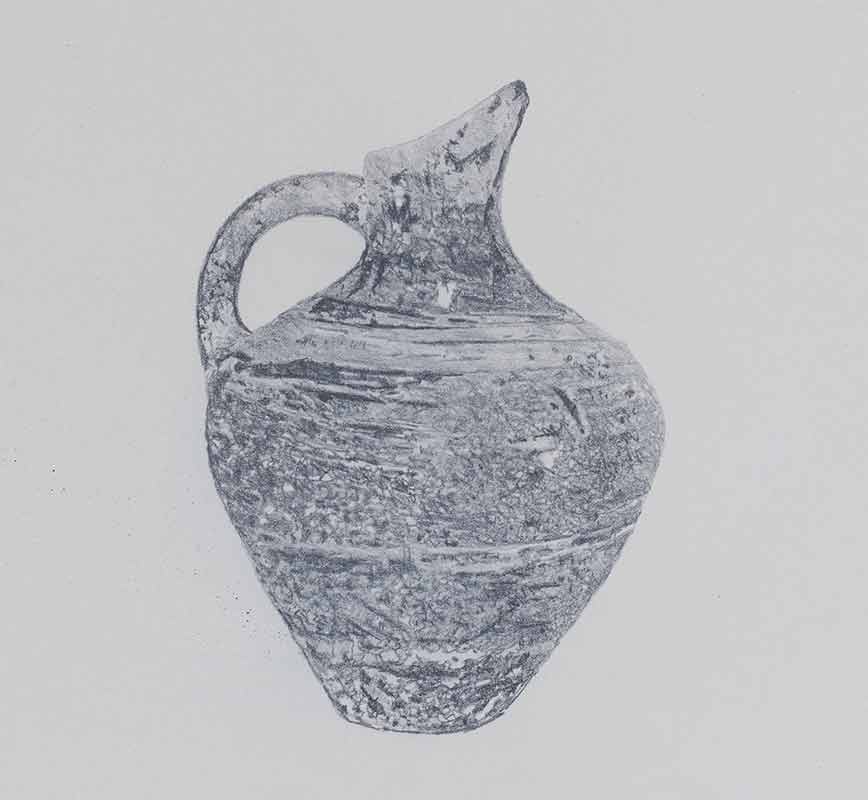
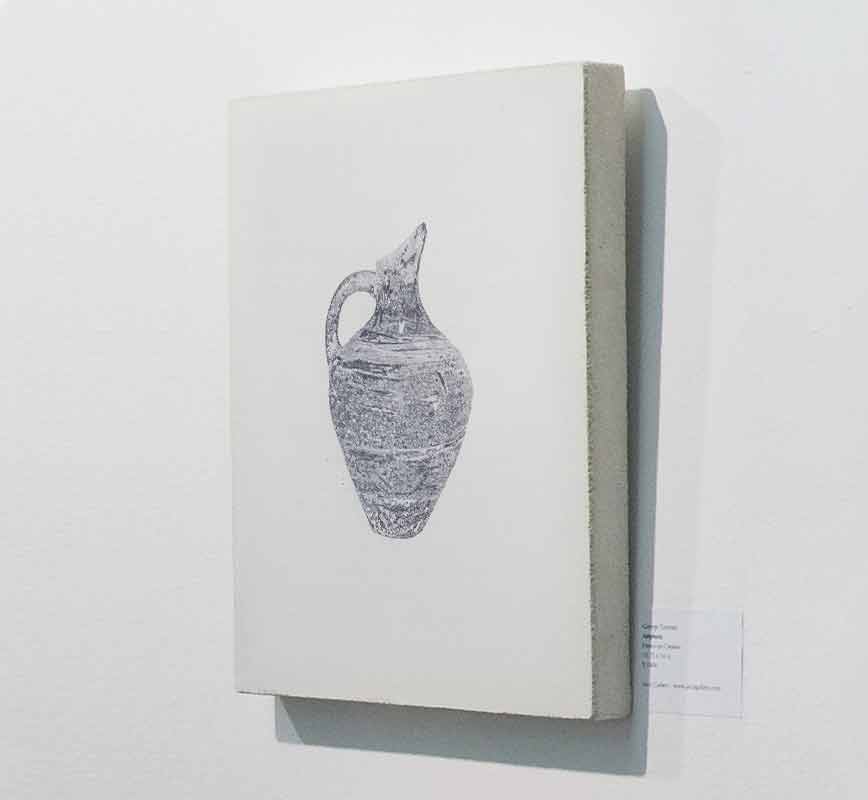
The amphora stands on a pale ground, its body turned slightly to the right, the single handle catching a low light that models the vessel's volume from pouring lip to base. Tzannes made this using a technique he developed himself: pigment fixed in cement as it hardens, the image embedded in the support rather than applied to it. The result is a surface at once dense and silky, the drawn vessel sitting in its grey ground as if it had always been there.
The amphora stands on a pale ground, its body turned slightly to the right, the single handle catching a low light that models the vessel's volume from pouring lip to base. Tzannes made this using a technique he developed himself: pigment fixed in cement as it hardens, the image embedded in the support rather than applied to it. The result is a surface at once dense and silky, the drawn vessel sitting in its grey ground as if it had always been there.
The structural logic of this technique is closer to archaeology than to painting. When an object is buried and the earth hardens around it, the object and its ground share a temporal event: they set together. Tzannes's cement fresco works on the same principle: the image and the support share the moment of hardening and cannot be separated. The vessel is fossilized in its ground, not painted on it, a fundamental inversion of the photorealist surface description he explored at OK Harris.
These vases were drawn from the archaeological catalogue of the Paliopoli excavations, a site on Kythera identified in local tradition as the place where Aphrodite emerged from the sea. Tzannes used the form of the excavated vessel as a metaphor for Aphrodite and the female form, the container that held the goddess before the goddess took shape. The amphora here is not a still-life subject; it is a mythologized archaeological form, the object as proof of the remembered myth.