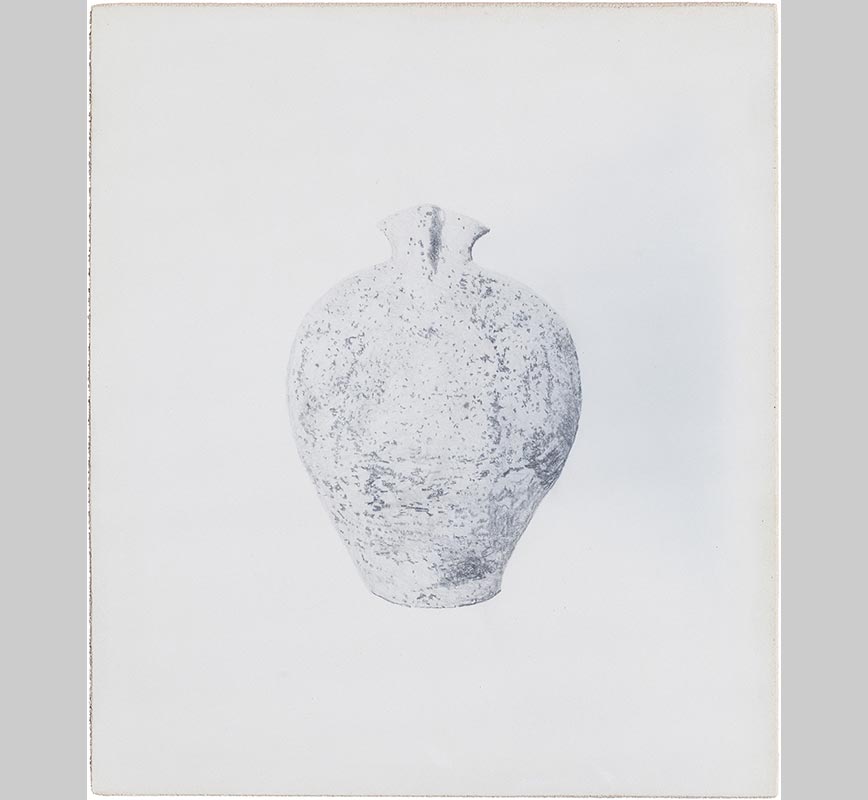
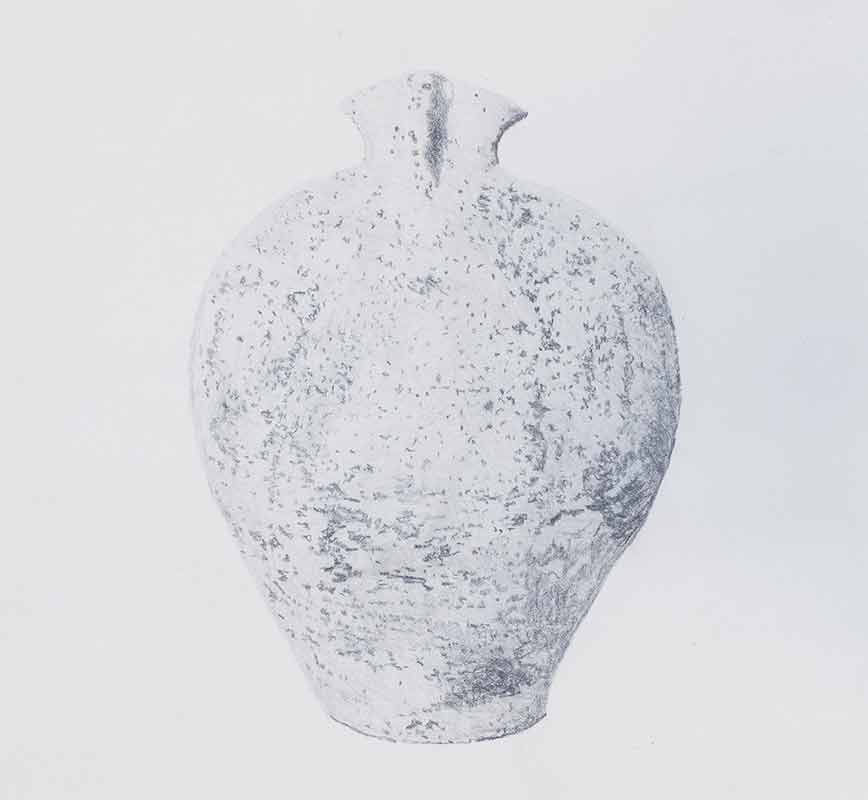
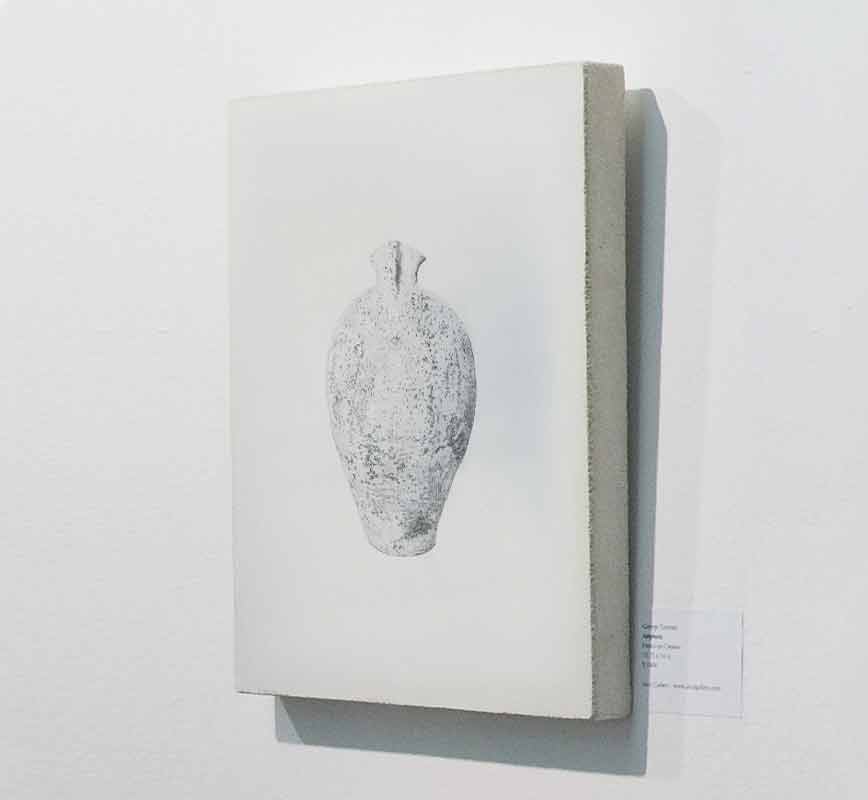
The tall transport amphora almost disappears into the pale cement ground. Its twin handles are the most visible elements, rising from the narrow body against a surface barely a different tone from the vessel itself. Tzannes has pushed the fresco-on-cement technique to its limit: the pigment is so close in value to the raw cement that the image seems to dissolve into its ground rather than sit upon it, the vessel held at the threshold of visibility.
The tall transport amphora almost disappears into the pale cement ground. Its twin handles are the most visible elements, rising from the narrow body against a surface barely a different tone from the vessel itself. Tzannes has pushed the fresco-on-cement technique to its limit: the pigment is so close in value to the raw cement that the image seems to dissolve into its ground rather than sit upon it, the vessel held at the threshold of visibility.
The beauty of this work is the beauty of the almost-gone. The elongated form, the slender twin handles, the way the body tapers to its base: all of it is there, legible, but barely. It requires the kind of sustained attention that reveals form gradually, not immediately. Lucio Fontana's ceramic works pursued a related economy, form reduced to its essential gesture; Tzannes arrives at the same reduction through the logic of burial rather than the logic of making.
The vessel was drawn from the Paliopoli archaeological catalogue, and the form is ancient: this profile has been recognized across the Eastern Mediterranean for three thousand years. Tzannes fixed it in cement at the moment of the cement's hardening, so the image shares its ground's own moment of becoming permanent. The amphora did not survive its burial intact; what survived was its outline, its type, its reference number in the catalogue. Tzannes renders that surviving form: the vessel as echo, the echo as presence.