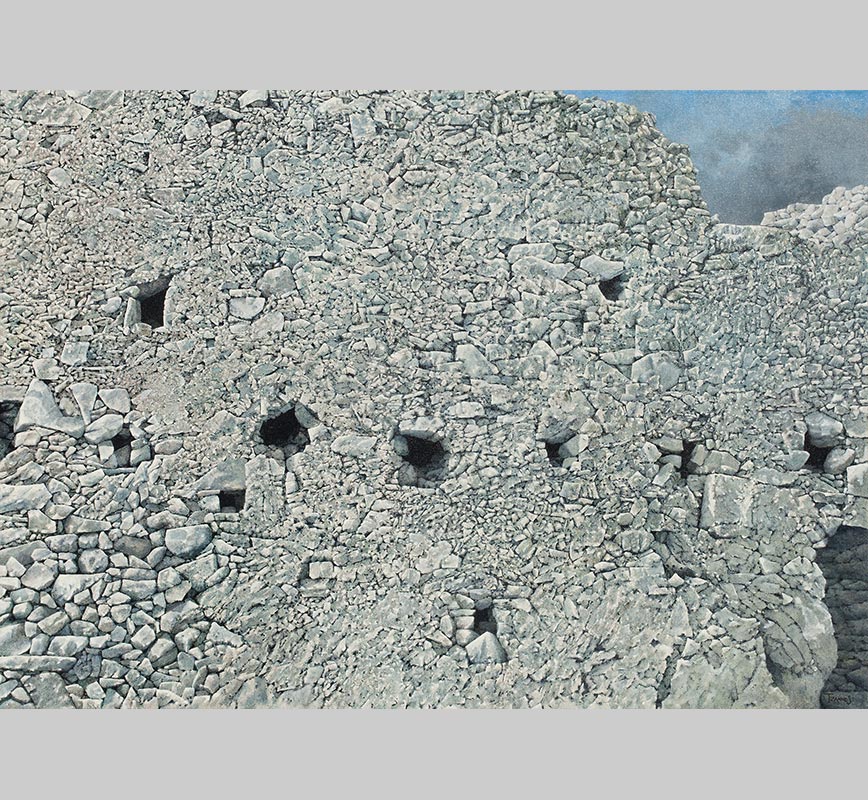
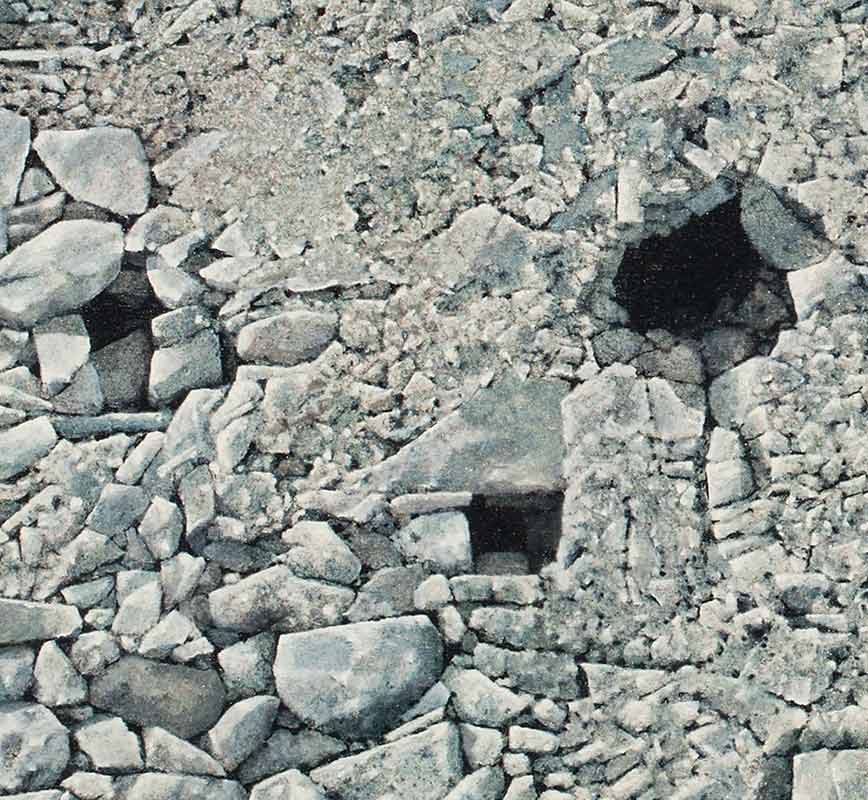
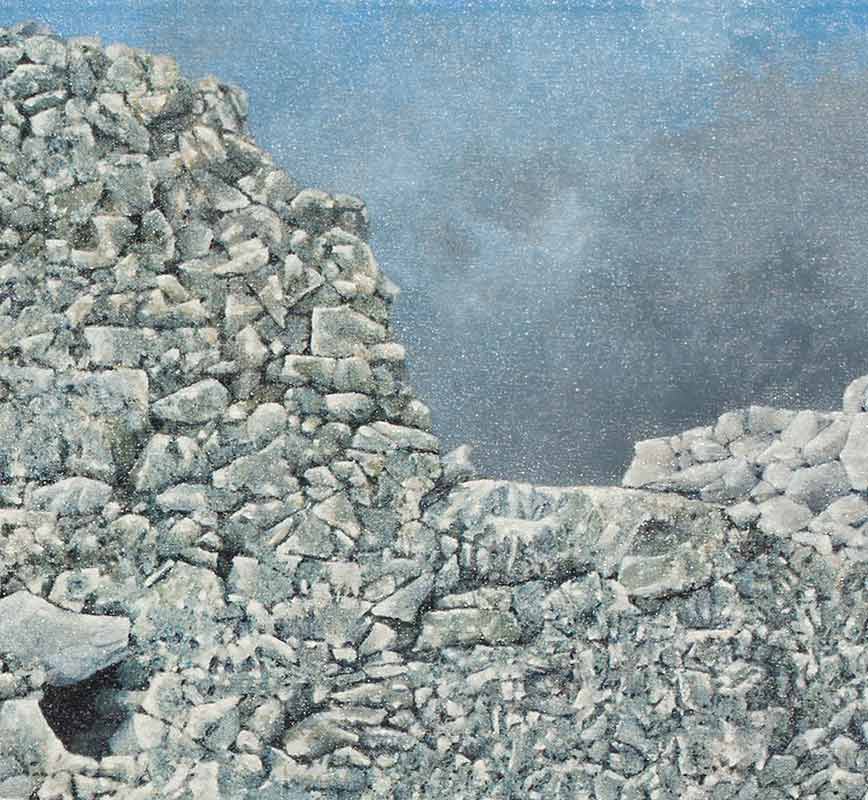
Tzannes found a window that someone filled with stones and made it the subject of a painting. The gesture is precise: this is not a wall with a blocked opening but a wall given another wall, the aperture answered with the same material that surrounds it. In acrylic on paper, he renders each stone, each mortar joint, each variation in the grey and buff and blue of the infill with the care he brings to any surface that has been shaped and changed by time.
Tzannes found a window that someone filled with stones and made it the subject of a painting. The gesture is precise: this is not a wall with a blocked opening but a wall given another wall, the aperture answered with the same material that surrounds it. In acrylic on paper, he renders each stone, each mortar joint, each variation in the grey and buff and blue of the infill with the care he brings to any surface that has been shaped and changed by time.
The question the composition poses is not sentimental but structural: was this closure deliberate, the window sealed by a particular person at a particular moment for a particular reason? Or did it happen slowly, stones gathering in a gap over generations, adaptation accumulating into permanence? Tzannes does not answer. The ambiguity is the subject. Kythera's built fabric is full of these decisions, each one a record of a life that pressed against the landscape and left a mark.
The photorealist painters who showed at OK Harris in SoHo, where Tzannes exhibited in 1994, applied the same visual discipline to the surfaces of contemporary American life: storefronts, diners, chrome-plated cars. Tzannes inverts the temporal register. The same precision that Richard Estes brought to the reflective glass of Manhattan brings here to stone that was already ancient when the United States was founded. The method is shared; everything else is different.