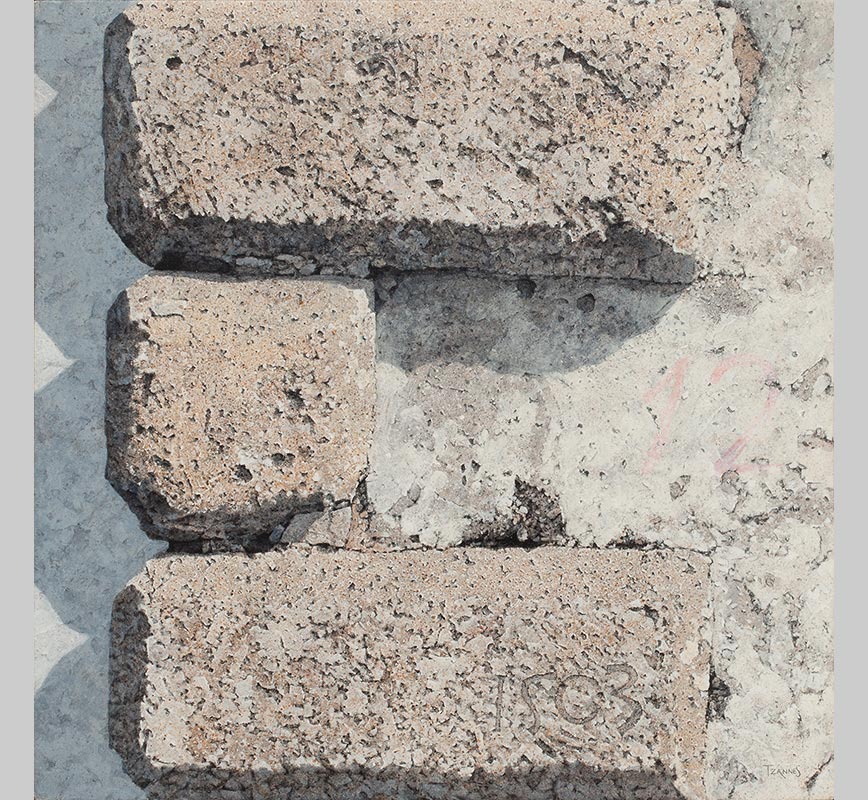
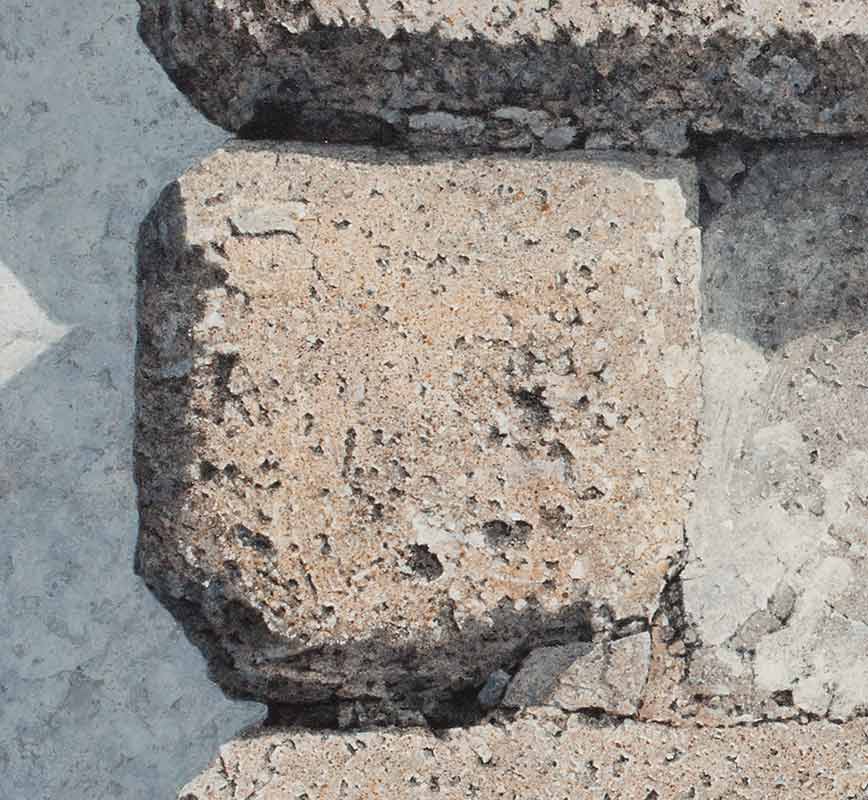
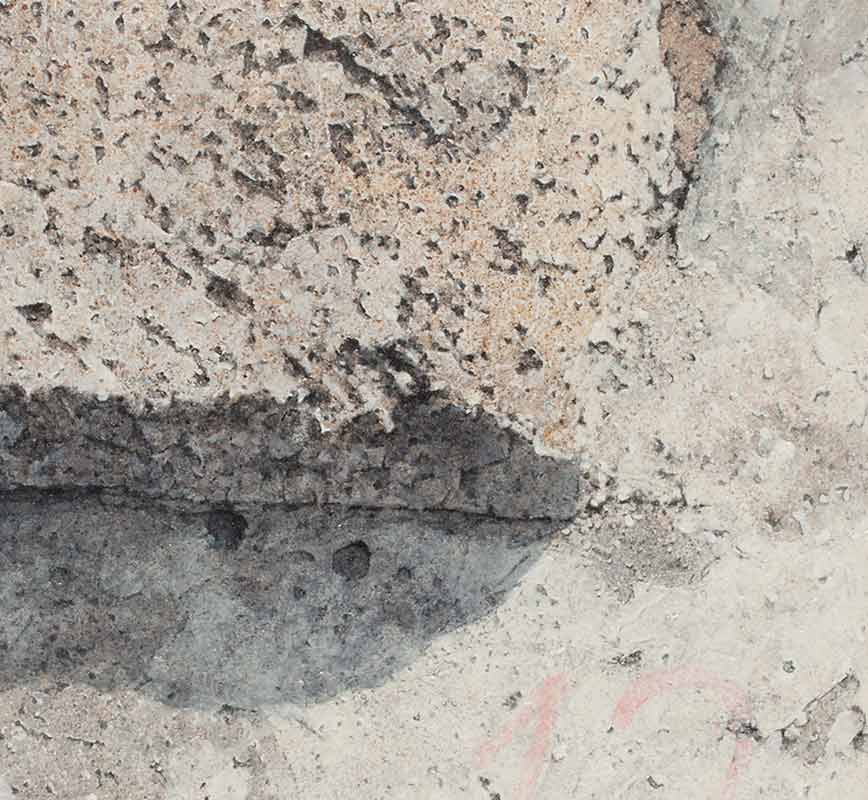
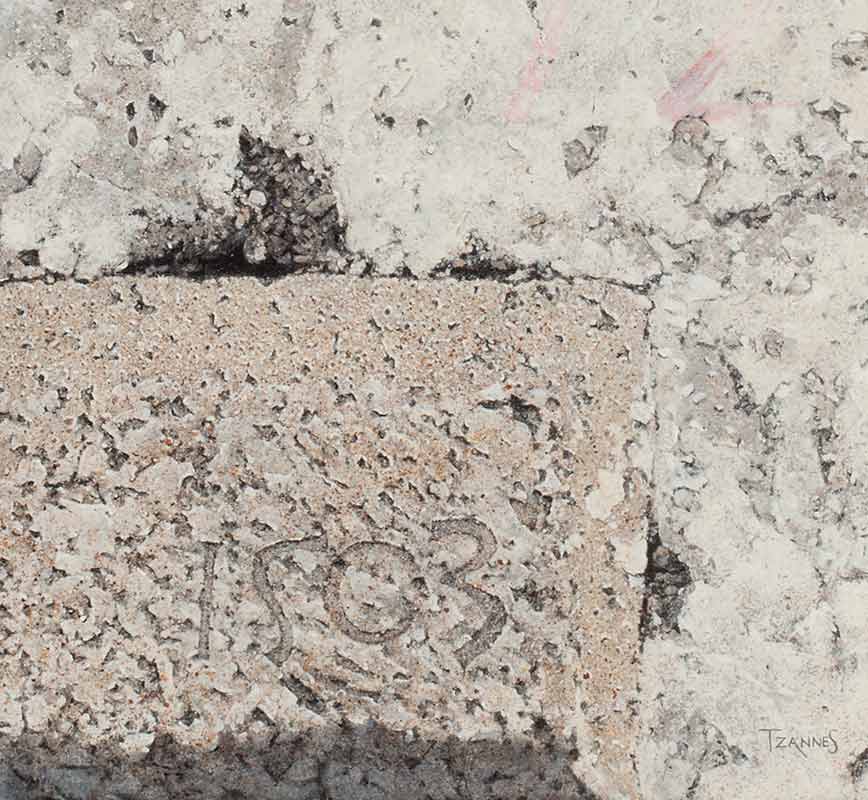
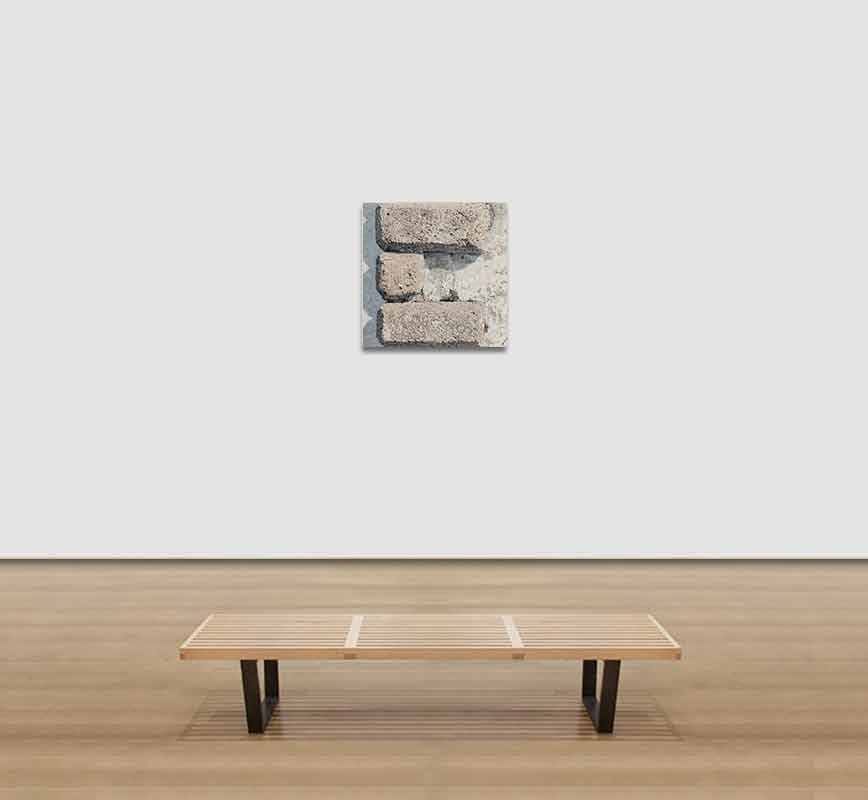
Tzannes moves in very close to a corner of the medieval castle at Chora, filling the picture plane with three horizontal courses of stone so weathered and porous that the surface reads almost as texture before it reads as architecture. The stones are rendered in soft ochre, buff, and pale grey, each one carrying its own pattern of erosion, cracks running through the surface in lines that have nothing to do with the mason's courses and everything to do with centuries of weather.
Tzannes moves in very close to a corner of the medieval castle at Chora, filling the picture plane with three horizontal courses of stone so weathered and porous that the surface reads almost as texture before it reads as architecture. The stones are rendered in soft ochre, buff, and pale grey, each one carrying its own pattern of erosion, cracks running through the surface in lines that have nothing to do with the mason's courses and everything to do with centuries of weather.
At this proximity, the wall approaches abstraction. The individual stones retain their identity, but the composition as a whole begins to function like a field painting: horizontal registers of tone and texture, no single element dominant, the eye moving across the surface rather than into the scene. Ben Nicholson found a related kind of abstraction in the details of architecture and relief, the geometry latent in ordinary surfaces suddenly becoming the whole subject. Tzannes arrives at it differently, through the patient accumulation of physical description rather than formal reduction, but the result has a similar quality of stillness.
Chora Castle was built during the Venetian occupation of Kythera in the thirteenth century. Its stones have been compressed by their own weight for eight hundred years. What Tzannes paints is not the castle but a cross-section of that compression, a record of time made visible in the way stone responds to centuries of load: the cracking, the crumbling edge, the surface that has given up its original precision.