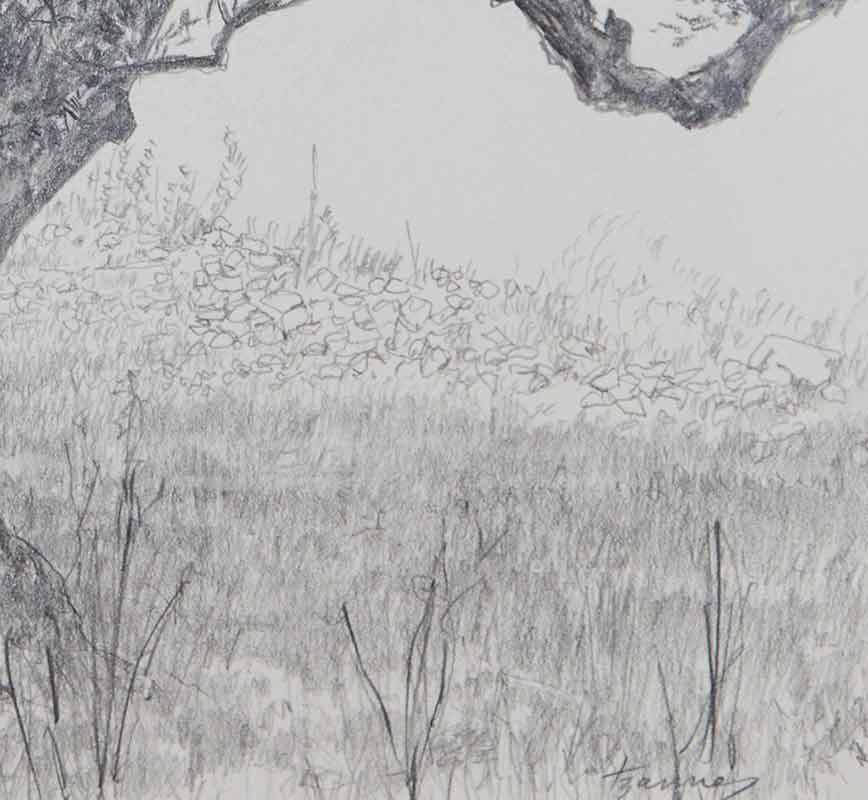
The wall at Paliochora spreads across a large canvas, its surface a puzzle of irregular stones fitted together over centuries, punctuated by dark rectangular openings that could be windows, arrow slits, or the places where a lintel finally gave way. Tzannes renders the full complexity of this surface in oil: the individual stones, the variation in their color, the light raking across the face of the wall from the right, each protruding course casting its own shadow, each recess settling into its own depth.
The wall at Paliochora spreads across a large canvas, its surface a puzzle of irregular stones fitted together over centuries, punctuated by dark rectangular openings that could be windows, arrow slits, or the places where a lintel finally gave way. Tzannes renders the full complexity of this surface in oil: the individual stones, the variation in their color, the light raking across the face of the wall from the right, each protruding course casting its own shadow, each recess settling into its own depth.
Anselm Kiefer also makes paintings of ruins, but his ruins are symbols, weighted with historical guilt, the landscape carrying the burden of what happened in it. Tzannes is doing something categorically different. The stones at Paliochora are not symbols. They are stones: specific, physical, irreducible. The dark openings in the wall are not metaphors for absence; they are openings. Tzannes's discipline is precision, and that precision is itself a form of respect for the material, a refusal to burden the wall with more meaning than the wall is willing to carry.
Paliochora was Kythera's medieval capital, a city of eight hundred houses built on a ridge for defensive advantage, abandoned in the early nineteenth century after raids left it depopulated. The ruins Tzannes painted still stand in the same configuration: no restoration, no interpretation, no signage. Just the wall, the light, and the distance that separates us from the people who built it.