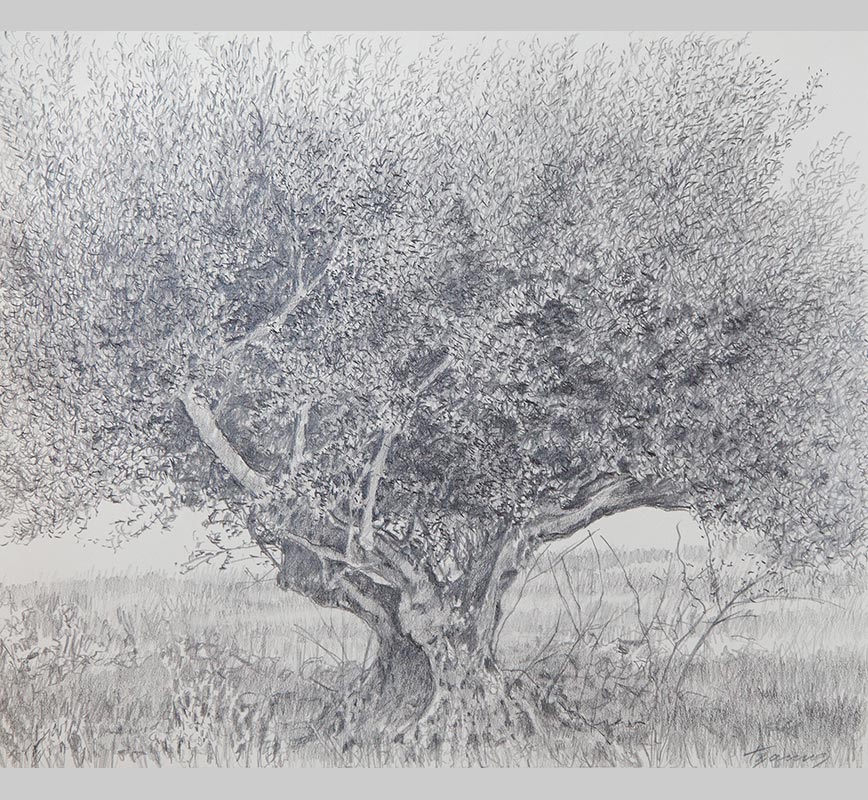
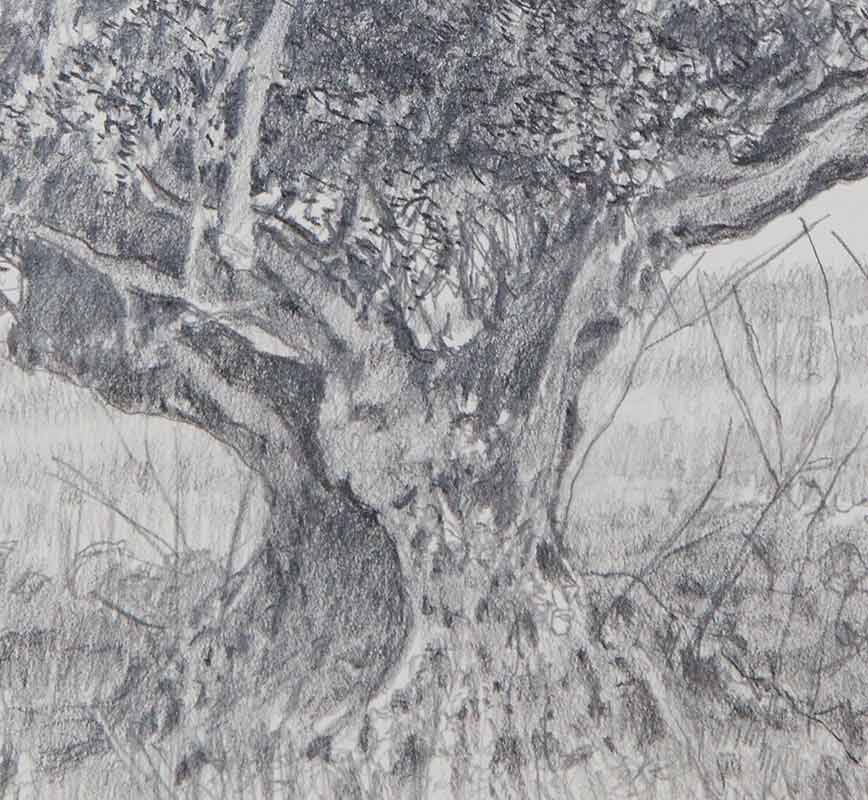
A niche cut into a weathered stone wall: Tzannes treats this as the whole subject, and nothing else competes. The surrounding masonry is rendered with intense particularity, each stone occupying its own place in the wall's accumulated logic. The eye goes to the niche, to the dark interior the stonework holds open like an answer to a question no longer asked. This is what Tzannes has spent decades finding in Kythera's built remains: the specific void that a specific human decision left behind.
A niche cut into a weathered stone wall: Tzannes treats this as the whole subject, and nothing else competes. The surrounding masonry is rendered with intense particularity, each stone occupying its own place in the wall's accumulated logic. The eye goes to the niche, to the dark interior the stonework holds open like an answer to a question no longer asked. This is what Tzannes has spent decades finding in Kythera's built remains: the specific void that a specific human decision left behind.
Andrew Wyeth described his practice as finding the extraordinary in the ordinary: the weathered door, the worn field, the simple structure given back its full weight through the sustained act of looking. Tzannes works in a related discipline, though the cultural register is different. Kythera's stone carries a history extending from the medieval to the archaic, and the niche here was not merely functional but likely votive, a space made to hold something of value or meaning. The darkness inside it is not empty. It is the measure of everything that has been placed there, removed, and forgotten.
The acrylic and pencil on archival board allow Tzannes to work at the boundary between painting and drawing, building up the stone surface with precision and then modulating it with line. The result is a tactile image: you can read the weight of these stones, the slight irregularity of each course, the fine grit of the mortar. It is the kind of looking that an archaeologist brings to an excavation: patient, close, convinced that the specific detail holds the general meaning.