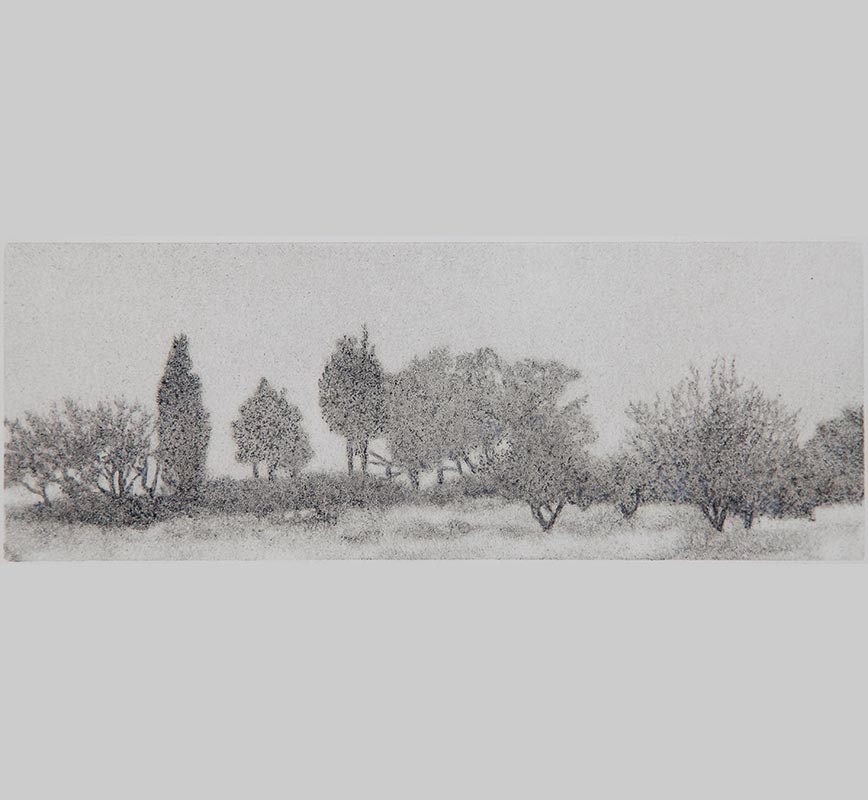
A row of olive trees lines the middle distance, their rounded dark forms spaced evenly across the width of the wide format, the cloudy sky above them taking up nearly half the picture plane. The chalk and charcoal on archival paper give the scene a velvety density: the trees are distinct, each with its own volume, but they are held together by the atmospheric pressure of the overcast sky pressing down on the grove with a uniform, contemplative light.
A row of olive trees lines the middle distance, their rounded dark forms spaced evenly across the width of the wide format, the cloudy sky above them taking up nearly half the picture plane. The chalk and charcoal on archival paper give the scene a velvety density: the trees are distinct, each with its own volume, but they are held together by the atmospheric pressure of the overcast sky pressing down on the grove with a uniform, contemplative light.
This is the Mediterranean at its most inward: not the brilliant summer light of the tourist's Kythera but the grey, still quality of an overcast day when the light has no direction and the landscape holds everything close. George Inness pursued exactly this quality in his late American landscapes, describing what he was after as sentiment, the feeling registered in the viewer through atmosphere rather than description. The connection Tzannes has acknowledged to Inness and to American tonalism is most legible in works like this one, where the scene is barely described and the mood is everything.
The trees in this work are not individualized; they form a collective, a frieze of similar volumes across the horizontal band of the middle distance. Tzannes intended the olive grove as a site of shared associative memory: not this tree but trees, not this grove but the idea of a grove, a place the viewer is invited to enter with whatever memory they carry of such a morning.