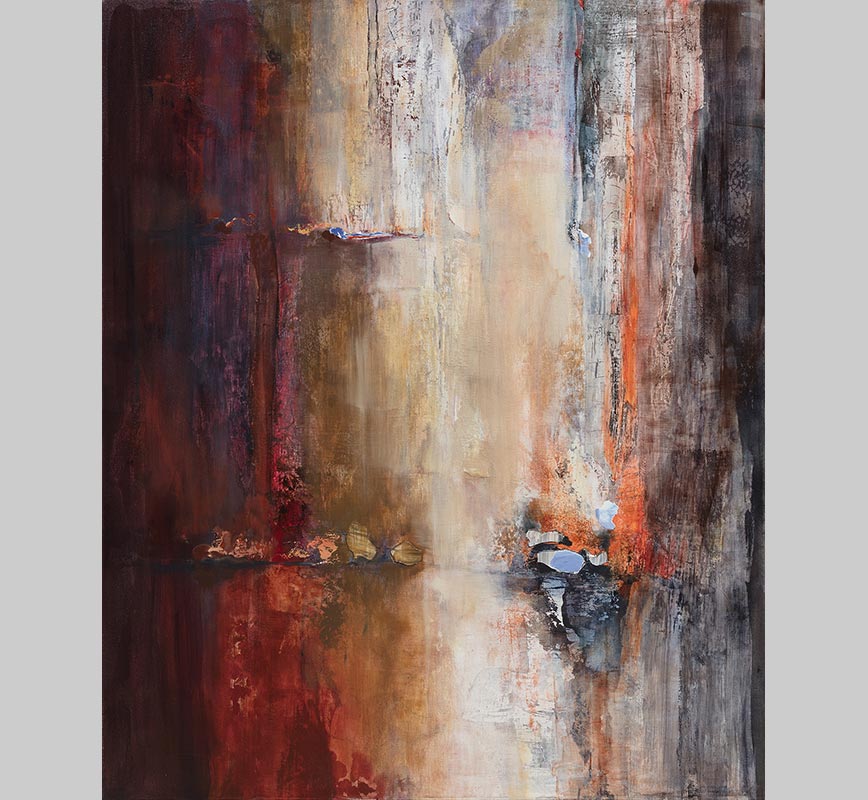
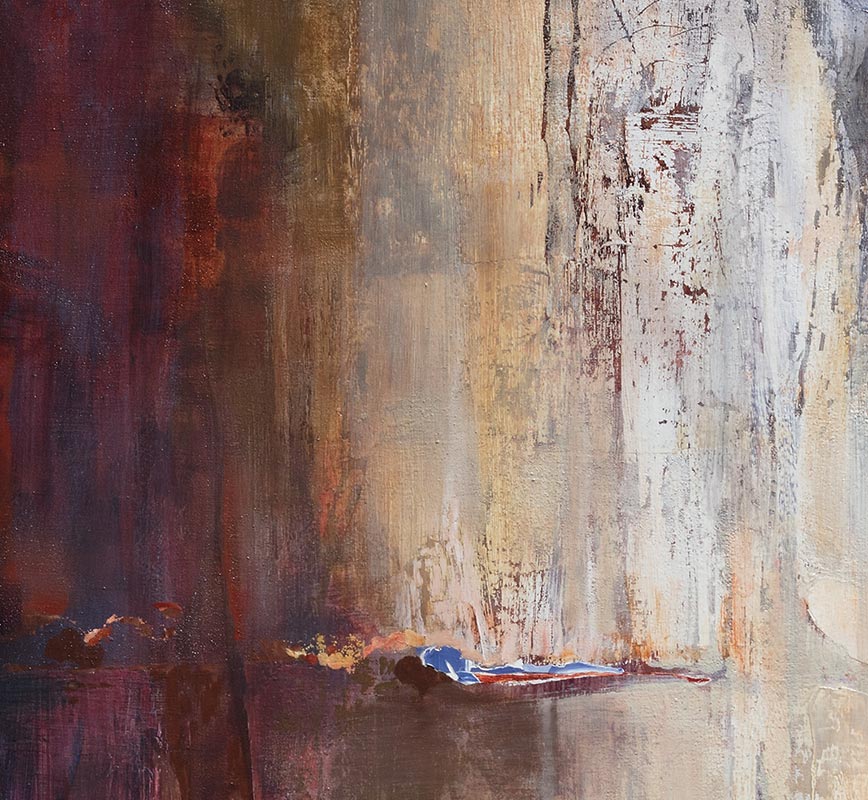
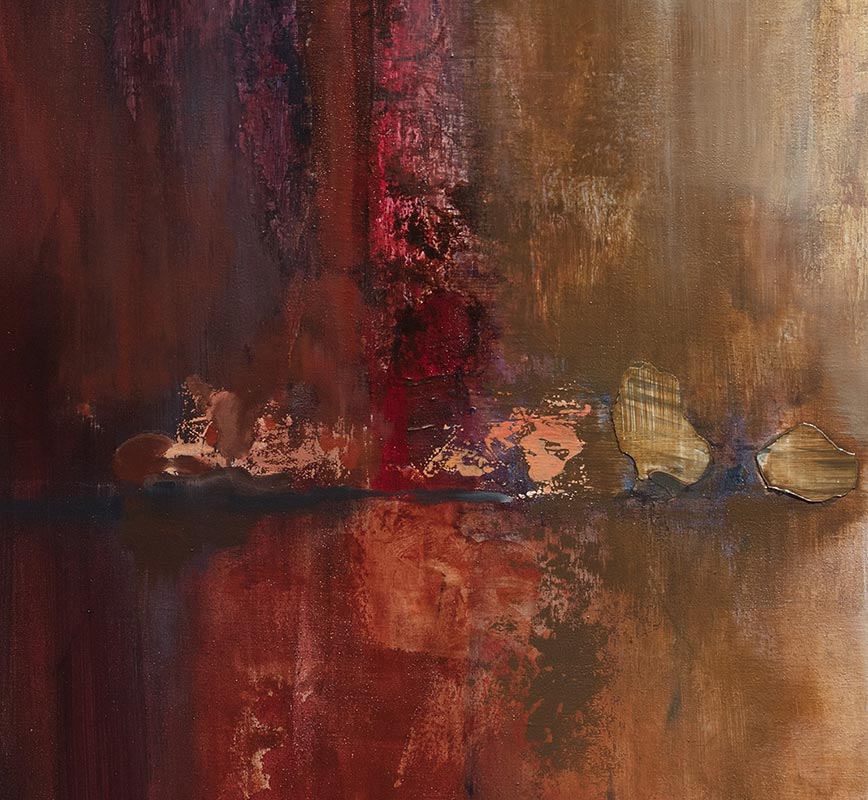
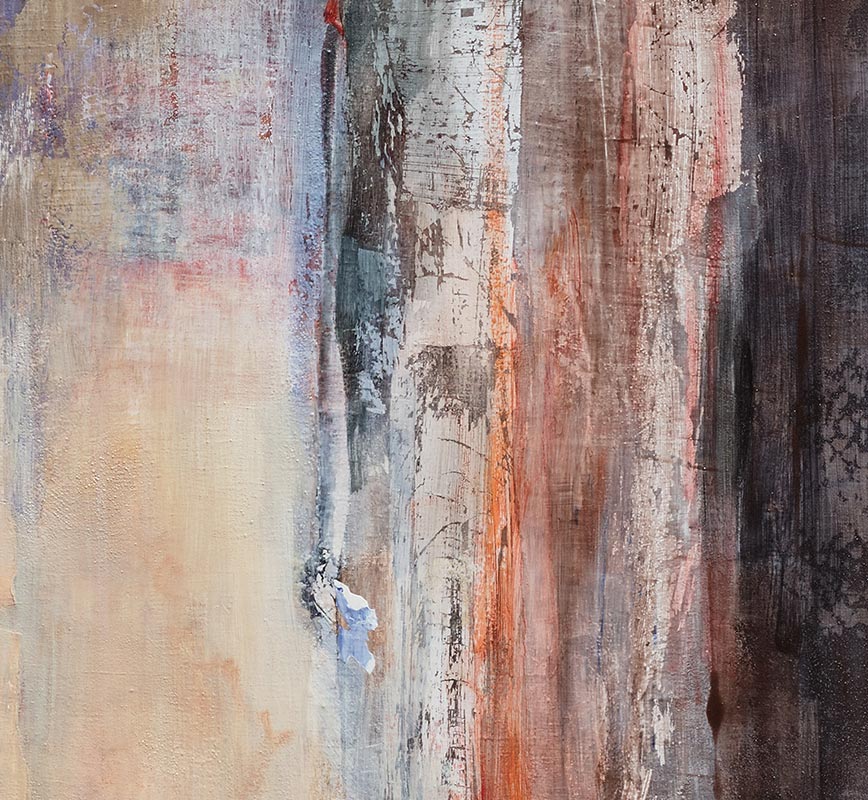
Time Transfixed is organized around an unlikely formal instrument: a serpentine trail of small dots moves across the lower half of the canvas, pale against the layered green, tracing a slow lateral path through the vertical flow of paint above and below it. The greens are dense and various, pooling light the way a forest canopy filters it, and the drip marks descending through the field reinforce the sensation that everything is in motion except the dotted trail, which holds.
Time Transfixed is organized around an unlikely formal instrument: a serpentine trail of small dots moves across the lower half of the canvas, pale against the layered green, tracing a slow lateral path through the vertical flow of paint above and below it. The greens are dense and various, pooling light the way a forest canopy filters it, and the drip marks descending through the field reinforce the sensation that everything is in motion except the dotted trail, which holds.
The title borrows from Magritte’s La Durée Poignardée [Time Transfixed] (1938), a surrealist image of a locomotive emerging through a fireplace. Magritte is in Petrov’s stated influences, and the borrowing is not casual: it invokes a lineage reaching Andrei through his uncle Dmitri, who moved in the orbit of Dada and Surrealist practice. Petrov’s transfixion is quieter than Magritte’s: not velocity arrested by domestic architecture but natural movement held in chromatic suspension.
Pat Steir’s waterfall paintings are relevant for the vertical paint behavior: dripped and poured marks generating structure through physical process. In Time Transfixed, the descending marks perform something similar, but the dotted trail introduces a lateral, calligraphic counter-movement. These two directions, vertical descent and horizontal path, sustain the temporal argument the title proposes: time continuing forward through a landscape that is otherwise falling.