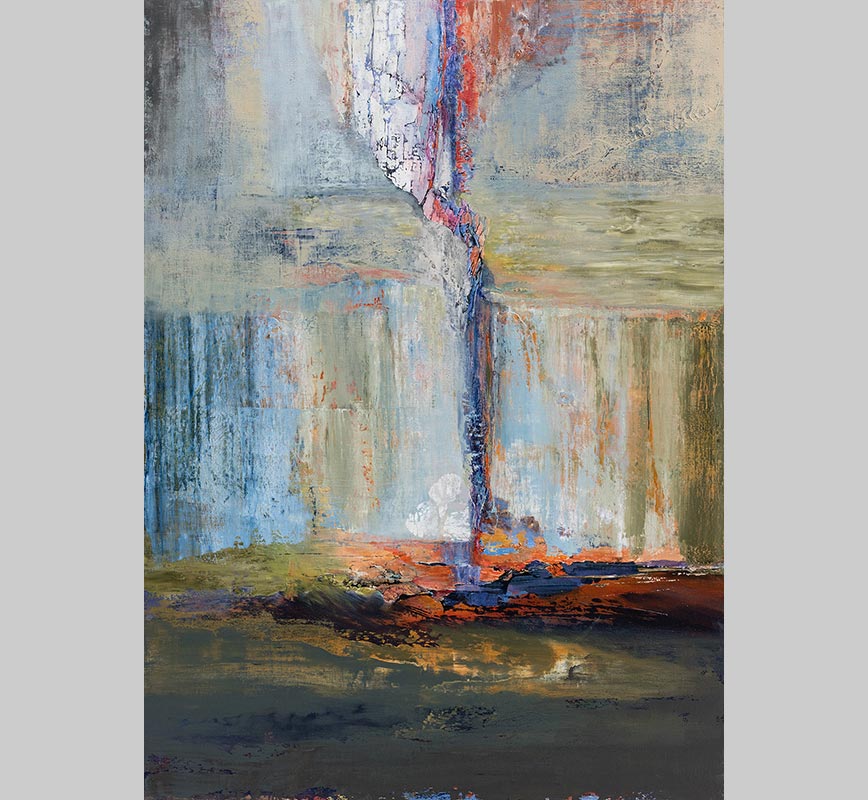
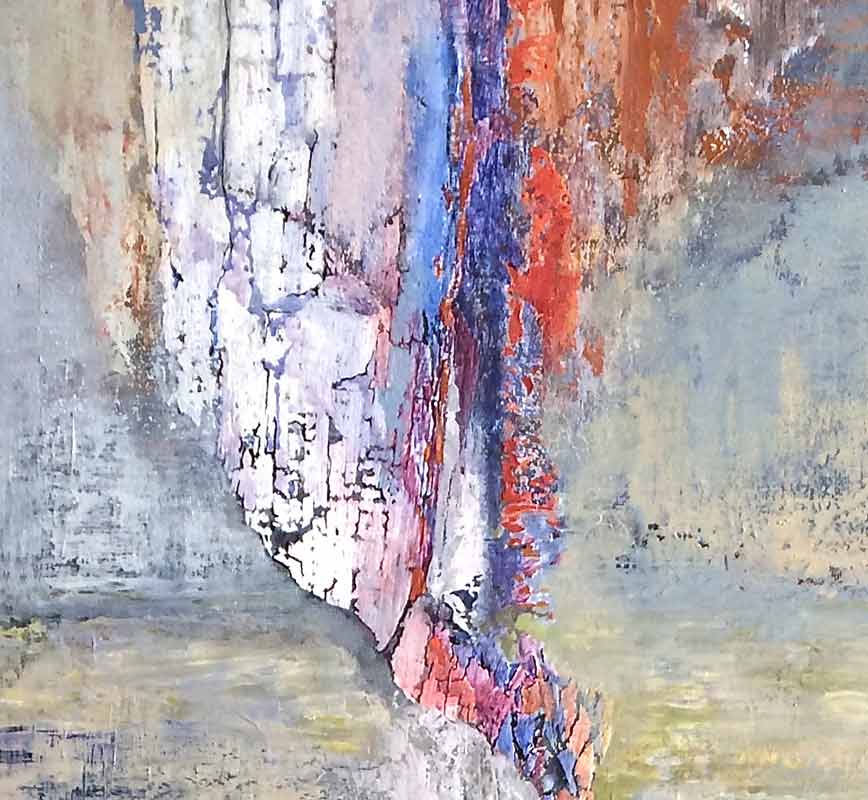
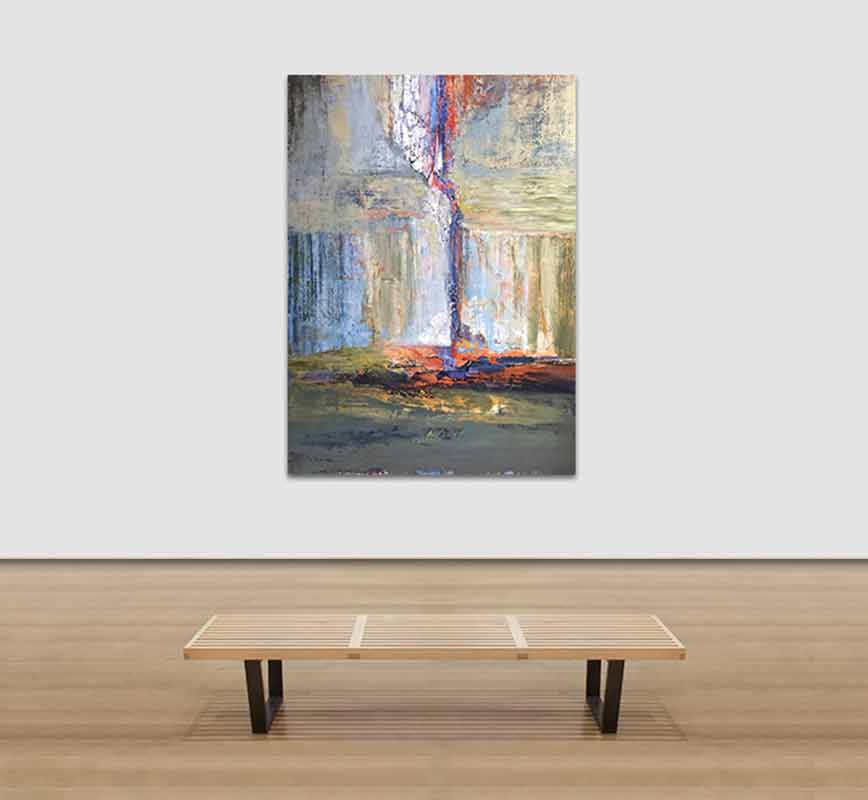
Heart of the Sunrise is painted at a scale that changes how it is experienced: the deep purples at the upper and lower edges press past peripheral vision, and the atmospheric blue-white at the center is literally chest-height. The architecture of the composition, subtle vertical and horizontal divisions that organize without confining, holds the fluid layers of paint the way a frame holds not what it bounds but what it makes possible.
Heart of the Sunrise is painted at a scale that changes how it is experienced: the deep purples at the upper and lower edges press past peripheral vision, and the atmospheric blue-white at the center is literally chest-height. The architecture of the composition, subtle vertical and horizontal divisions that organize without confining, holds the fluid layers of paint the way a frame holds not what it bounds but what it makes possible.
Petrov moves in the opposite direction from Helen Frankenthaler: where Frankenthaler’s staining technique dissolved painterly weight, pigment absorbed into unprimed canvas to become light, Petrov builds through glazing and accumulation. The colors in Heart of the Sunrise carry weight and density even in the atmospheric blue-white passages. Depth here is achieved by accumulation, not by thinning.
The orange and red events in the lower third and the scattered middle passages are the dawn in this painting: not the gradual warmth of a long horizon but the abrupt intrusion of warmth into a still-cool space, which is how dawn actually behaves. The deep purples bracketing the composition perform the residual night. Between them, the atmospheric center holds the moment of transition, the light caught between one condition and another.