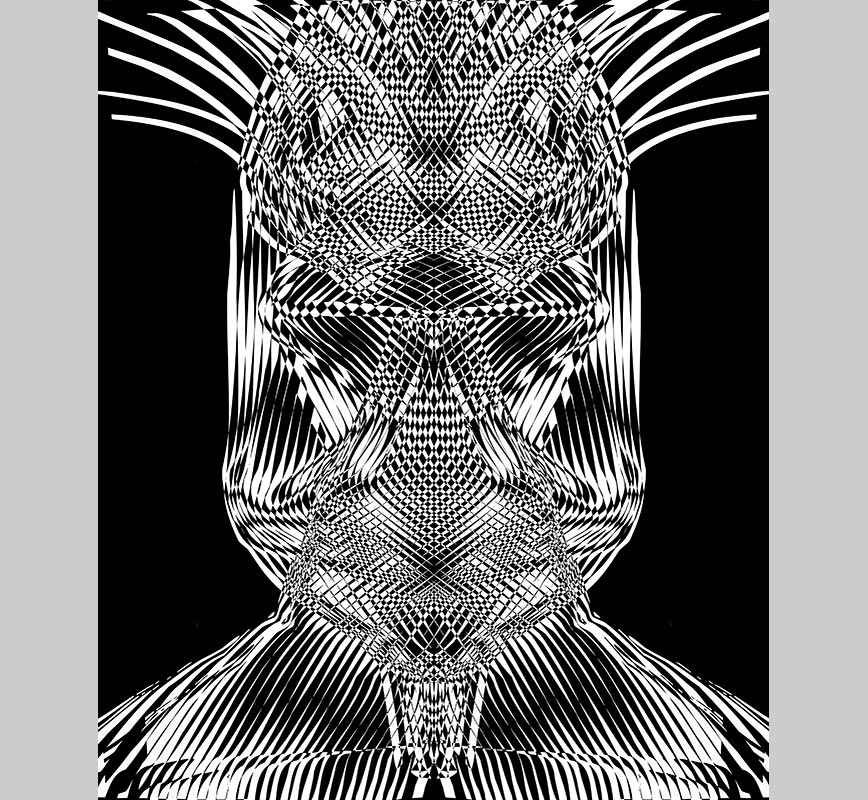
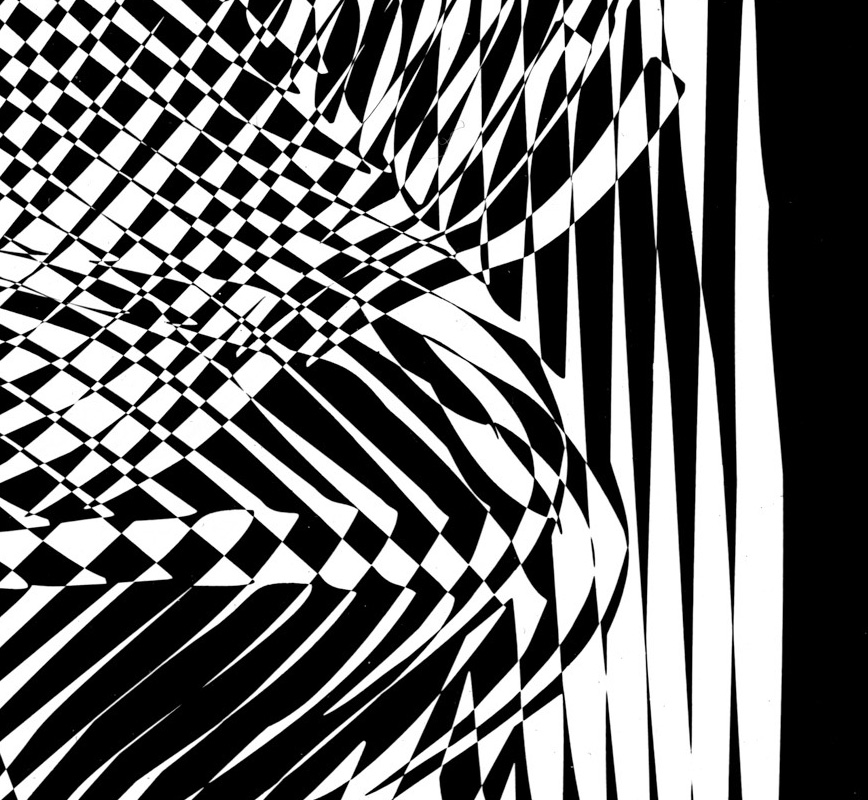
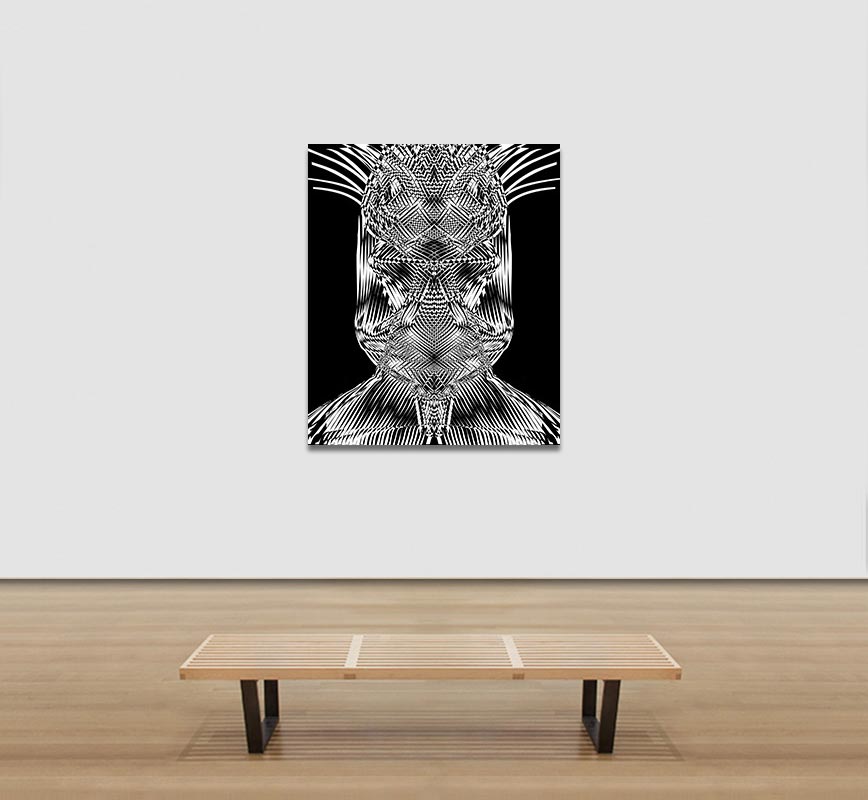
A crumpled piece of paper, photographed and subjected to Ragazzini's darkroom process, yields this: a symmetrical, web-like figure that reads as somewhere between organism and machine. The manipulation of light, form, and texture transforms what the eye recognized as paper into a dense geometric pattern. The black-and-white contrast is absolute, tones inverted at their limits, the surface graphic and rhythmic in a way that has nothing to do with the original subject and everything to do with its geometry.
A crumpled piece of paper, photographed and subjected to Ragazzini's darkroom process, yields this: a symmetrical, web-like figure that reads as somewhere between organism and machine. The manipulation of light, form, and texture transforms what the eye recognized as paper into a dense geometric pattern. The black-and-white contrast is absolute, tones inverted at their limits, the surface graphic and rhythmic in a way that has nothing to do with the original subject and everything to do with its geometry.
This image belongs to the body of work Ragazzini was developing from the late 1950s onward: photomechanical transformations arrived at through experimentation rather than theory, from a formation in industrial graphic arts rather than in any knowledge of contemporary art. When Victor Vasarely and Bridget Riley were building their Op-Art practice in Paris and London through deliberate compositional research into the phenomenology of visual pattern, Ragazzini was extracting the same optical territory from physical material in a Roman darkroom, without awareness of what they were doing. Where they composed their effects from scratch, he found them already latent in the crumpled surface. The pattern was there; the darkroom revealed it.
This distinction between composition and revelation is not merely biographical. It produces a different kind of optical image: one that carries the specific texture of the source material even after transformation. The paper remains paper, its weight and grain are present in the density of the black, even as it becomes something unrecognizable. It is this persistence of the original in the transformed that gives Ragazzini's Op-Art a material complexity that purely painted optical work cannot share.
The title Ninja adds a dry note: stealth, precision, the controlled deployment of minimal means to maximum effect. It describes the process as much as the image.