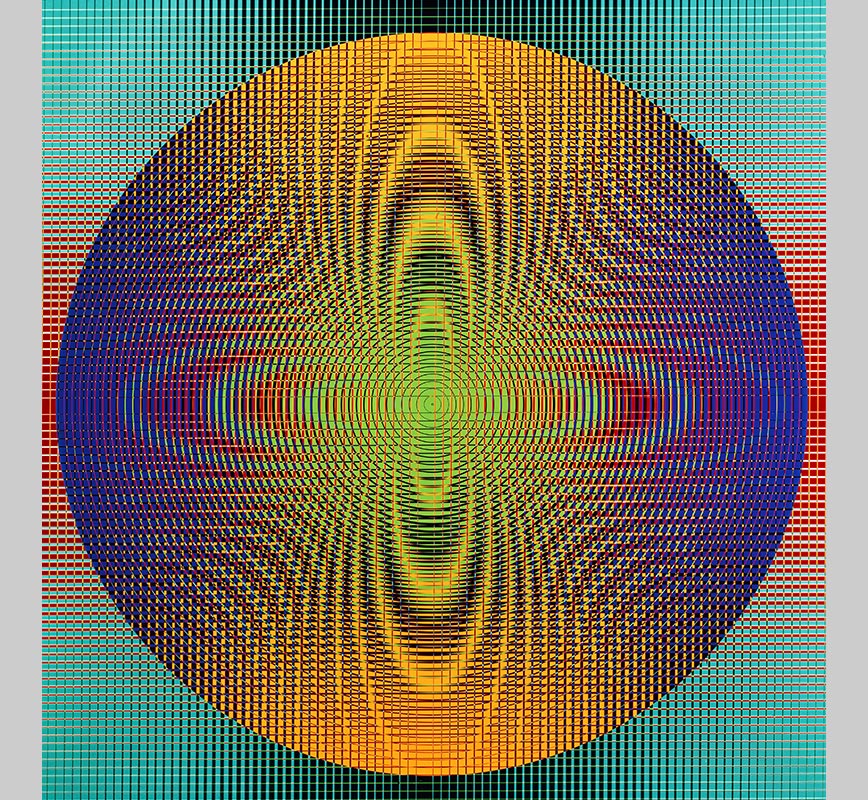
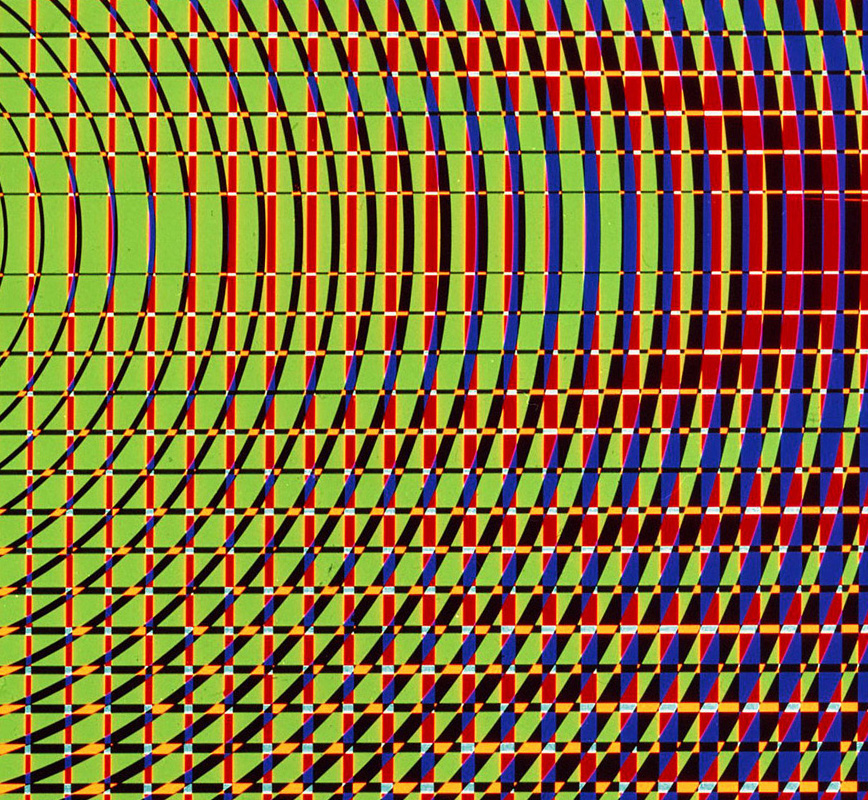
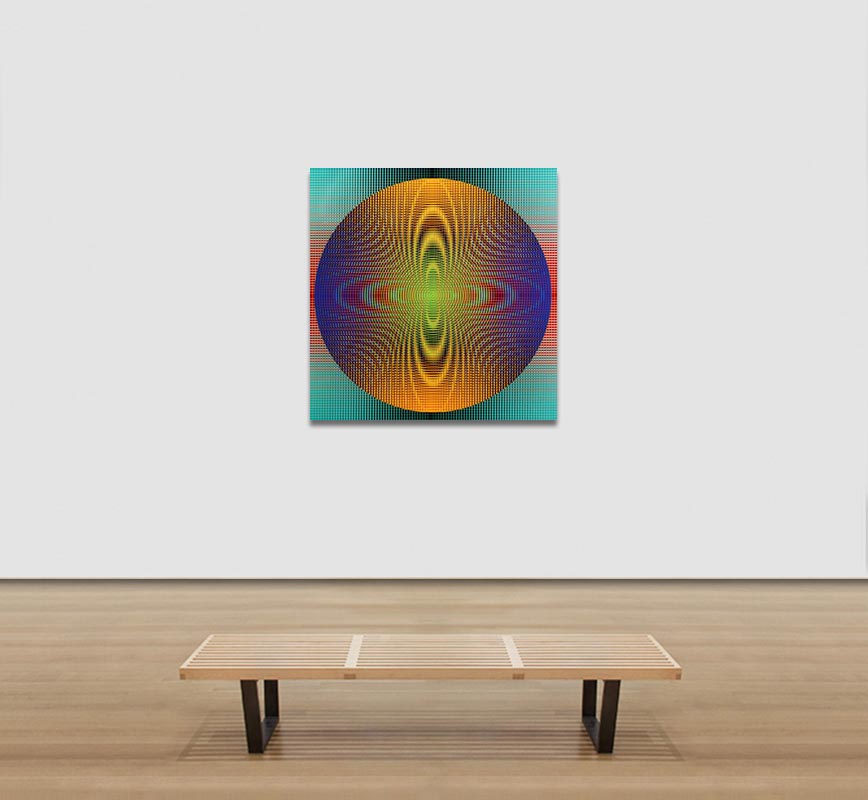
What appears to be a computer-generated image was made in 1969 in an analog darkroom without a single line of code. Ragazzini named the process three-pattern interference: vibrant gradients of orange, blue, and green radiate outward in concentric circles, producing the illusion of a three-dimensional sphere suspended within the frame. The formula was his own invention, involving the precise superposition of multiple photographic patterns whose chromatic effects cancel and combine according to their phase relationships.
What appears to be a computer-generated image was made in 1969 in an analog darkroom without a single line of code. Ragazzini named the process three-pattern interference: vibrant gradients of orange, blue, and green radiate outward in concentric circles, producing the illusion of a three-dimensional sphere suspended within the frame. The formula was his own invention, involving the precise superposition of multiple photographic patterns whose chromatic effects cancel and combine according to their phase relationships.
The work sits within the Op-Art movement that Vasarely and Bridget Riley were defining in painting during the same years, but the relationship is one of independent parallel arrival rather than shared context. Ragazzini had no knowledge of the international Op-Art world when he was developing these experiments; his formation was in serigraphy and photomechanical process at a lithography company in Faenza, not in art history or contemporary practice. Where Riley and Vasarely composed their optical effects through deliberate research into visual perception, Ragazzini discovered his through the logic of the photographic process itself. The sphere pulsates not because it has been drawn to pulsate but because the physics of superposed patterns requires it: this is wave mechanics made visible, not composition simulating it.
In 1965 Ragazzini held the first entirely photographic Op-Art exhibition, at the Galleria della Libreria Einaudi in Rome. Neither he nor the gallery director was aware that MoMA was simultaneously presenting The Responsive Eye, the landmark survey that would define the movement internationally. The simultaneity was genuine and independent, discovered after the fact. This work, produced four years later, is part of the practice that was already fully formed by then, and that would be developed further during the London decade: a practice that predated the digital tools which would eventually approximate its effects by more than thirty years.