ENZO RAGAZZINI: WHAT THE EYE FINDS
An in-depth look at the Creature series: the making, the thinking, and the vision that started it all
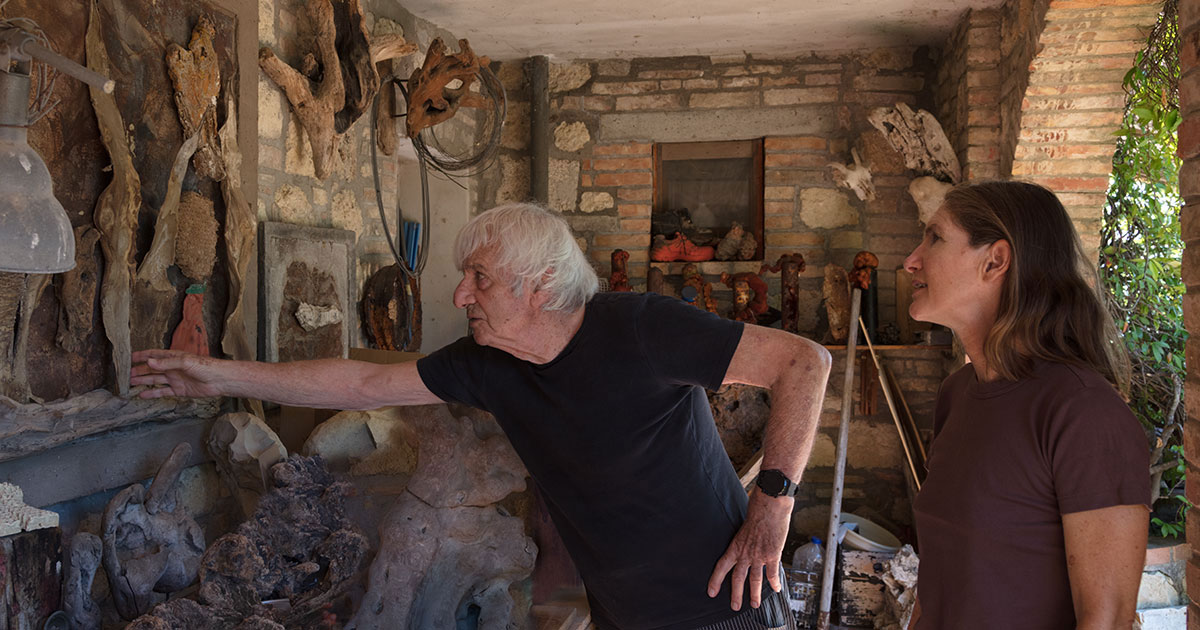
I first saw the Creature when I visited Enzo's studio in the Tuscan countryside. I was surrounded by a collection of paraphernalia that populated every shelf, forming a museum of ideas, where objects coming from the most different origins dialogued creating new meanings. I was looking at a print and Enzo told me: "you see it is that driftwood over there." I was astounded, and when he patiently guided my eyes I saw it as well. But the magic persisted because I knew that hadn't he seen it the image would have stayed there dormant forever.
Enzo Ragazzini has been creating for over thirteen years artworks that put in evidence a recognizable head out of the mirroring of the most disparate objects and surfaces: stone, bark, corroded metal, cracked plaster, agave leaf, worn fabric. The mirroring produces bilateral symmetry, and bilateral symmetry, as the visual system has known since long before anyone gave it a name, means face. What makes this a phenomenon rather than a technique is pareidolia: the involuntary, pre-conscious compulsion of the human mind to find faces wherever the conditions for a face exist. The mind cannot choose not to see it. It arrives before the decision to look, before the question of what you are looking at. You are already looking at a face.
What Ragazzini does next is where the work becomes something more than a demonstration of perceptual mechanics. He works the image. He elaborates tonal depth, draws out what the surface was holding, brings the chromatic range to the density the finished work requires. The act is not mechanical reproduction of a natural accident. It is the creative work of an artist who knows which fragment contains what the process will reveal, at what angle and distance the material yields its fullest potential, and how far to bring the image in the elaboration that follows. He adds nothing that was not there. He subtracts nothing. The threshold between the surface and the presence is the work. The range of what the work releases in the viewer is something Ragazzini has described himself: "My friend Elinor, an anthropologist, saw in them the origin of primitive totems, while another friend, a psychoanalyst, interpreted them as products of our dreams. Some people enjoy the mechanism of doubling, while others appreciate their form, texture, and color." The work does not prescribe its reading. It opens one.
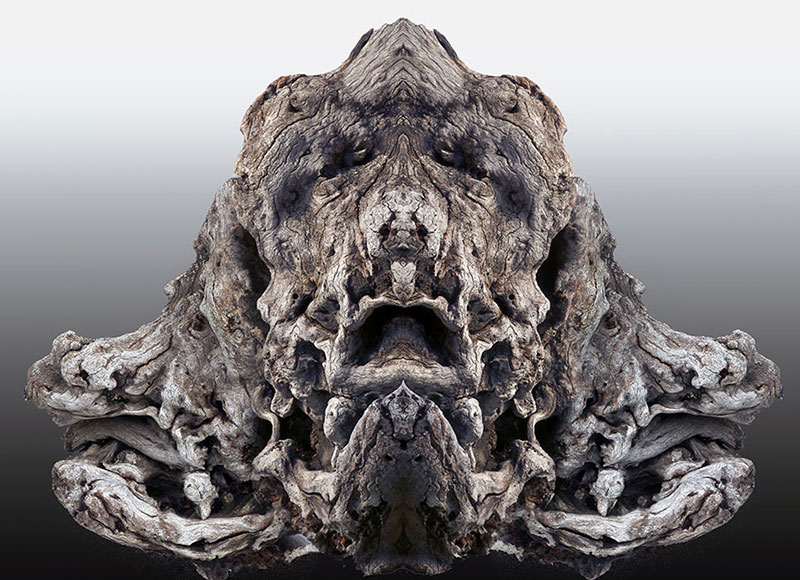
The driftwood from the beach of Kythera that yielded Cerberus and opened the Creature series
The Origin: Kythera and Cerberus
The series has a precise origin, documented in Ragazzini's own words. In 2013, the Fondazione Dantesca di Firenze invited artists to interpret the Divine Comedy. Ragazzini's studio in the Tuscan countryside was populated, as it still is, with pieces of driftwood gathered during canoe trips and forest walks: forms shaped by water, wind, and time into objects that had already accumulated the character of something found rather than made. One piece, from the beach of the island of Kythera, resembled a monstrous dog when seen in profile. Dante's Cerberus has three heads. Photographed frontally and partially mirrored, the driftwood yielded exactly the three-headed face.
"It is a thing of infinite richness," Ragazzini wrote afterward. "Now I see faces everywhere." For two years that followed, he continued to find them: in walls, rocks, rust, bark, puddles, wherever matter accumulates into suggestion. The series that opened with a Dantesque commission became a way of seeing that has not closed.
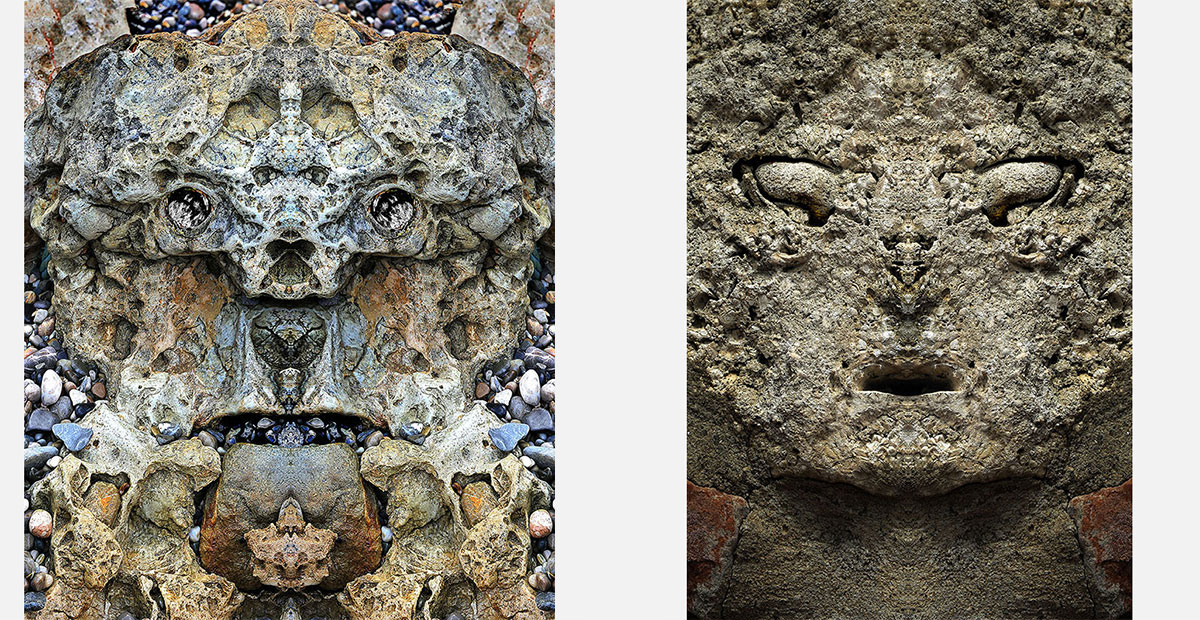
The Stone family: presences assembled over geological time
Stone
Stone is where the faces that emerge from rock surfaces carry the authority of something assembled over geological time: mineral grays, pale ochres, ash whites that carry no warmth, no organic hint. The presences that surface belong to no civilization and no epoch. They are neither human nor divine, neither historical nor mythological. They are simply there, with the solidity of something that was always going to be visible once someone looked at exactly this angle, from exactly this distance.
The mirroring activates bilateral symmetry already latent in the material, and then the elaboration brings the chromatic and tonal depth to a density the raw photograph only approximates. At viewing distance the face coheres into a timeless apparition; up close the surface dissolves into granular abstraction. The stone works hold both readings simultaneously, the figural and the purely geological, and do not resolve the tension between them. That unresolved tension is part of what makes them compelling to stand in front of.
The act of clarifying and deepening what is already there, rather than inventing what is not, connects this body of work to Alberti's account of where figuration begins: a collaboration between the shaping forces of nature and the recognizing eye of the observer. Ragazzini's method belongs to that lineage and extends it, stopping before the completion, leaving the threshold open.
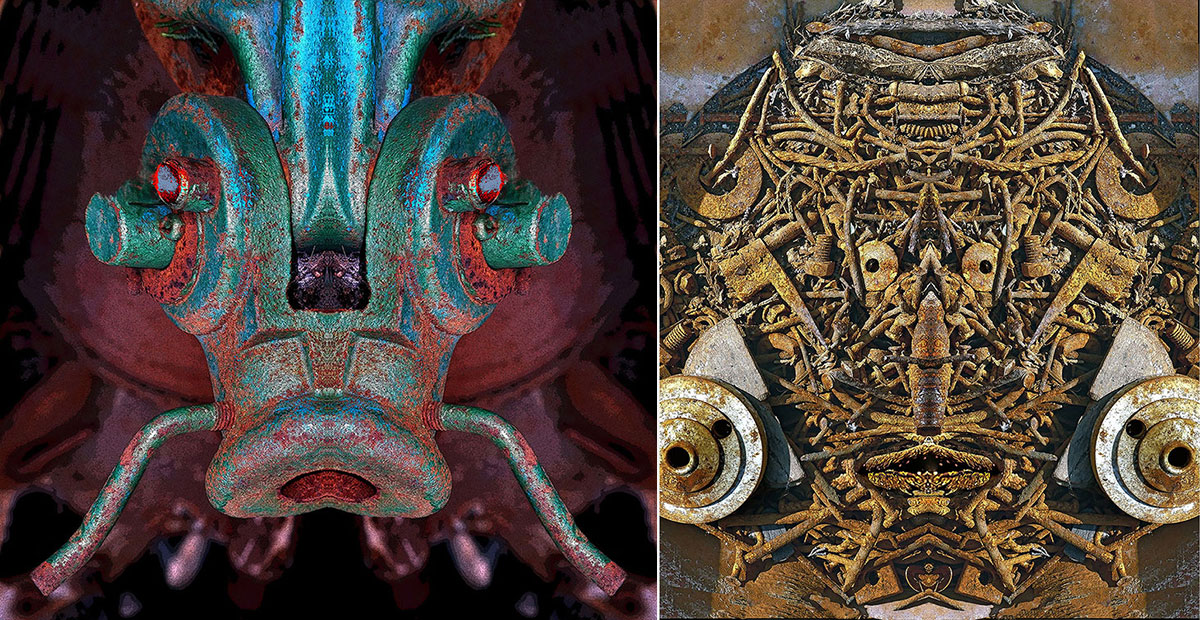
The Metal family: the slow chemistry of oxidation made visible
Metal
Rust, corrosion, industrial abandonment, the slow chemistry of oxidation: these processes operate without intention and accumulate complexity no deliberate composition could produce. The faces the metal works yield carry the character of their origins: skeletal, totemic, possessed of authority the raw material never suggested. Scorched grays, oxidized silvers, and earthen browns gather into presences that read as faces, or as masks, or as both simultaneously, the distinction ceasing to matter once the image has declared itself.
The Expressionist tradition, in the work of Ernst Ludwig Kirchner, Emil Nolde, and Oskar Kokoschka, understood that raw and damaged surfaces carry an affective charge that polished or idealized material cannot reach. The metal works in this series arrive in that register without pursuing it stylistically. The corrosion did the work the Expressionists did with a brush. The mirroring makes it visible. The subsequent elaboration brings it to its full potential, the stippled luminosity of oxidation catching light like the grain of a print, the surface achieving a tactile depth more usually associated with expressive painting than with photography.
In some of these works the face that surfaces refuses to resolve into anything identifiable: not human, not animal, not mythological in any specific sense. Roland Barthes argued that the task of art is not to express the inexpressible but to resist the reduction of what resists naming: to hold open, against the viewer's demand for decoding, what the image declines to yield. The discipline of certain works in this family is precisely that refusal. The ambiguity is not a problem to be solved. It is the content of the work.
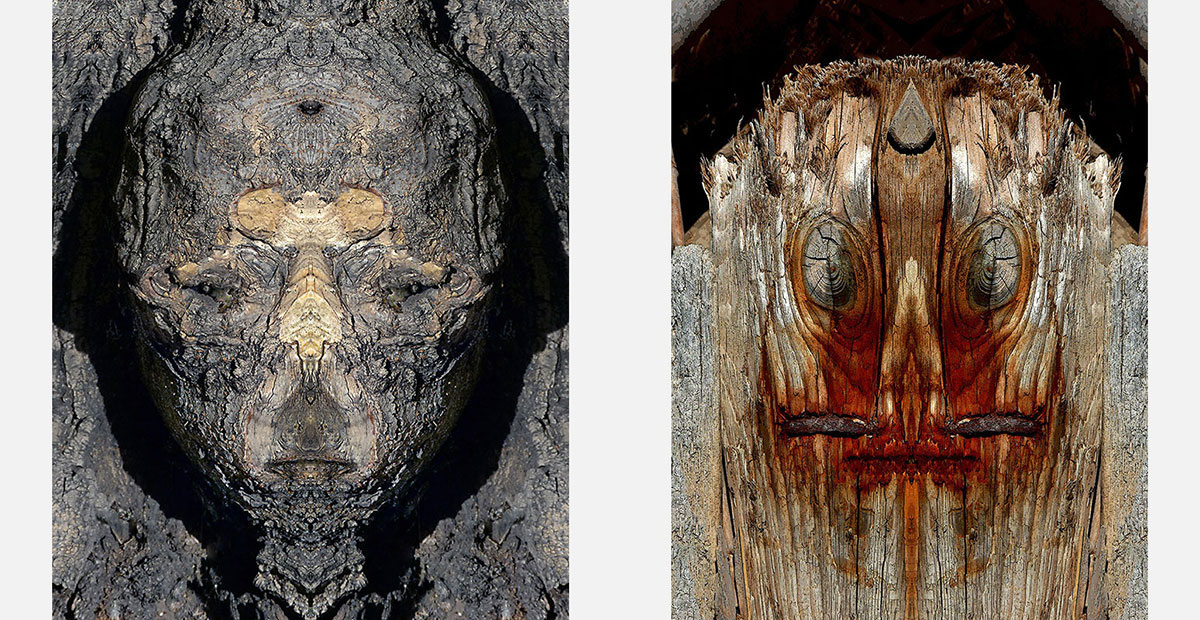
The Wood and Bark family: presences with a shamanistic character, ancient-rooted
Wood and Bark
Tree bark carries in its growth patterns, its knots and fissures and grain, a bilateral symmetry that already belongs to the structure of living things. When the mirroring activates it, what emerges tends toward the frontal and the watchful: faces with a shamanistic character, ancient-rooted, belonging to the woodland tradition of figures that guard and warn. The palette of these works, browns and grays and charcoals with occasional bursts of copper and moss, has a warmth and tactile specificity that the stone and metal works do not share.
Max Ernst formulated the structural principle of this approach in the Histoire Naturelle frottages of 1926, pressing paper against resistant surfaces and letting the material generate what the hand could not invent. The method is structurally identical in the Creature series, transposed into photography. The camera and the mirror are instruments of solicitation. The bark generates the image; Ragazzini finds the frame in which it becomes fully visible.
The art historian Aby Warburg called certain charged formal configurations Pathosformeln: gestural or visual forms that survive across centuries in cultural material, re-emerging when conditions allow. Frontal, apotropaic faces that guard and warn constitute one of the oldest such lineages in human visual culture, found in trees understood to hold protective presence long before there was a word for what they held. The wood works in this series surface that lineage without seeking it. The bark places it there. Ragazzini finds the frame in which it becomes visible.
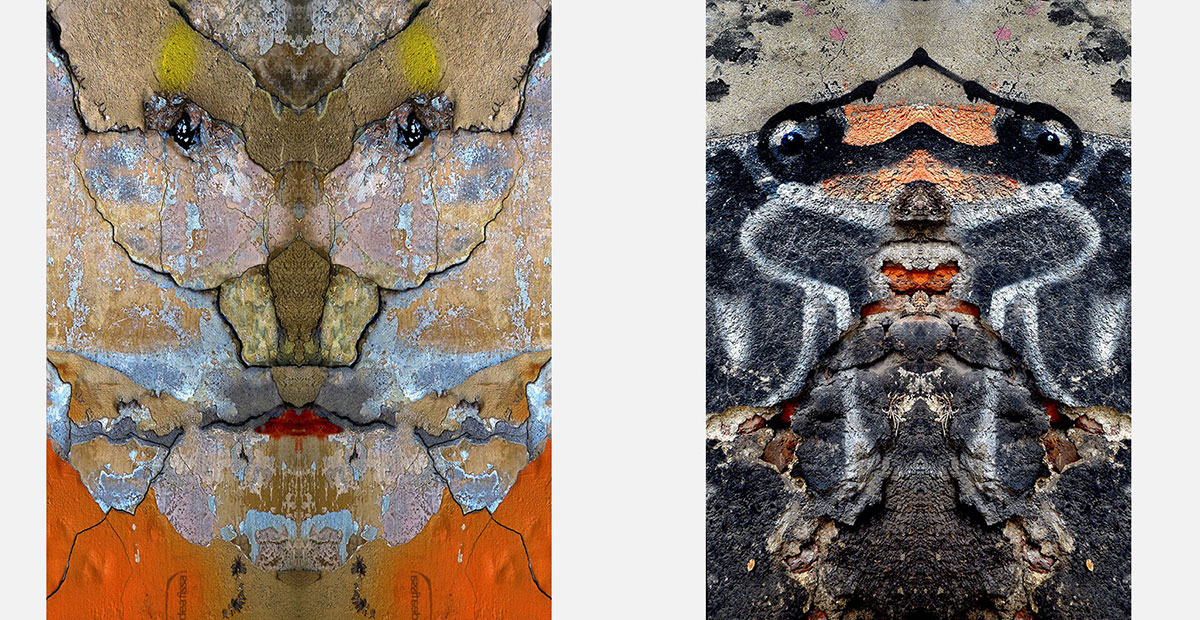
The Walls family: chromatic complexity accumulated through sheer duration
Walls and Urban Surfaces
The wall works are the most chromatic group in the series and the most painterly in register. Cracked plaster, graffiti residue, moss, lichen, faded pigment: the urban wall accumulates chromatic complexity through sheer duration, through the layering of mark over mark over decades, that no single act of composition could produce. Greens, oranges, silvers, rust reds, and celadons appear alongside each other in ranges that no individual artistic act could have generated. The faces that surface from this material are correspondingly varied in character: mask-like, atmospheric, confrontational, delicate, strange.
Leonardo observed in the Trattato della Pittura that old cracked walls yield castles and infinite figures to the attentive eye, his counsel being practical: use the wall to train the imagination. Ragazzini does not use it to train anything. The wall is the work. The graffiti, the weathering, the layering of mark over mark: these are not artistic acts but the residue of use and time. The mirroring finds in them what no deliberate composition could have placed there.
The Expressionist sensibility mapped this territory most carefully: the understanding that a cracked and stained surface carries an emotional charge proportional to its resistance to control, a density of mark that idealized or polished material cannot reach. The urban wall gets there by a different route, through sheer duration rather than stylistic choice. What that encounter with random material yields is what André Breton called convulsive beauty: the unconscious surfacing through the accidental, the found object speaking from a place the composed work cannot reach.
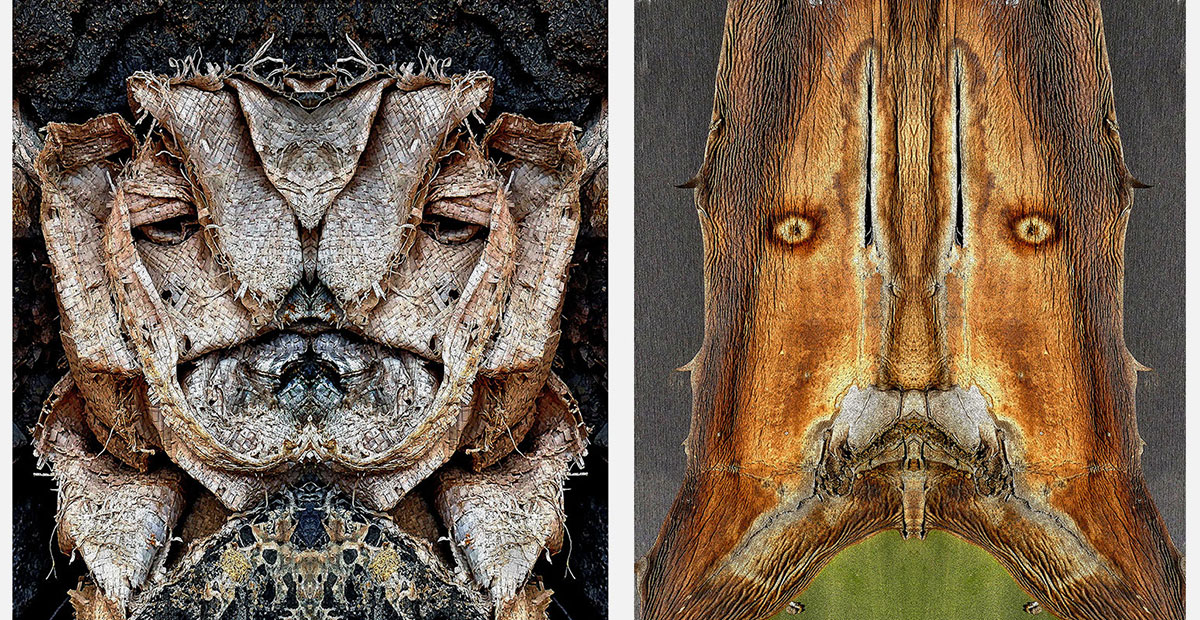
The Organic family: the series' most unexpected argument
Organic: Agave and Fabric
The organic works carry the series' most unexpected argument. That stone and bark and corroded metal hold figural potential is a claim with a long precedent, from Alberti to Leonardo to Ernst. That a dried agave leaf, a piece of worn fabric, should yield presences of equal authority extends the argument into territory where the precedent is thinner and the claim correspondingly bolder. The capacity for figural projection is not confined to stone or bark or the materials of traditional anthropomorphic projection. It is everywhere matter accumulates into suggestion, and the visual system will find it everywhere.
The agave works yield elongated, regal figures from the natural striations and curling layers of the leaf: warm ochres and cool grays unlike any other family in the series, surfaces that give up their creatures slowly, the way organic material reveals its internal logic only when you have been looking long enough. Giuseppe Penone's practice within the Arte Povera tradition, finding the tree inside the industrial timber and working with rather than against the grain of organic structure, is the relevant precedent for the collaboration between artist and material that these works enact.
The fabric works carry the series' most democratic argument. Arte Povera established that the worn and discarded carry meaning unavailable to conventional artistic substances, precisely because of their resistance to idealization. Ragazzini extends that understanding into an unexpected register: the woven surface, the stitched seam, the worn edge of anything that has passed through human use. Pareidolia engages regardless of material. The visual system does not evaluate the origin of what it is looking at before finding the face. It finds the face because it cannot choose not to.
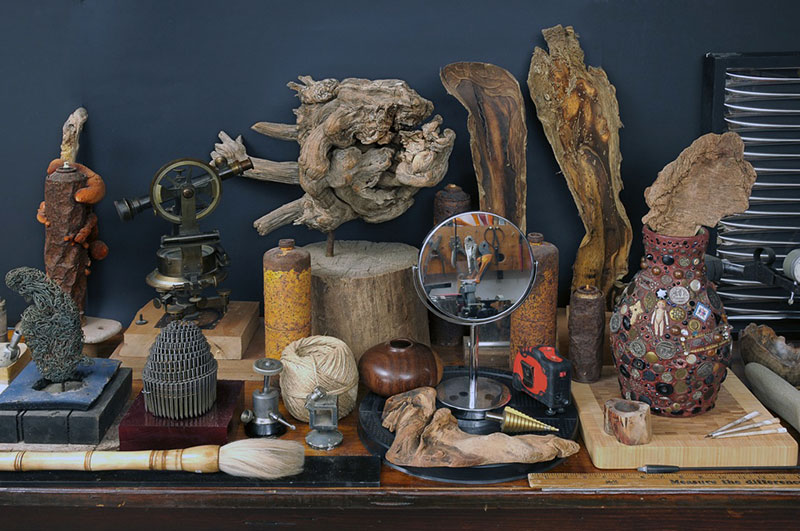
The working table of the Sarteano studio where found objects are revealed by the mirror
The Theoretical Lineage
The perceptual phenomenon at the heart of the Creature series has been observed across five centuries and two disciplines. Leon Battista Alberti, in De statua, traced the origins of sculpture to the moment when early humans recognized the shape of a human body in a rock or fallen tree shaped by forces no one had directed. They felt the impulse not to create but to complete: to clarify what was already there. Leonardo da Vinci named the same phenomenon in practical terms in the Trattato della Pittura: a painter who contemplates old cracked walls will find in them castles, countries, and infinite figures. His counsel was for painters training their imagination. Ragazzini turns the exercise inside out. He does not use the surface to train his hand toward something else. The surface is the destination.
The scientific grounding for what Alberti and Leonardo described by observation comes from Ruggero Pierantoni, physicist and vision theorist, whose L'occhio e l'idea (Boringhieri, Turin, 1981) argues that the visual system is a compulsive pattern-extraction engine: in full alignment with the laws of quantum physics, the mind cannot help but impose order on retinal chaos, and the face is the pattern it seeks most urgently. Pareidolia is not a curiosity or a cognitive error. It is the visual system operating exactly as it was built to operate, arriving at the face before conscious attention has had time to intervene. Ragazzini has cited Pierantoni's text in his own writing on the series as the confirmation of what the work demonstrates empirically. The image and the theory arrived at the same place independently.
The passage from Pierantoni that Ragazzini cites is worth quoting in full: "The world is truly chaotic. We are lost in a vortex of Democritean atoms: without order, without meaning, without love. Nothing exists outside of us, or rather, outside of all the 'mes' that consider themselves to be such. For some inexplicable reason, forms are produced within the various 'mes'. That non-existent and therefore meaningless vortex outside is ordered, catalogued and described by our 'mind', which alone redeems us from nothingness. Everything else is silence." This is not, in Pierantoni's account, a description of a perceptual quirk. It is a description of how consciousness works: the face is not found because it was placed there. It is found because the mind cannot survive without finding it.
The work also connects to a longer tradition of hidden figuration within art history itself. The late Renaissance divertissements of Giuseppe Arcimboldo assembled realistic elements, fruits, vegetables, books, to produce a realistic portrait: the face as composite of the world. Ragazzini inverts the operation. He photographs fragments of reality that are already quasi-abstract, and through bilateral symmetry and a process of graphic synthesis reveals ridges and lines that give the finished work an abstract painterly quality. The surface transcends its origin. Arcimboldo built the face from the world; Ragazzini finds the world has already built the face.
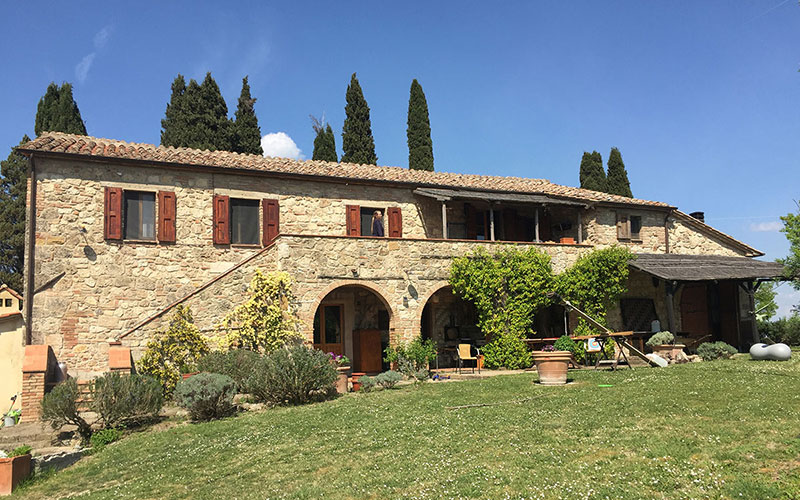
The country house in Sarteano near Siena
The Studio in the Tuscan Hills
Sarteano is a hill town above the Val di Chiana, forty kilometers from Siena, in the part of Tuscany that the Renaissance used as backdrop when it needed to think. Piero della Francesca painted this landscape into the background of his portraits because it was the kind of place that made the mind go quiet and the eye go long. The road that climbs to the studio passes through oak and cypress and the particular silence of land that has been cultivated and watched for three thousand years. You arrive at a building that looks, from the outside, like nothing in particular.
Inside, everything is particular. Every surface holds something gathered over decades: driftwood from canoe trips and forest walks, rusted fragments, mosaic vessels, mechanical instruments, roots, bones, mirrors, objects whose original purposes have dissolved entirely into the general logic of accumulation. The shelves rise to the ceiling. The table runs the length of the room. Nothing here is decorative. Everything is a candidate. This is not a studio in the conventional sense, a clean space organized around production. It is something older: a cabinet of the world, a studiolo in the Florentine tradition, a room organized entirely around the habit of looking at things until they yield what they contain.
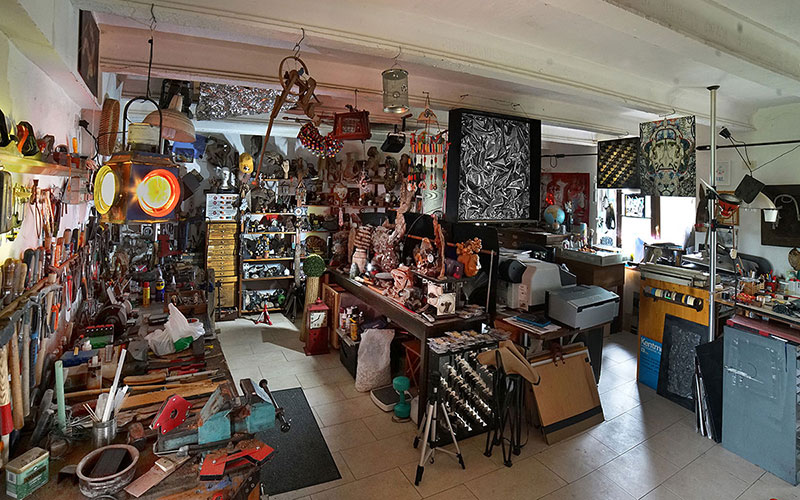
The studio holding together a lifetime of work
Alberti wrote in De statua that figuration begins not with the hand but with the eye: with the moment a human being, standing before a rock shaped by erosion or a tree hollowed by time, recognized in it the form of something living and felt the impulse not to create but to complete, to clarify what the material was already holding. That moment is the origin of art, in Alberti's account, and it is also the origin of the Creature series, repeated in this studio every time Ragazzini picks up a piece of driftwood or a fragment of rusted metal and rotates it in the light until the face declares itself. The same act, five centuries apart, in the same landscape.
Dante knew this valley. He walked roads not far from here in the years of his exile, carrying the Commedia forward page by page through the same hills, the same light, the same silence. He gave Cerberus three heads because the tradition gave them to him, but he made the monster embodied, material, present, a creature of mud and appetite rather than pure theological symbol. When the Fondazione Dantesca di Firenze invited Ragazzini to interpret the Comedy and a piece of driftwood from a Greek beach yielded exactly three heads, it was not coincidence. It was the long logic of a place that has always understood that the world carries more meaning than it declares, that the face is already in the stone, that you have only to look.
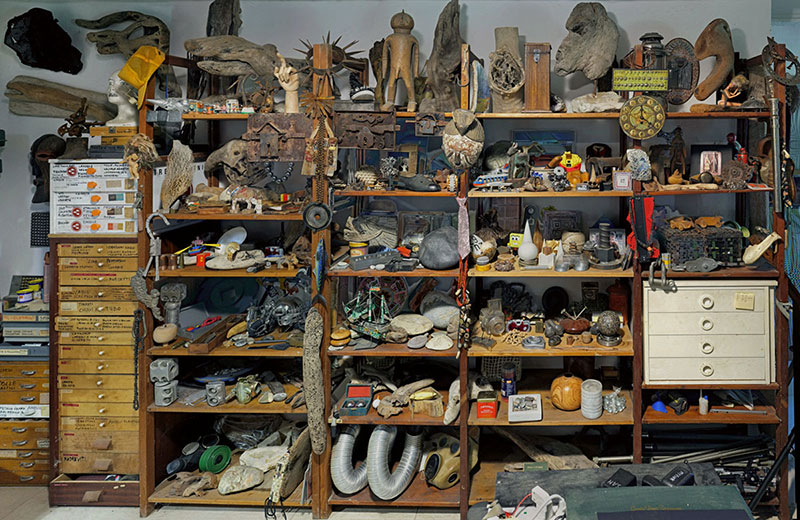
Sixty years of accumulated looking in a cabinet of the world in the Florentine tradition
The essence of this studio began in London in the 1960s, in the years of the ICA and the experimental scene that surrounded it, when objects started accumulating in the way they do around a mind that cannot stop noticing things. Then Rome, where another studio harbored what Ragazzini brought back from four decades of photographic work in Asia, Africa, and the Americas. It all landed in this loft-like space in a country house near Siena that he renovated over twenty years ago: at once a Renaissance studiolo and a Wunderkammer, accumulated across a lifetime around the unique interests and vision of an artist. This was the nurturing ground from where the Creature series emerged and Ragazzini could not stop finding what was waiting to be found.
View Other Works by Enzo Ragazzini View the Creature Exhibition