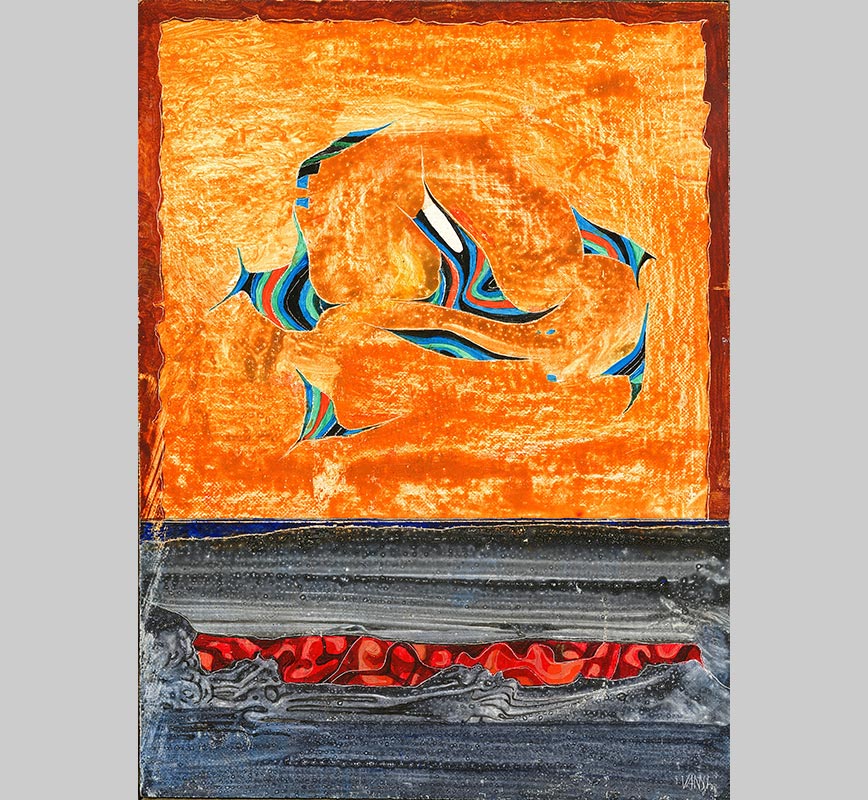
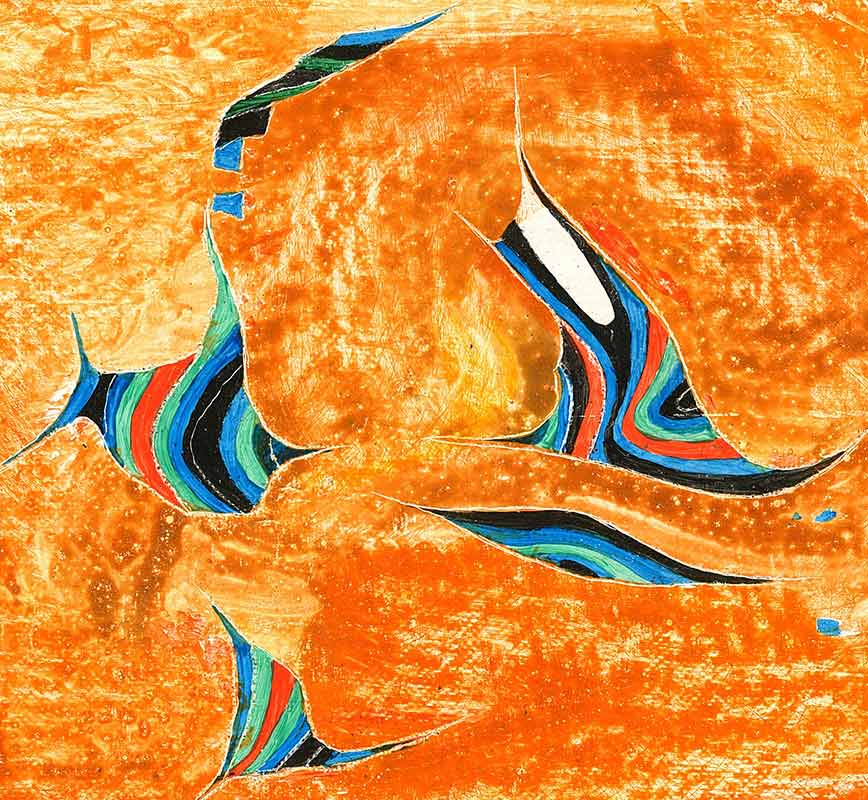
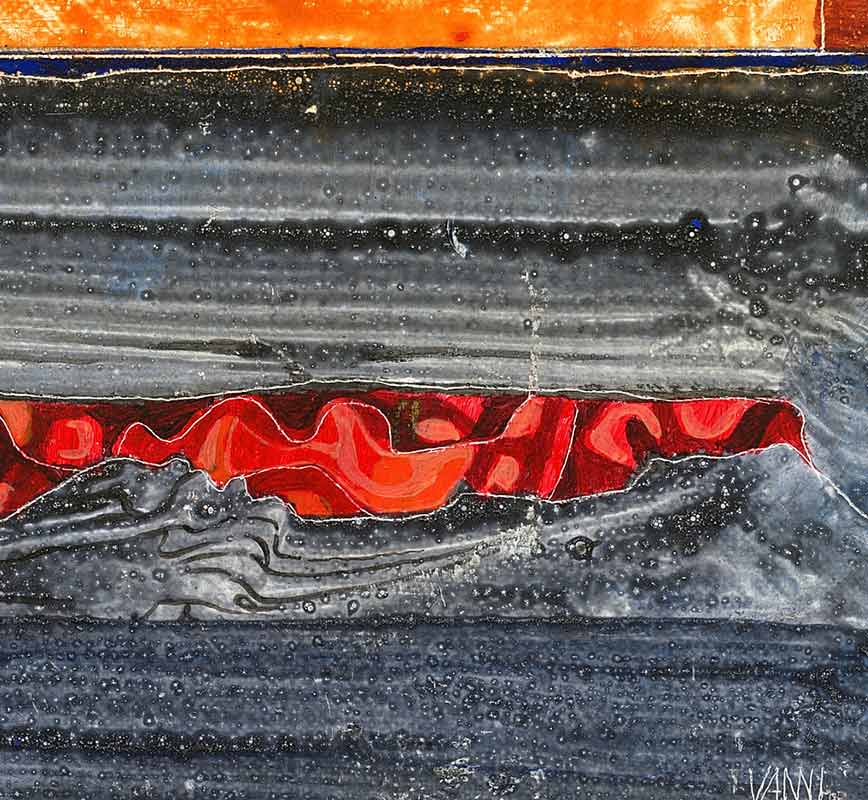
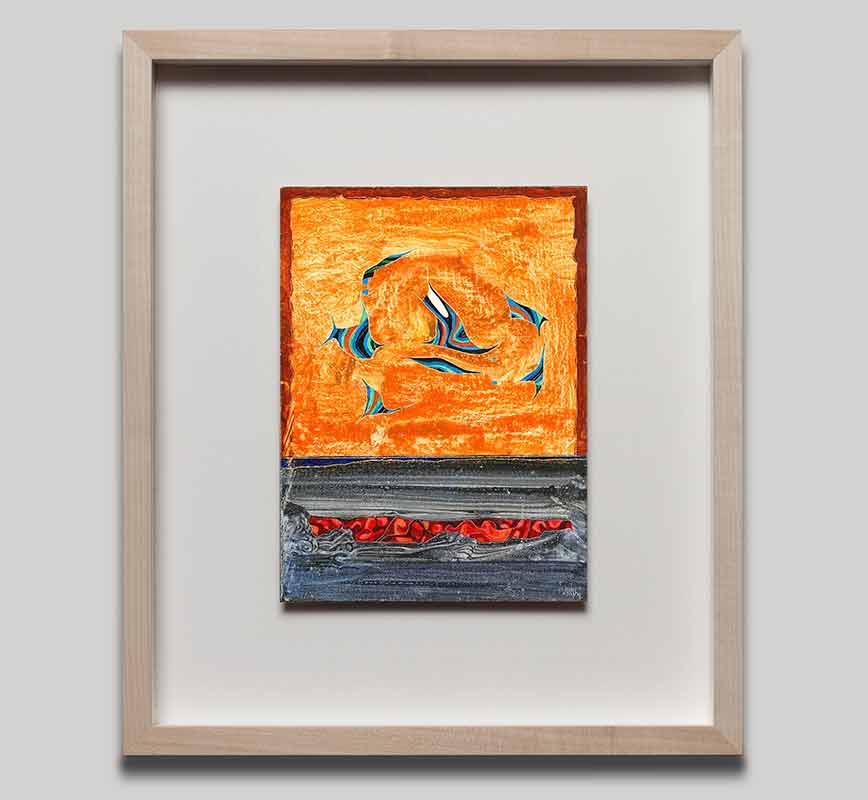
With Elementi di una citta [Elements of a City], Vanni gives pictorial form to his evolving interest in spatial dynamics, filtered through the Parisian atmosphere of the mid-1950s. A dense, radiant field of red dominates the canvas, reading at once as surface and atmosphere. From this vibrant membrane, pale blue and green geometries begin to coalesce and fragment, like distant city grids barely surfacing from beneath a dense fog. These forms neither rest on the surface nor recede fully into depth; they hover, suspended.
With Elementi di una citta [Elements of a City], Vanni gives pictorial form to his evolving interest in spatial dynamics, filtered through the Parisian atmosphere of the mid-1950s. A dense, radiant field of red dominates the canvas, reading at once as surface and atmosphere. From this vibrant membrane, pale blue and green geometries begin to coalesce and fragment, like distant city grids barely surfacing from beneath a dense fog. These forms neither rest on the surface nor recede fully into depth; they hover, suspended.
This was a moment of intense observation and synthesis for Vanni. The fluid interplay of geometric and lyrical abstraction on view at the Galerie Denise Rene, as well as the spatial poetics of artists like Vieira da Silva and Zao Wou-Ki, helped refine his own direction. Rather than align himself fully with one camp, Vanni developed a personal idiom, neither strictly Informel nor geometrically programmatic, where color, space, and structure engage in a dialogue of suspension.
Vanni's application of color heightens this equilibrium. The red field is not flat, but subtly modulated, absorbing and releasing the embedded geometries as though it were a living membrane. Here, structure is latent rather than declarative, emerging through disruption rather than articulation. The boundary line becomes an event, a site of transformation where space flickers between material and dematerialized states. Vanni's cityscape is not constructed but sensed: it flickers into view, element by element, like a memory half-recalled or a vision not yet fully formed.