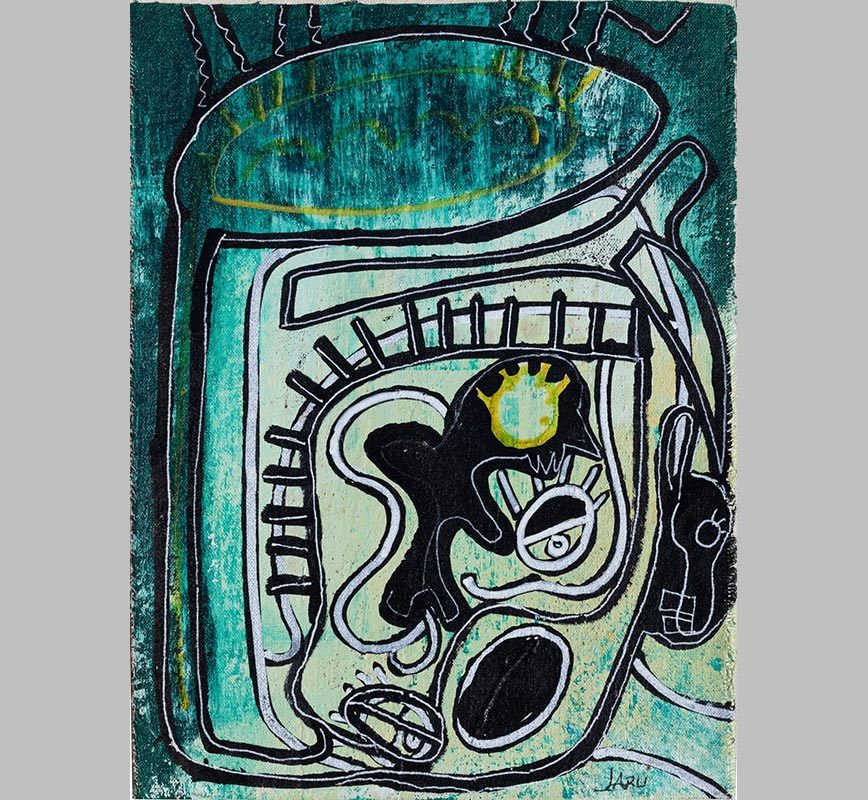
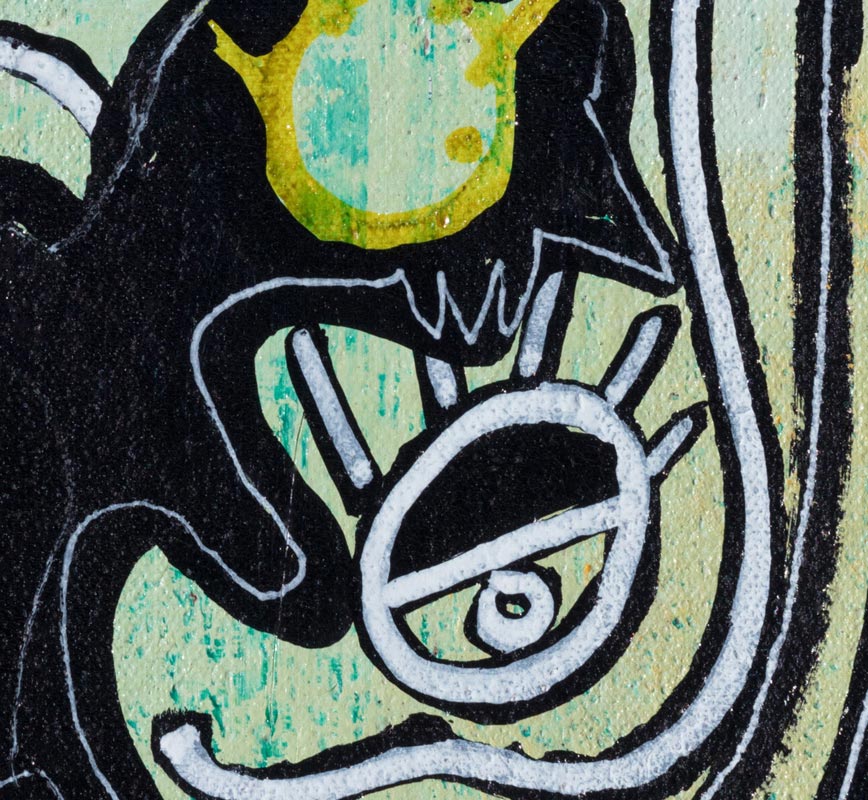
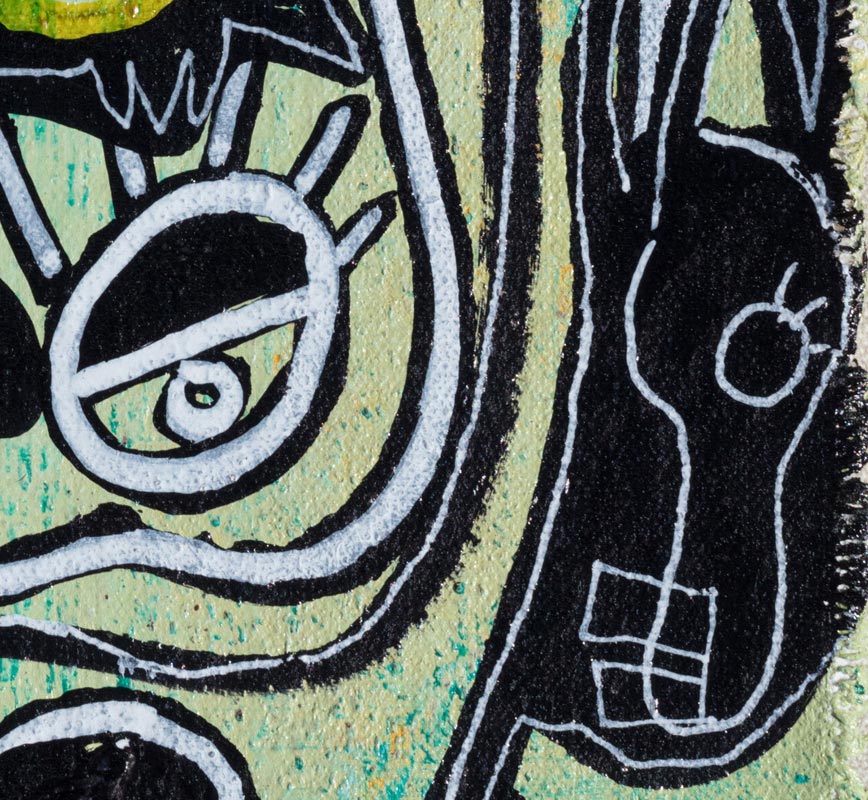
Germ Babysits renders the intergenerational transfer of influence as grotesque tenderness: a stylized “baby germ” under the watchful eye of its elder, the text announcing “Baby Germ, mind your baby brother.” The black-and-white linework is dense and unsparing, figures exaggerated to the point where their physical distortion mirrors the distortion of the social logic they inhabit: a world in which the next generation is not protected but groomed, shaped to participate in the same cycles of ambition and replacement that formed the one doing the shaping.
Germ Babysits renders the intergenerational transfer of influence as grotesque tenderness: a stylized “baby germ” under the watchful eye of its elder, the text announcing “Baby Germ, mind your baby brother.” The black-and-white linework is dense and unsparing, figures exaggerated to the point where their physical distortion mirrors the distortion of the social logic they inhabit: a world in which the next generation is not protected but groomed, shaped to participate in the same cycles of ambition and replacement that formed the one doing the shaping.
Jaru operates within the long tradition of underground comics as a vehicle for social critique, a formal vocabulary of bold outlines, flat picture plane, and figures reduced to expressive silhouettes, without illustrating it. His Bad Germ mythology is constructed from scratch, the figures formally indebted to the comic-strip lineage but serving a satire that belongs entirely to the specific conditions of the contemporary art world. Art Spiegelman’s Maus demonstrated that the comic-strip form could carry the full weight of historical horror without diminishing it; Jaru’s chronicles carry an equivalent weight in a different register.
The title’s double meaning sustains the image. To babysit is to care for something temporarily in the absence of the rightful authority: the implication is that the elder germ is not the permanent holder but a stand-in, filling a role until the next occupant is ready. This temporary custody is how influence works in the world the Chronicles of Bad Germ describes: not inherited with any permanence, but passed from hand to hand in a chain where the last holder is always already being replaced.