Linseed oil, pigments, beeswax, and glass powder on Panel
36 x 36 in
91 x 91 cm
SOLD
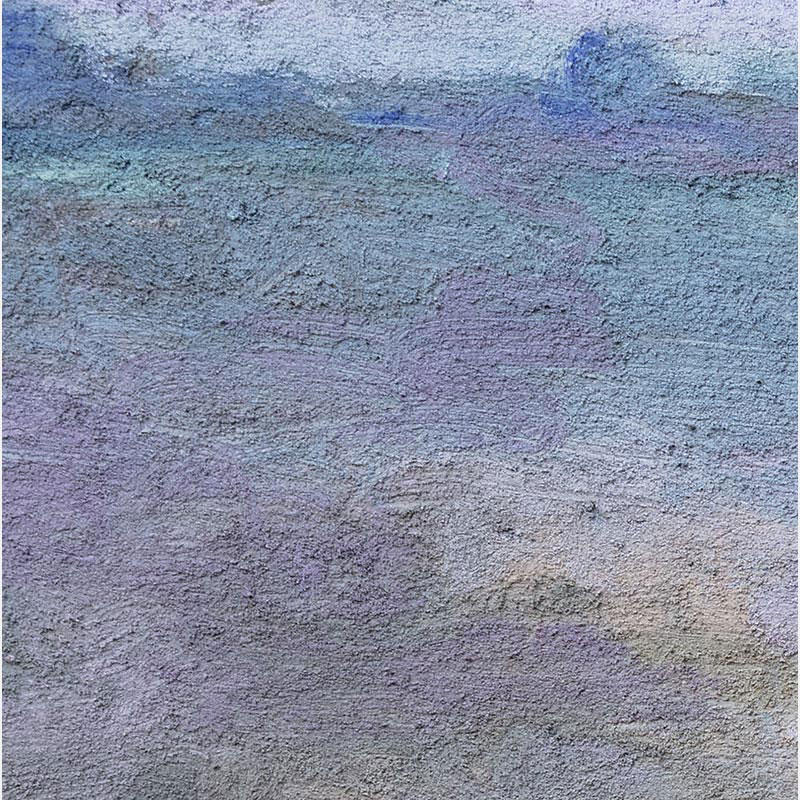
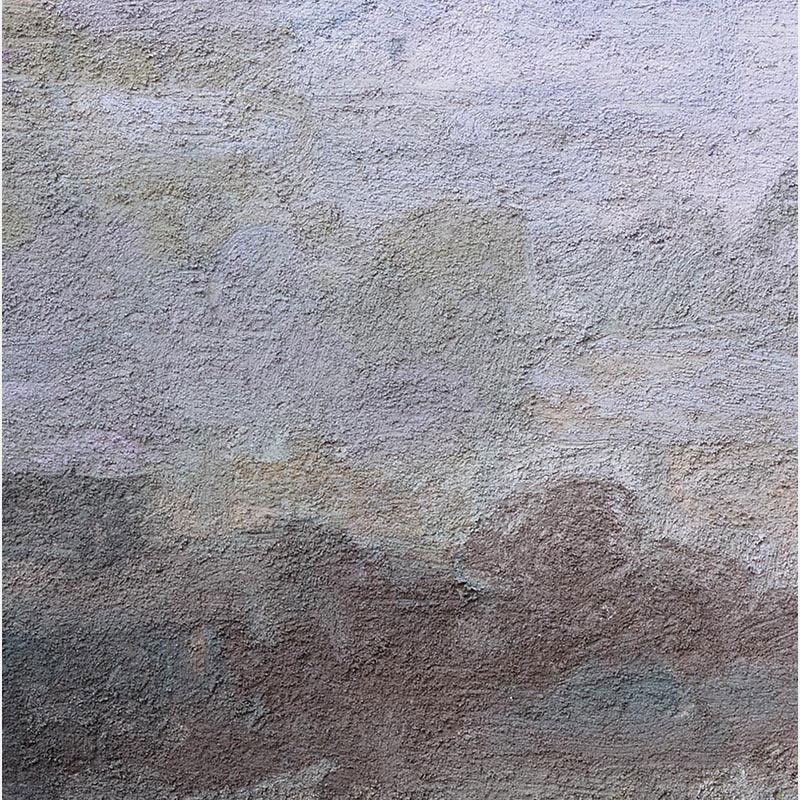
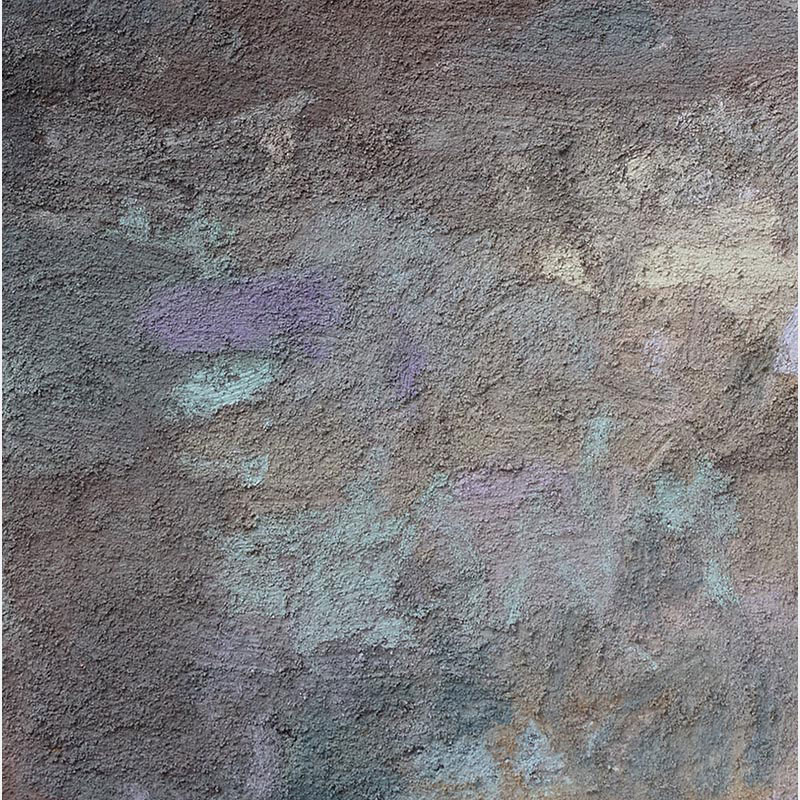
In Memorie II [Memories II], a painting of dissolution: soft lavenders, misty blues, and muted greens merge into earthy grays across a surface that has no sharp edge anywhere, no mark that declares itself as a mark. The horizon, implicit rather than drawn, hovers between vastness and intimacy, giving the impression of a place seen at a remove in time rather than at a distance in space. The glass powder in the encaustic medium contributes a velvety translucency to the surface, as if the memory itself were behind a thin film of material time.
In Memorie II [Memories II], a painting of dissolution: soft lavenders, misty blues, and muted greens merge into earthy grays across a surface that has no sharp edge anywhere, no mark that declares itself as a mark. The horizon, implicit rather than drawn, hovers between vastness and intimacy, giving the impression of a place seen at a remove in time rather than at a distance in space. The glass powder in the encaustic medium contributes a velvety translucency to the surface, as if the memory itself were behind a thin film of material time.
The title positions the painting explicitly as memory rather than perception, and the visual logic follows: colors and forms are present but not insistent, their edges absorbed by the semi-transparent wax layers that both carry and diffuse them. This is one of the defining properties of De Gennaro's encaustic medium, that what has been deposited is not on the surface but inside it, visible through successive strata of wax and linseed oil in a way that creates literal optical depth rather than illusionistic pictorial space.
The work invites comparison to the late paintings of J.M.W. Turner, particularly the unfinished Venetian watercolors and the final oil canvases in which form dissolves into atmosphere and the painting becomes less an image than a condition of light. Turner's surfaces work differently, through oil glazing and paint manipulation rather than encaustic translucency, but the atmospheric result shares something essential: the painting as a field in which light and memory are held in suspension rather than fixed. De Gennaro's Campanian formation gives this atmospheric dissolution a different temperature than Turner's northern European one: the memory is warmer, the dissolution slower, the light more consistently present in the lower field even as it diffuses upward.
![Encaustic abstract landscape by Orazio De Gennaro. Soft lavenders, misty blues, and muted greens dissolving into earthy gray with velvety translucent surface. Memorie II [Memories II], 2023.](../paintings-orazio-de-gennaro/images/artwork23a.jpg)
![Room view of encaustic abstract landscape Memorie II [Memories II] (2023) by Orazio De Gennaro, 36 x 36 inches. Soft blues and grays on panel.](../paintings-orazio-de-gennaro/images/artwork23e.jpg)