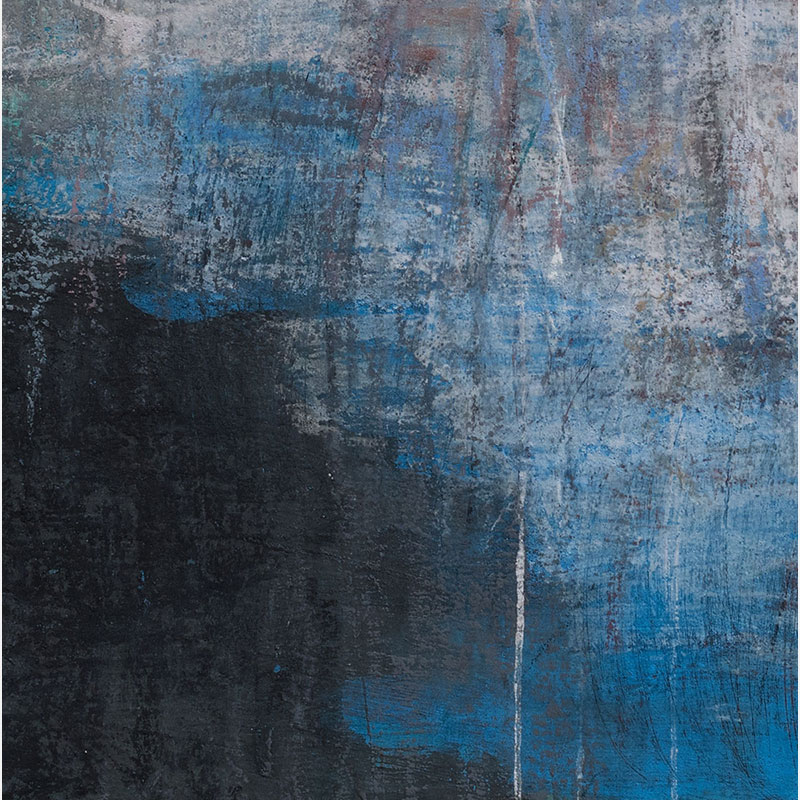
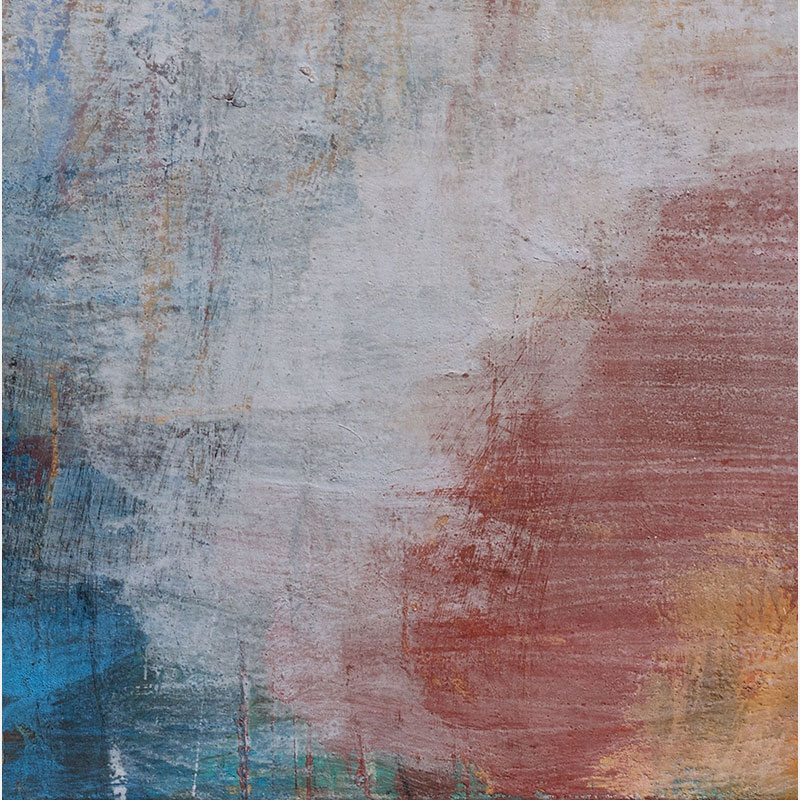
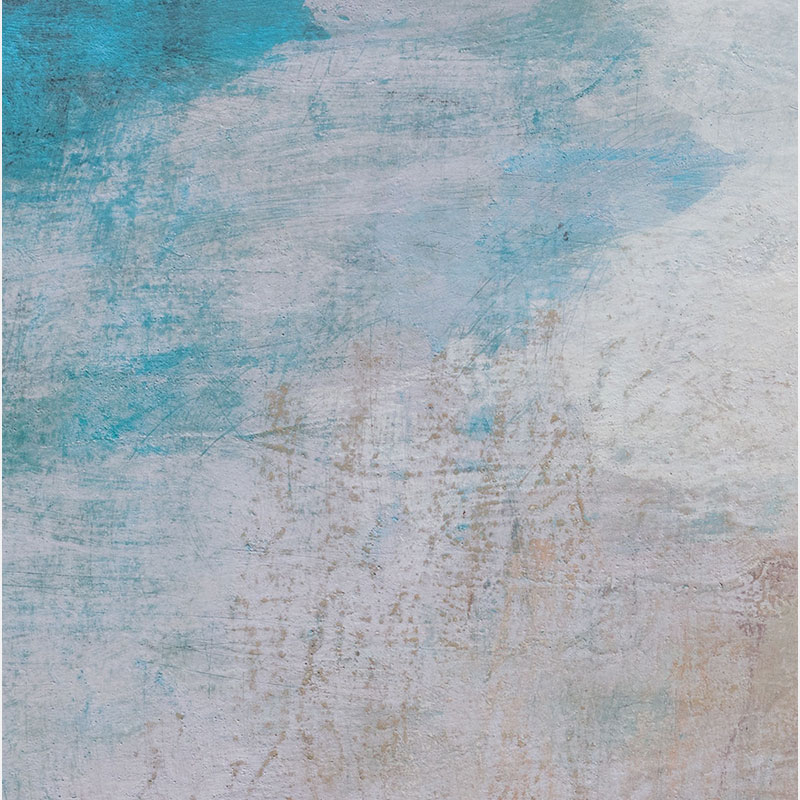
Tempo Perso [Lost Time] opens on a field of pale grays and diffuse whites that seem to hold light rather than reflect it, the surface dissolving upward into that luminous register while warm ochres pool at the upper right and a dense black mass anchors the lower left. Turquoise surfaces in a passage near the base, unexpected against the earth palette, and graphite verticals scratch through the layers as if marking time on a wall that has forgotten what it was recording. The paint does not illustrate time; it accumulates as time does.
Tempo Perso [Lost Time] opens on a field of pale grays and diffuse whites that seem to hold light rather than reflect it, the surface dissolving upward into that luminous register while warm ochres pool at the upper right and a dense black mass anchors the lower left. Turquoise surfaces in a passage near the base, unexpected against the earth palette, and graphite verticals scratch through the layers as if marking time on a wall that has forgotten what it was recording. The paint does not illustrate time; it accumulates as time does.
De Gennaro builds this surface from handmade oil pastel, earth pigments, lime, and graphite applied over a thick impasto of lime and sand, then scraped and reworked until the layers carry the record of everything that happened to them. The horizontal format, nearly four feet wide, gives the field a landscape logic without ever resolving into landscape: there is no horizon line, only the slow movement of weight from dark to pale as the eye rises through the surface.
I builds its pale zones through precisely this logic: a surface grounded in light-bearing materials, lime and white pigment, that has been weighted by black and ochre until the luminous passages read as hard-won rather than given. The work arrives at its own paradox: darkness applied until the remaining light becomes the argument. Pierre Soulages spent decades developing what he called outrenoir, the luminosity generated when darkness is worked until it exceeds itself; Tempo Perso approaches the same question from the opposite direction, but arrives at a comparable conviction that the relationship between weight and light is where painting thinks. The title names what this kind of painting holds: not a moment but a duration, not a place but the feeling of having been in one.
![Abstract painting by Orazio De Gennaro. Pale grays and diffuse whites dissolving upward, warm ochres at upper right, dense black mass at lower left, turquoise passage and graphite verticals. Tempo Perso [Lost Time], 2011.](../paintings-orazio-de-gennaro/images/artwork19a.jpg)
![Room view of abstract painting Tempo Perso [Lost Time] (2011) by Orazio De Gennaro, 44 x 48 inches. Pale grays and ochres on canvas.](../paintings-orazio-de-gennaro/images/artwork19e.jpg)