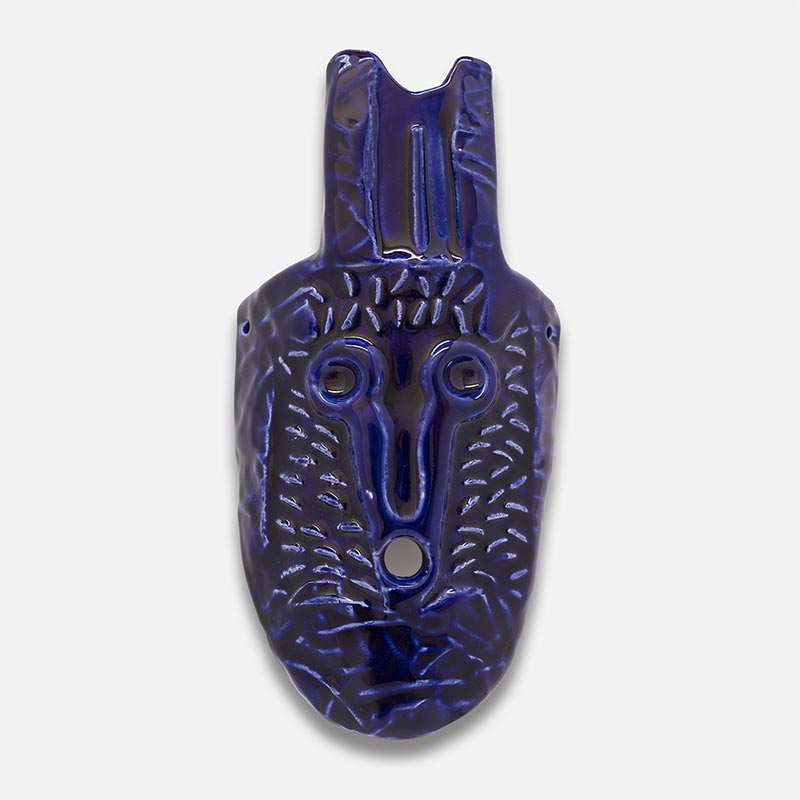
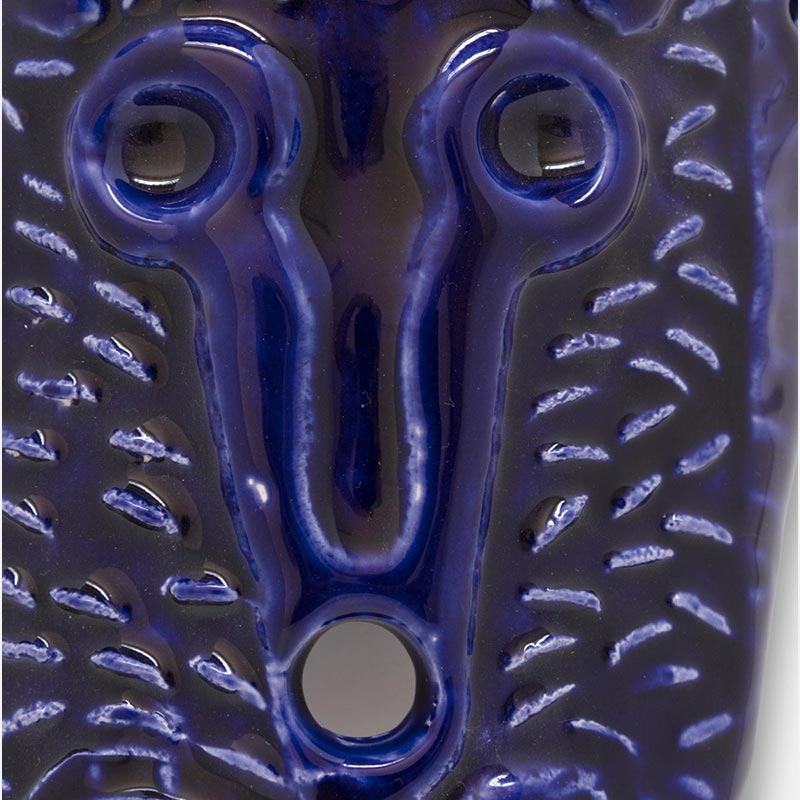
Maschera Blu I [Blue Mask I] bristles. The pointed almond-shaped mask is covered entirely in short diagonal incised marks, packed close and regular, catching the cobalt blue differently at each angle: darker in the incised channels, lighter on the raised surfaces, the whole field shimmering, simultaneously controlled and alive. The face within holds its ground: two round eye apertures with concentric rings, a central nose, a small round mouth. The mask looks like something that could move while remaining absolutely still.
Maschera Blu I [Blue Mask I] bristles. The pointed almond-shaped mask is covered entirely in short diagonal incised marks, packed close and regular, catching the cobalt blue differently at each angle: darker in the incised channels, lighter on the raised surfaces, the whole field shimmering, simultaneously controlled and alive. The face within holds its ground: two round eye apertures with concentric rings, a central nose, a small round mouth. The mask looks like something that could move while remaining absolutely still.
Part of the Masks series, the work deploys the all-over mark as its primary formal argument: the surface not organized around a central image but covered uniformly, the incised marks operating simultaneously as texture, pattern, and surface event. The face emerges from this field rather than sitting within a neutral ground, the schematic features holding their symbolic charge against the competing energy of the surrounding marks.
The tight all-over incised surface connects the work to the practice of Cy Twombly, who covered surfaces with dense repeated marks that function simultaneously as writing, drawing, and surface event: the mark as a systematic covering that is also always expressive, the total field as the argument. Crisafi’s ceramic surface applies this logic in a different medium and registers it through the cobalt blue, the glaze varying its depth with each mark’s angle, so that the surface shimmers rather than declares, holds movement within absolute stillness.