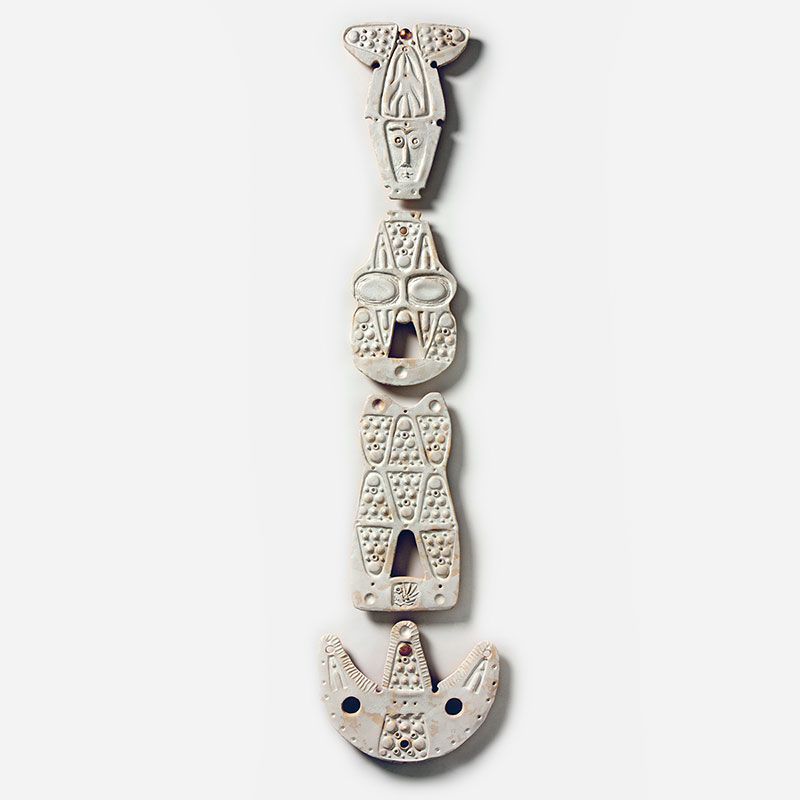
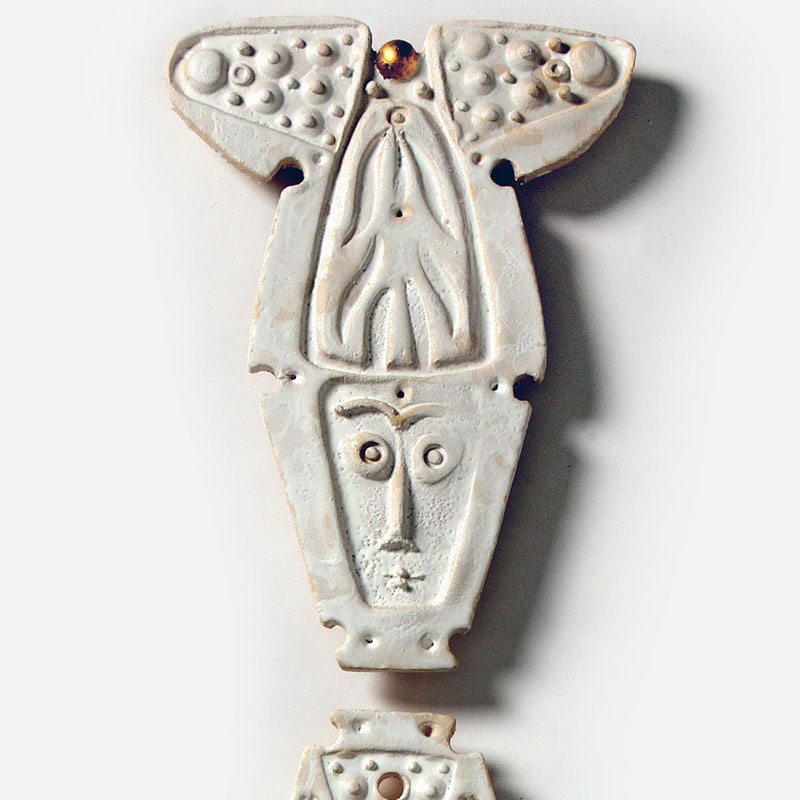
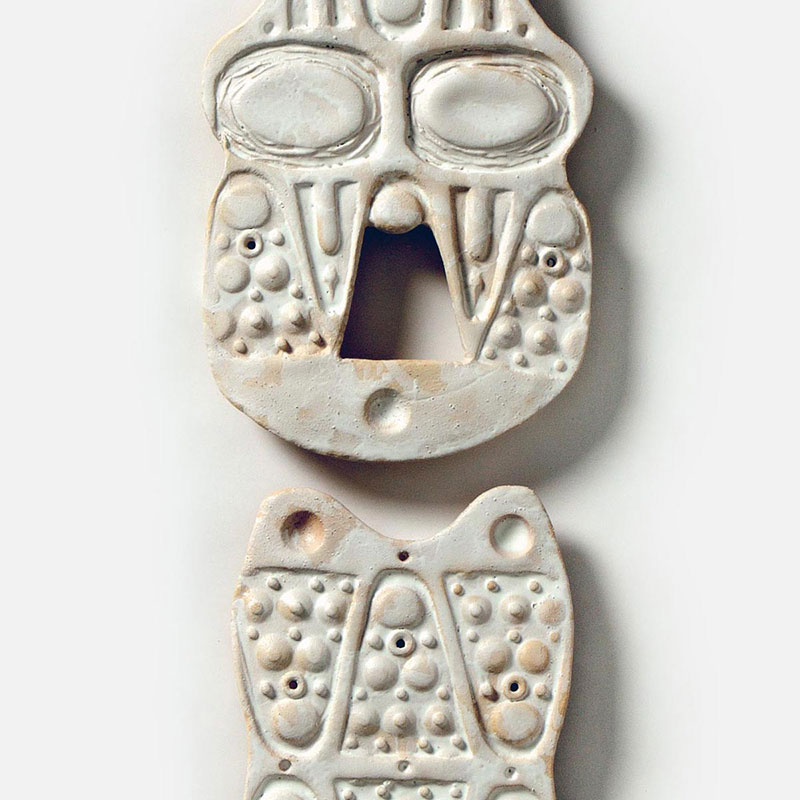
Legami XVII [Bonds XVII] unfolds gradually. The vertically aligned ceramic elements appear lighter and more exposed, their pale surface registering subtle shifts of texture, relief, and luster without declaring any single chromatic event. Rather than asserting a unified body, the sculpture reads as a sequence of signals and pauses, inviting the viewer to follow it upward as a progression rather than receive it as a mass. Presence here is cumulative, built through attention and duration rather than immediate impact.
Legami XVII [Bonds XVII] unfolds gradually. The vertically aligned ceramic elements appear lighter and more exposed, their pale surface registering subtle shifts of texture, relief, and luster without declaring any single chromatic event. Rather than asserting a unified body, the sculpture reads as a sequence of signals and pauses, inviting the viewer to follow it upward as a progression rather than receive it as a mass. Presence here is cumulative, built through attention and duration rather than immediate impact.
The emphasis on repetition and interval opens a dialogue with modern sculptural practices that privilege reduction and serial structure, yet the tactile irregularities of the surface resist industrial neutrality: the handmade marks, the slight variations between elements, the unpredictable behavior of luster in the kiln introduce a vulnerability that keeps the work from becoming system. Medardo Rosso understood that sculptural presence could be a durational event rather than an immediate encounter, and Legami XVII operates in that spirit: a work that yields its full weight only to sustained looking.
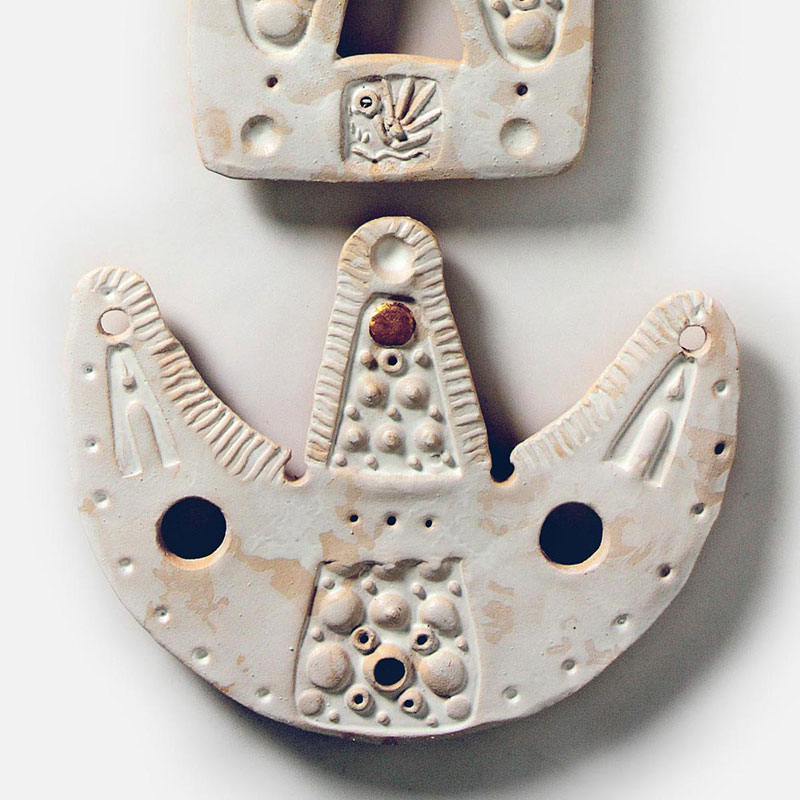
The lower element plays a decisive formal role. Its form departs from the expectation of a stabilizing base, introducing an asymmetry that subtly unsettles the figure’s vertical progression. This deviation prevents closure, keeping the sculpture perceptually open and reinforcing the experience of connection as something unresolved: ligature here is temporal rather than structural, a condition that unfolds through continuity of attention. Within the Legami [Bonds] series, Legami XVII reaffirms connection as a process rather than a state.