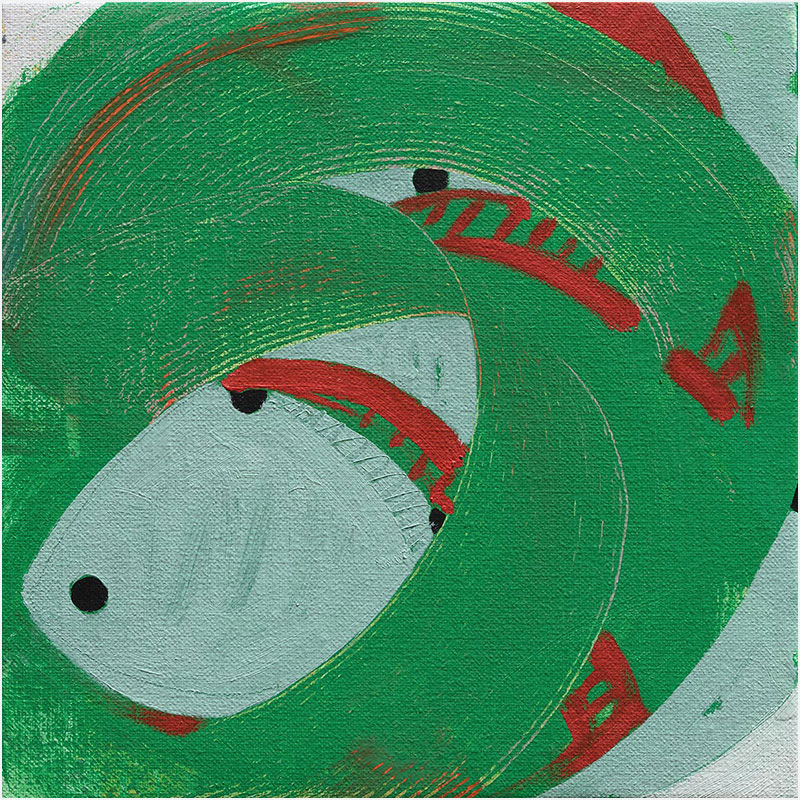
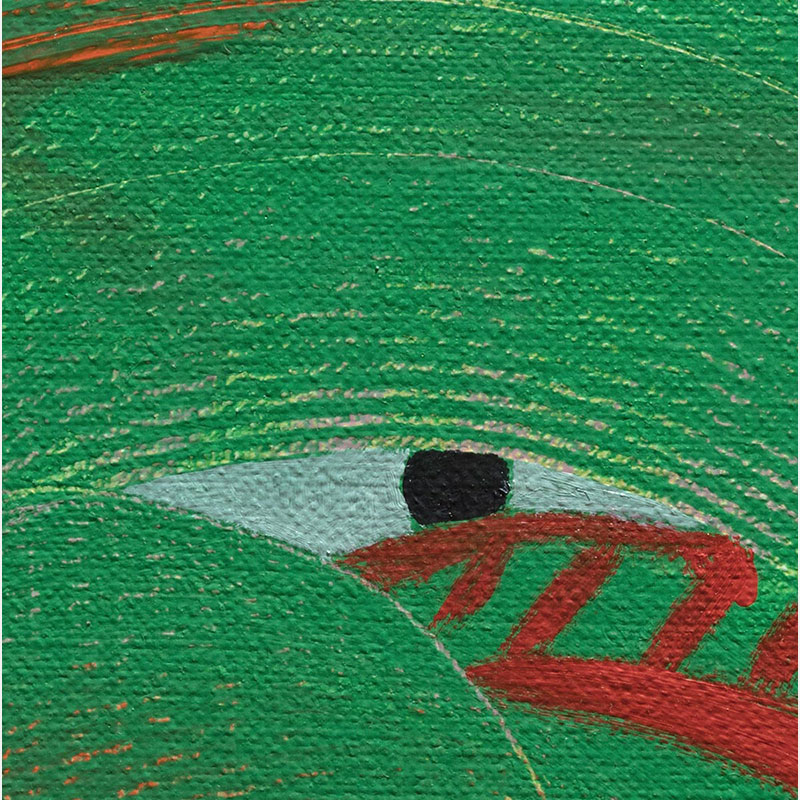
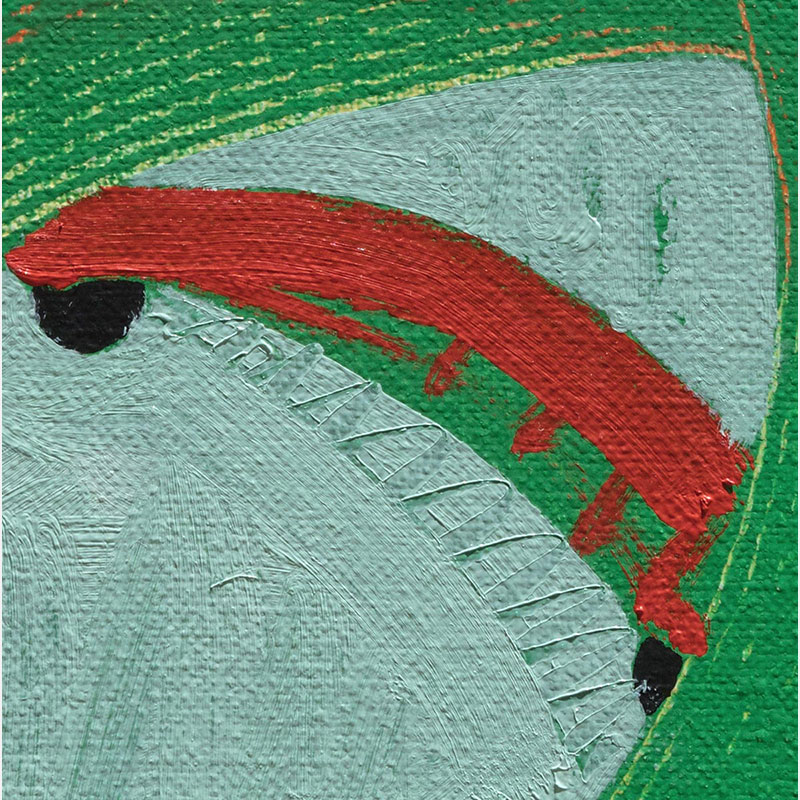
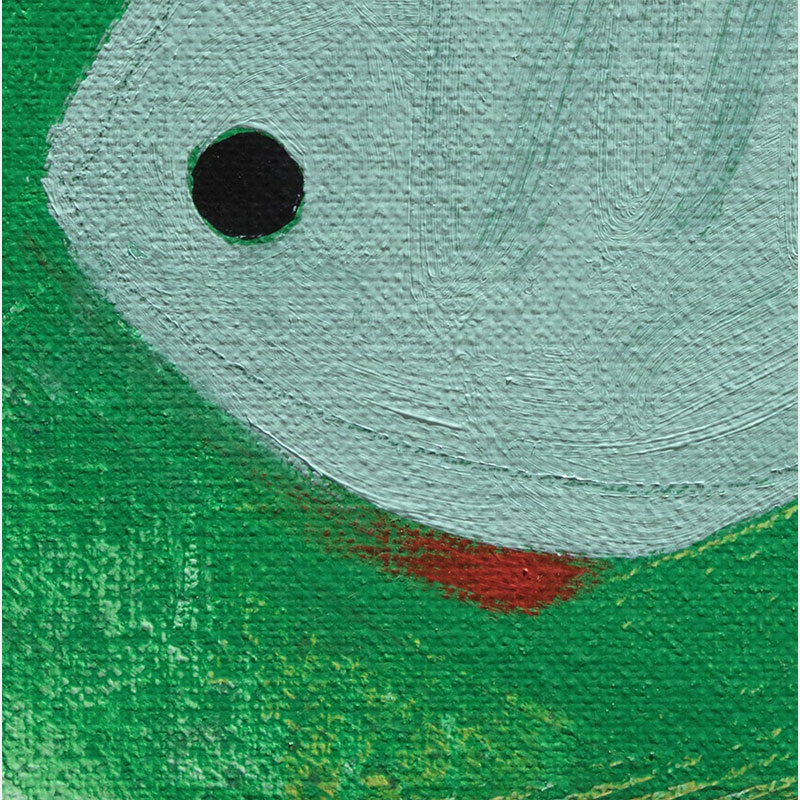
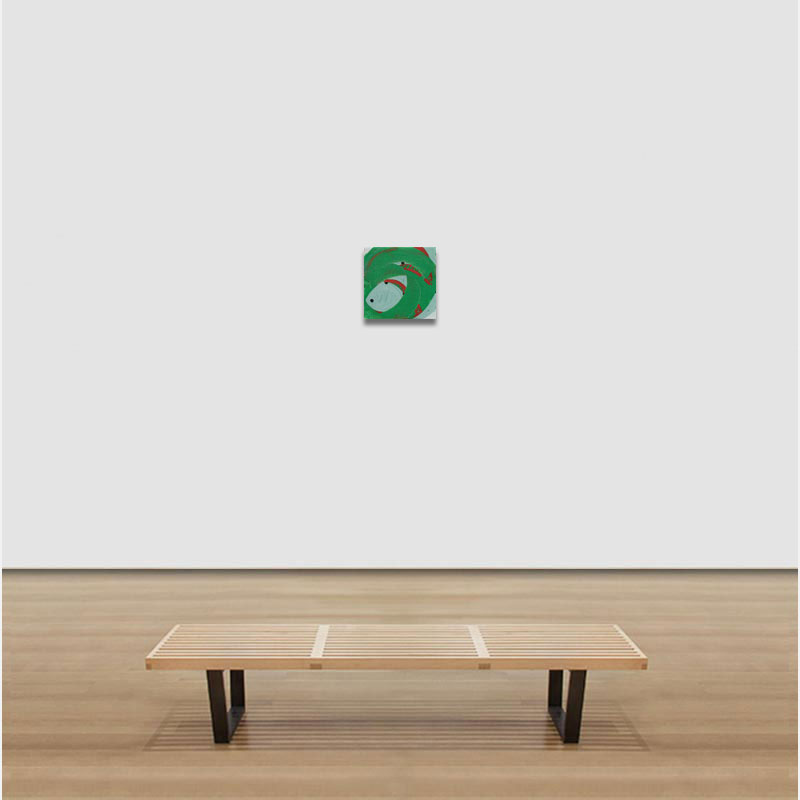
A green coil of overlapping rings winds close around a pale grey-green oval. Red combs climb its inner edges like ladders, hard black dots closing several of the runs. The green is heavy and cool; the red is quick and crisp against it, a little alarming. Orange glows faintly through the green at the upper left, and red fills a wedge in the upper right corner. It holds two colours that will not share, and the result is lush and tightly wound.
A green coil of overlapping rings winds close around a pale grey-green oval. Red combs climb its inner edges like ladders, hard black dots closing several of the runs. The green is heavy and cool; the red is quick and crisp against it, a little alarming. Orange glows faintly through the green at the upper left, and red fills a wedge in the upper right corner. It holds two colours that will not share, and the result is lush and tightly wound.
Concentric grooves score every green ring. The coil reads as a brush circling a fixed centre again and again, each turn slightly offset from the last, with orange threaded through the upper rings. The red belongs to another order of work. It is short, regular, almost printed, laid along the inner edges and through the gaps, with a black dot closing several runs. Red lives only at the margins and in the gaps of the green.
Juan Uslé's banded paintings assemble horizontal fields from sequences of short, discontinuous brushstrokes. Roberto Caracciolo's red rungs build no field at all. They ride the edge of a curve, and black dots close some sequences before they can spread.