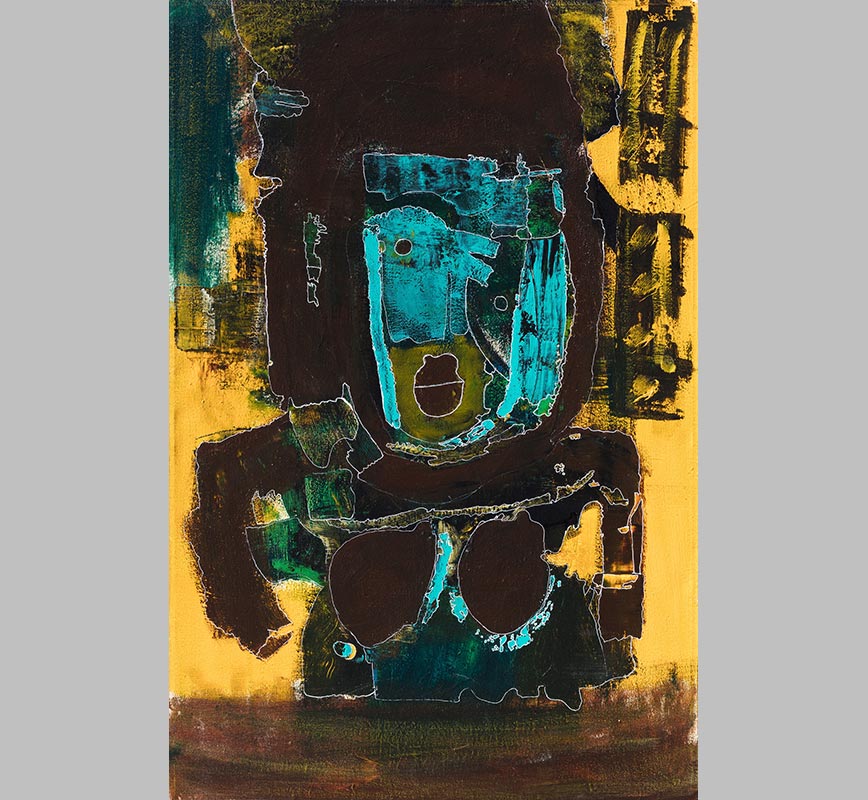
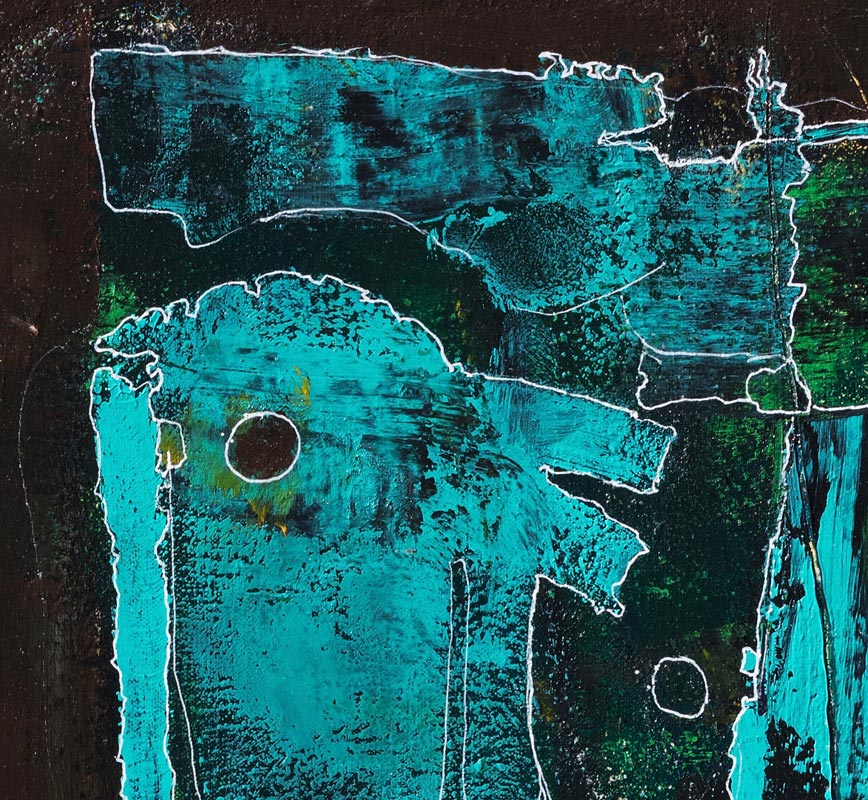
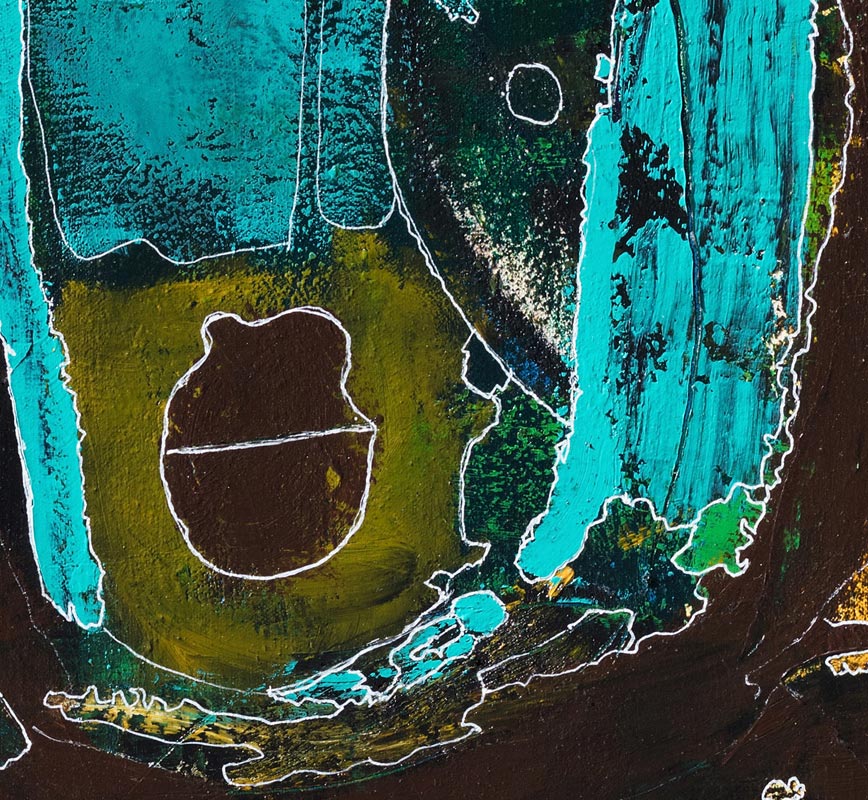
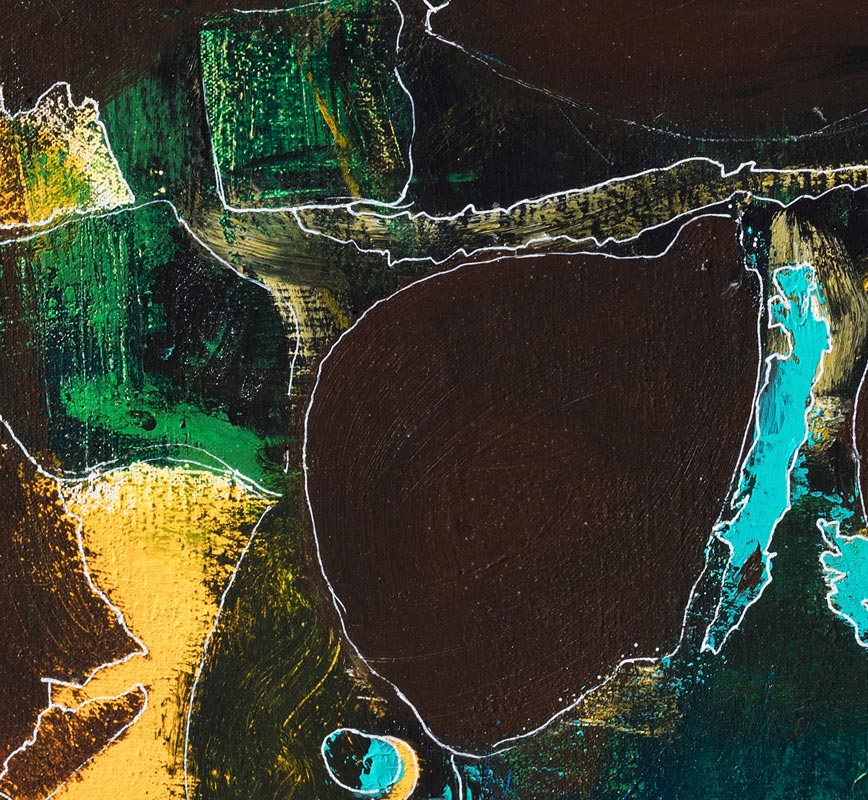
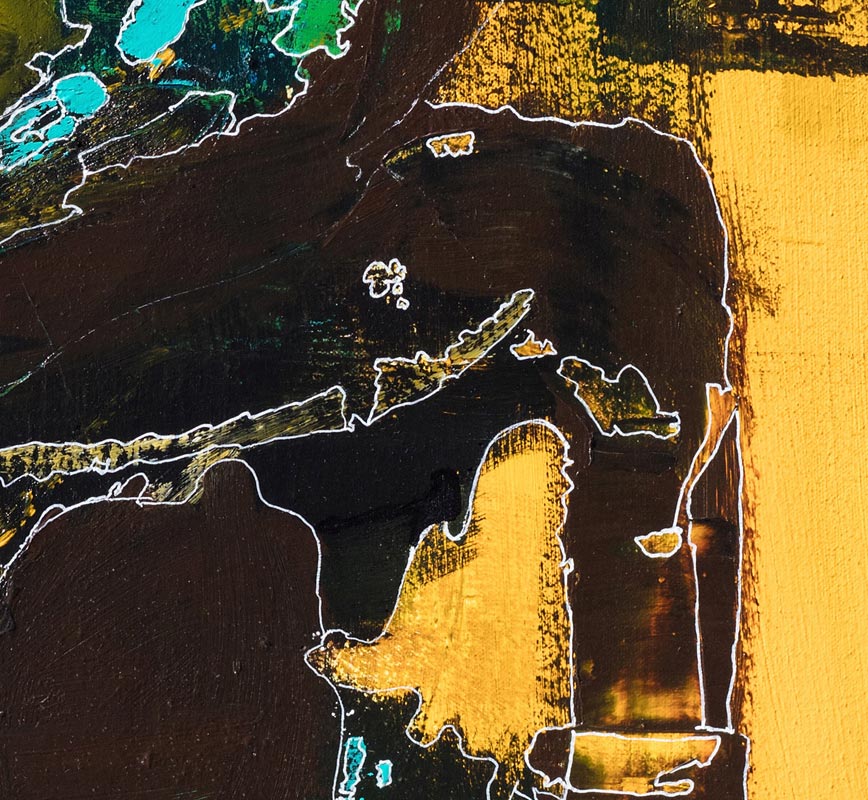
A bird-like figure commands the upper register of Pecking Order, its angular beak and elongated legs rendered in subdued purples, greens, and grays that hold their own against the luminous yellow and deep blue filling the canvas behind and below. Beneath it, fragmented shapes suggest limbs, partial figures, forms that have not quite resolved into bodies: present but compressed, as if the weight of the dominant form above has flattened everything underneath into a state of becoming rather than being.
A bird-like figure commands the upper register of Pecking Order, its angular beak and elongated legs rendered in subdued purples, greens, and grays that hold their own against the luminous yellow and deep blue filling the canvas behind and below. Beneath it, fragmented shapes suggest limbs, partial figures, forms that have not quite resolved into bodies: present but compressed, as if the weight of the dominant form above has flattened everything underneath into a state of becoming rather than being.
The color organization carries the argument. The bird occupies the cooler, more muted register while the background asserts itself in warm yellow and saturated blue, creating a tension in which dominance is not illustrated but structured into the chromatic logic. This is closer to the compositional thinking of early Expressionism, where color contrast was understood as a vehicle for psychological meaning, than to straightforward figuration. Ernst Ludwig Kirchner’s urban scenes, where the environment actively shapes the condition of figures rather than merely surrounding them, share something of this logic.
The title names the organizing principle with economy. Pecking order: the instinctual hierarchy that structures social life in nature and, by extension, everywhere else. The fragmented forms below the bird are not simply subordinate; they are in the process of competing for position among themselves, each partial shape pressing against the others for space. Jaru makes this not a commentary observed from outside but a condition rendered from within, the visual experience of the painting enacting the pressure it describes.