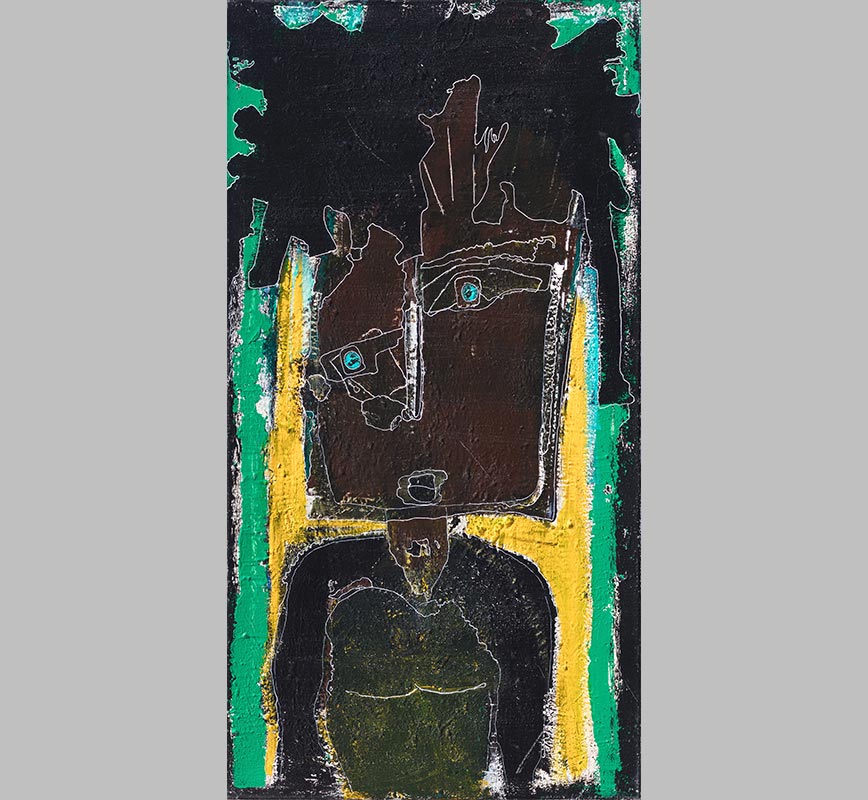
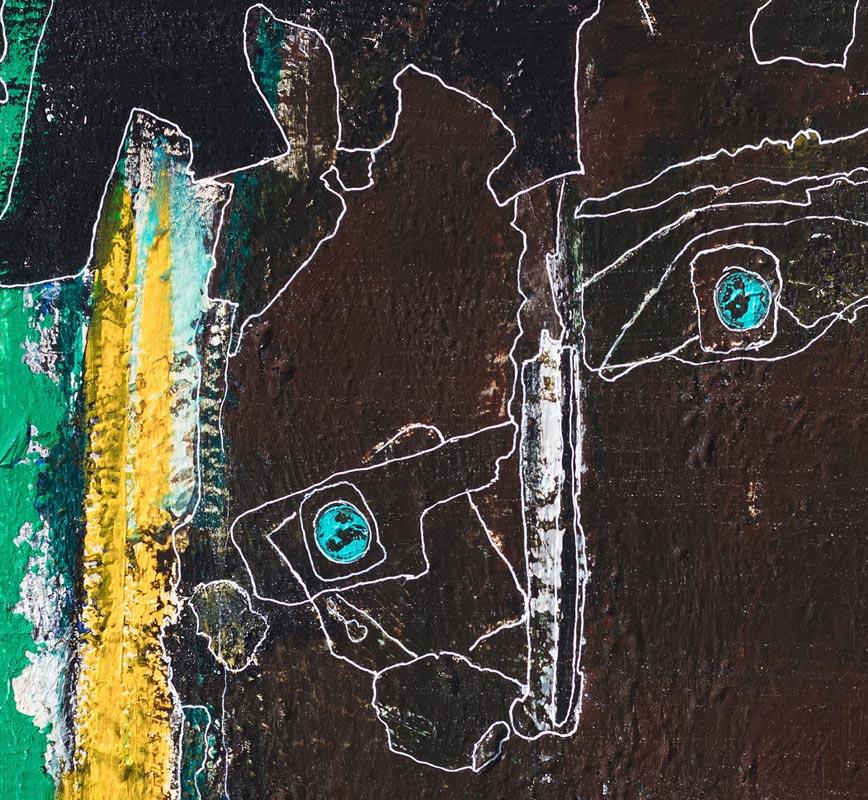
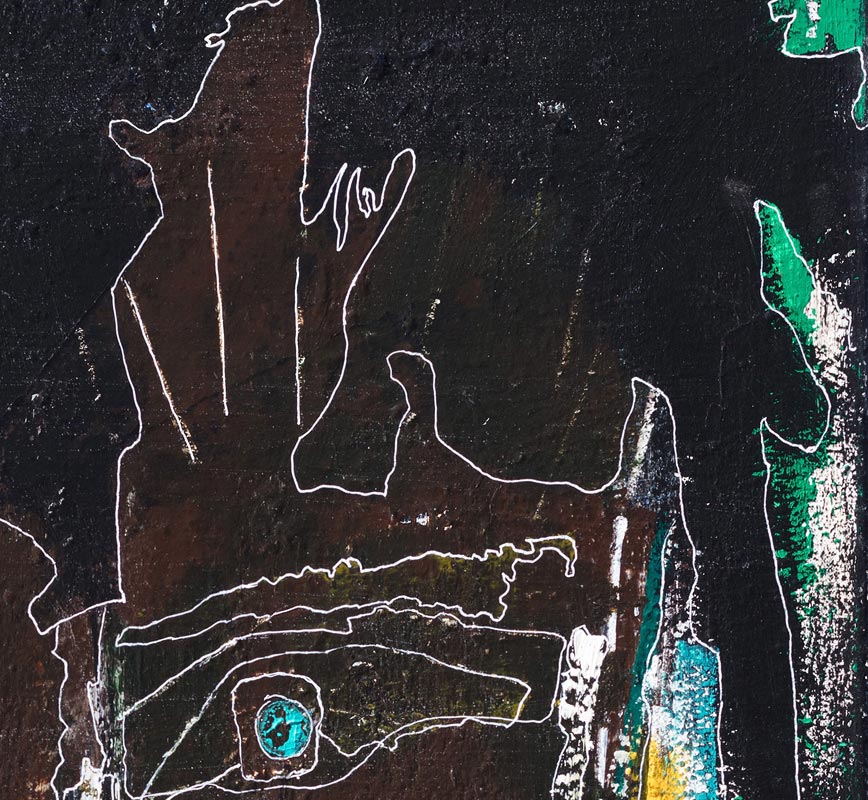
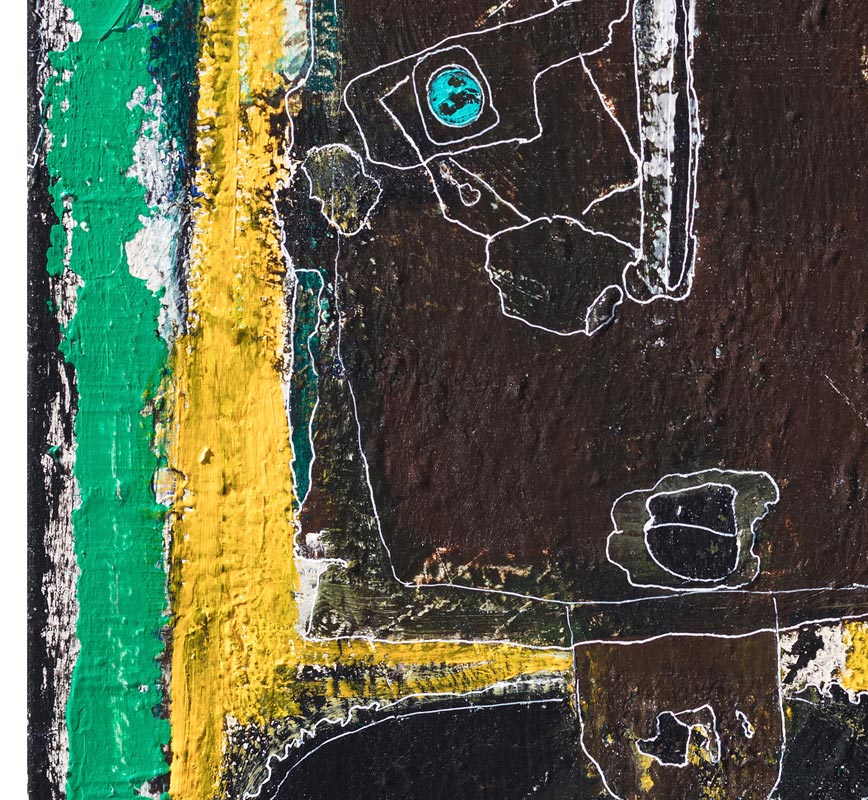
For The Love of Opium unrolls across its wide horizontal canvas in a procession of rounded interlocking forms, each outlined with thick purposeful lines in ochre, brown, and muted gray. The shapes suggest reclining figures or fragments of figures, though nothing resolves into a body with certainty. The composition has the quality of a frieze: forms following forms, the eye traveling without finding an anchor or endpoint. The surface is still but the stillness is not empty; it has the charged quality of deep rest.
For The Love of Opium unrolls across its wide horizontal canvas in a procession of rounded interlocking forms, each outlined with thick purposeful lines in ochre, brown, and muted gray. The shapes suggest reclining figures or fragments of figures, though nothing resolves into a body with certainty. The composition has the quality of a frieze: forms following forms, the eye traveling without finding an anchor or endpoint. The surface is still but the stillness is not empty; it has the charged quality of deep rest.
The color in For the Love of Opium does not announce itself but accumulates: warm ochres and deep sienna held in restrained chromatic tension, atmospheric density rather than expressionist intensity. The natural pigments Jaru grinds himself carry the bodied, slightly irregular warmth of materials that have been handled rather than manufactured, and the surface reads accordingly. Rufino Tamayo’s earthy palette occupies a similar register, though Tamayo’s synthesis runs through Mexican heritage and European modernism simultaneously; what Jaru shares with him here is the understanding that color can do its work quietly.
The title introduces a register that the formal tranquility simultaneously supports and complicates. Opium: the dissolution of the boundary between self and surroundings, consciousness becoming permeable to what is normally held at a distance. The rounded interlocking forms enact something of this, shapes flowing into each other, boundaries softening without disappearing, each form maintaining its outline while yielding at the edges to what is adjacent. The painting is a formal equivalent of the state the title names: the self present but loosened, contemplating from within a world that has become continuous with the body.