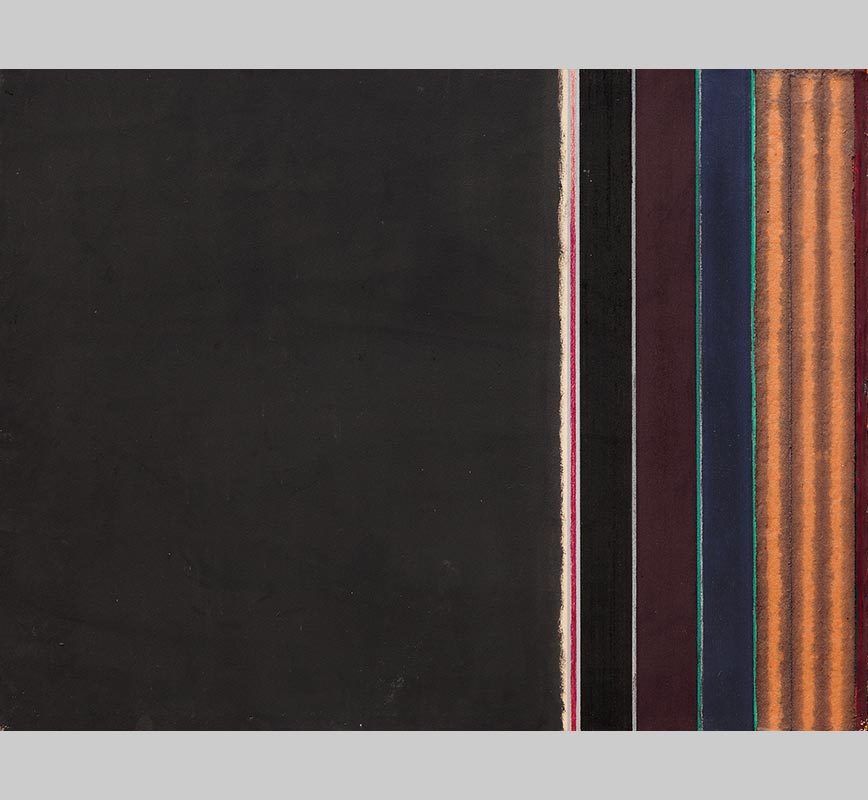
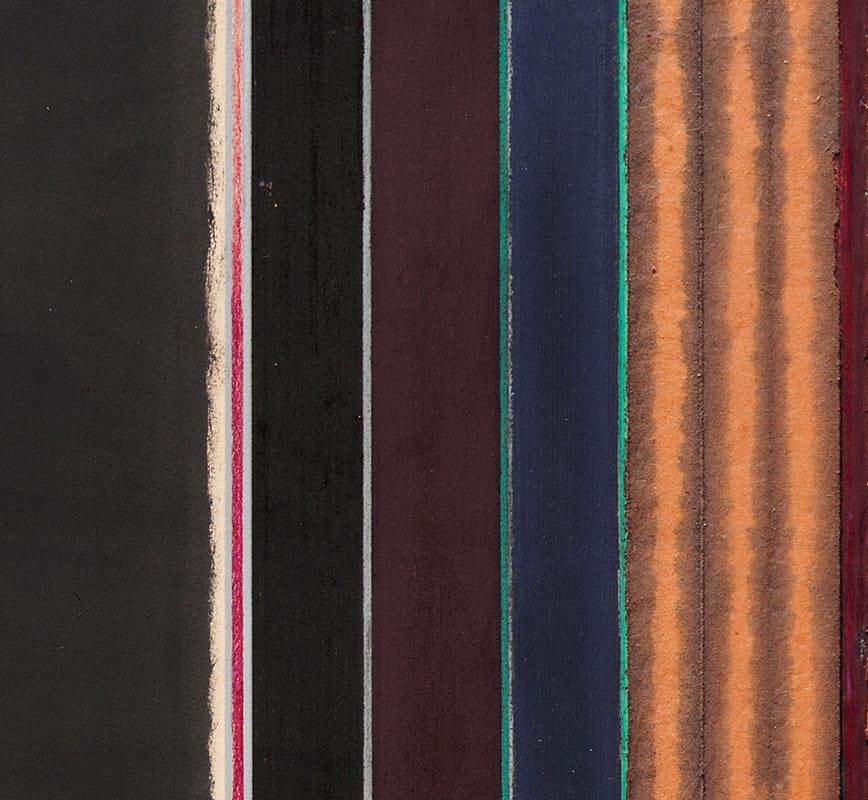
The bands in San Anton taper. They begin near the top of the canvas and narrow as they descend, their tips arriving at different points along the lower edge, so that the vertical field of color reads not as a grid but as a field of individually paced events, each band tracing its own arc. Orange, pink, green, and blue, all in pastel registers, create a luminosity through adjacency rather than through gradation, the flat surfaces generating light through the precision of their relationships.
The bands in San Anton taper. They begin near the top of the canvas and narrow as they descend, their tips arriving at different points along the lower edge, so that the vertical field of color reads not as a grid but as a field of individually paced events, each band tracing its own arc. Orange, pink, green, and blue, all in pastel registers, create a luminosity through adjacency rather than through gradation, the flat surfaces generating light through the precision of their relationships.
Each band in San Anton is a distinct decision, taped and placed, its width calibrated against its neighbors, the organic taper at the base the result of deliberate modulation rather than painterly accident. This is the reverse of Morris Louis’s approach within Color Field painting: Louis stained raw canvas with poured acrylic, the color absorbed into the weave so that the painted surface became the ground and figure dissolved into atmosphere. Canin’s rigor is present even when the effect is one of floating ease.
The pastel palette is itself a positioning statement. Where Color Field painters working in the Greenbergian tradition often favored saturated primaries or the dark resonance of late-period work, Canin’s oranges and pinks and pale greens carry a different emotional register: lighter, more open, closer to the quality of outdoor light at a particular hour than to the interior drama of the gallery. This palette connects his work to a lyrical strand within American abstraction that remains underacknowledged in standard histories of the movement.
The painting achieves luminosity through the interaction of its pastel hues. Rather than relying on gradation or texture, the colors remain flat, allowing their intensity and placement to create the illusion of light.