Trading in Securities suspends its objects in mid-air: ropes, hanging forms, a draped length of white fabric, a candelabra-like structure, all balanced in the ambiguous dark space of the fresco ground with no visible means of support. The composition holds the precarious as its primary visual condition, and the title earns that reading: the financial term “securities” refers to instruments of value that are, by definition, at risk. These objects are held by confidence, not by physics.
Trading in Securities suspends its objects in mid-air: ropes, hanging forms, a draped length of white fabric, a candelabra-like structure, all balanced in the ambiguous dark space of the fresco ground with no visible means of support. The composition holds the precarious as its primary visual condition, and the title earns that reading: the financial term “securities” refers to instruments of value that are, by definition, at risk. These objects are held by confidence, not by physics.
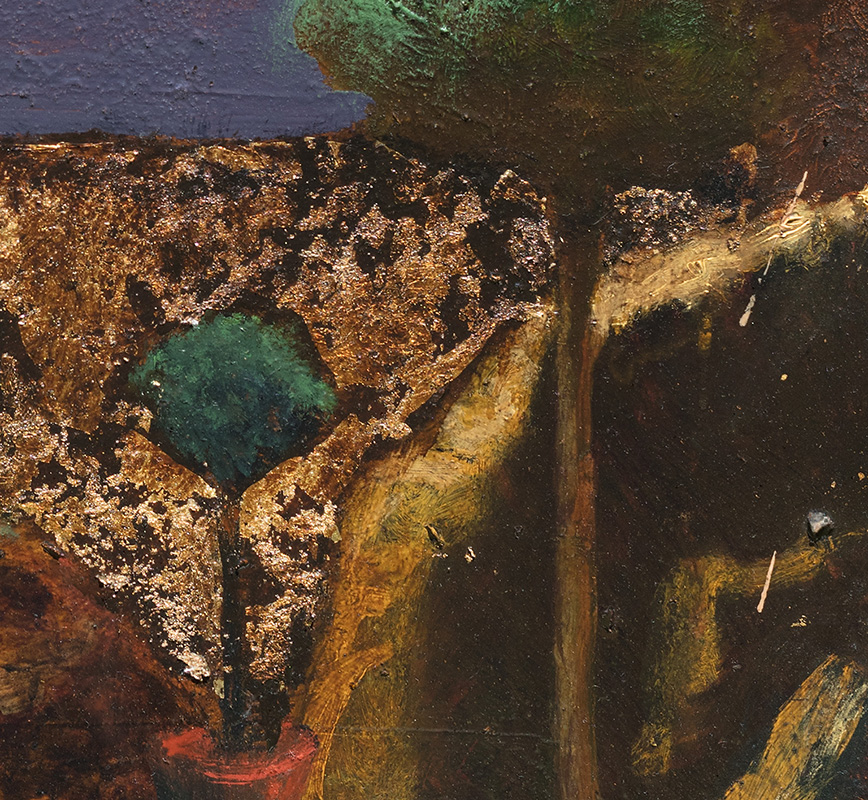
The fresco surface in this large horizontal canvas is darker and more nocturnal than much of Kitterle’s fresco work, the ground carrying heavy blues and blacks. Against it, the hanging objects glow: the white drapery, the gold-colored forms, a pale cloud-like shape near the center. The contrast between the darkness of the ground and the luminosity of the suspended objects creates the work’s central tension: things of value, held aloft by systems the painting cannot make visible.
Alexander Calder’s mobiles hold objects in precarious dynamic balance by forces the viewer cannot locate: the suspension is the subject. Kurt Schwitters’s Merz collages assembled fragments of economic and social life into precarious aggregates. Kitterle operates in the same conceptual territory as both, but through fresco: the materiality of the support giving the suspended objects a historical weight that paper fragments and wire cannot carry.