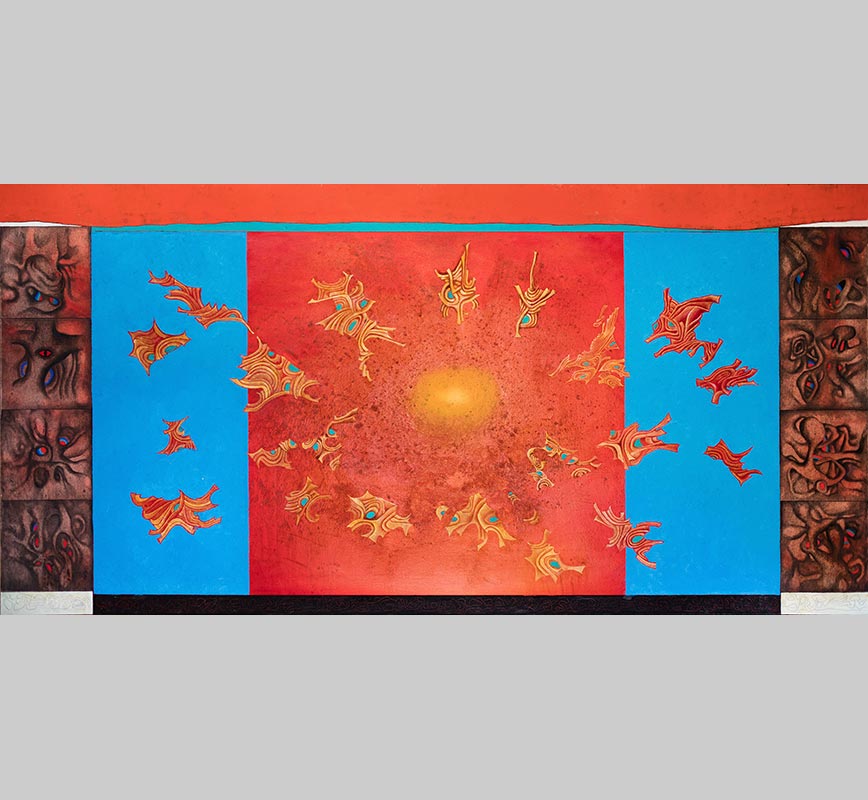
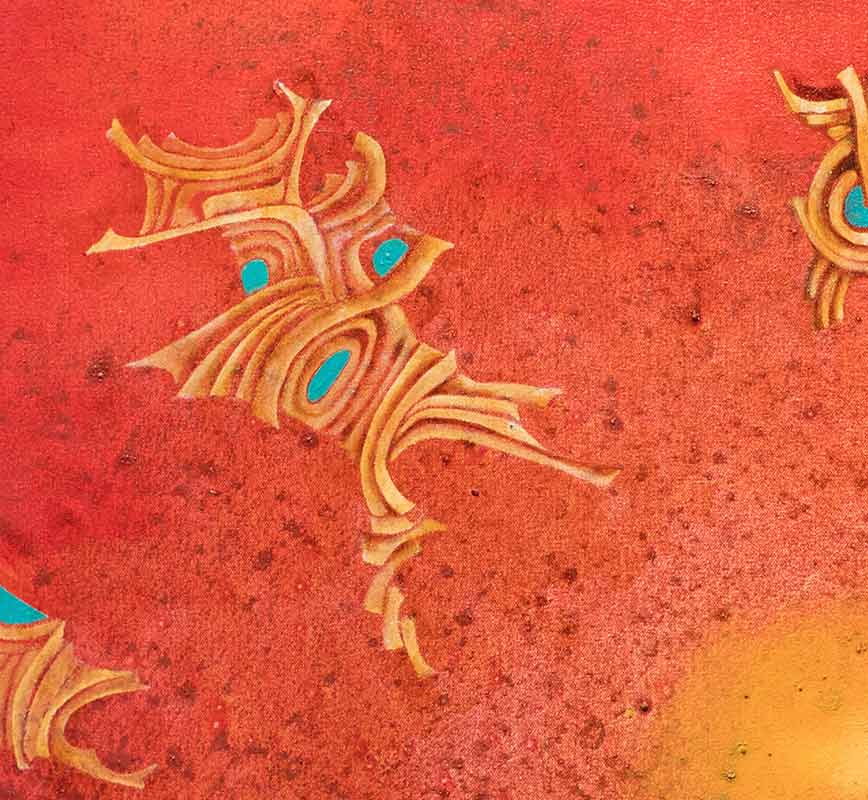
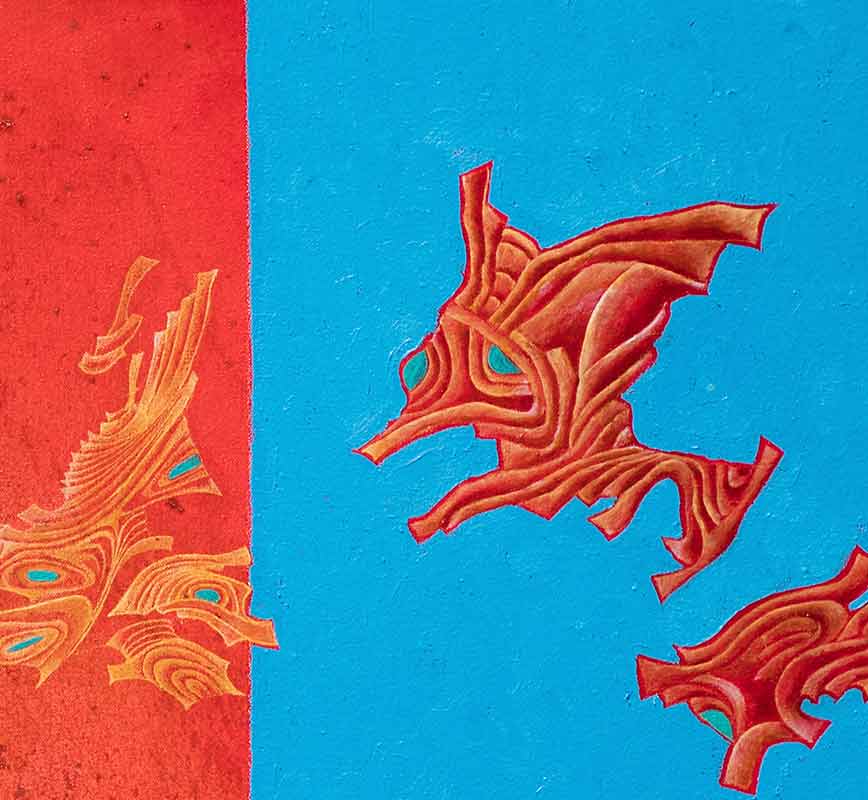
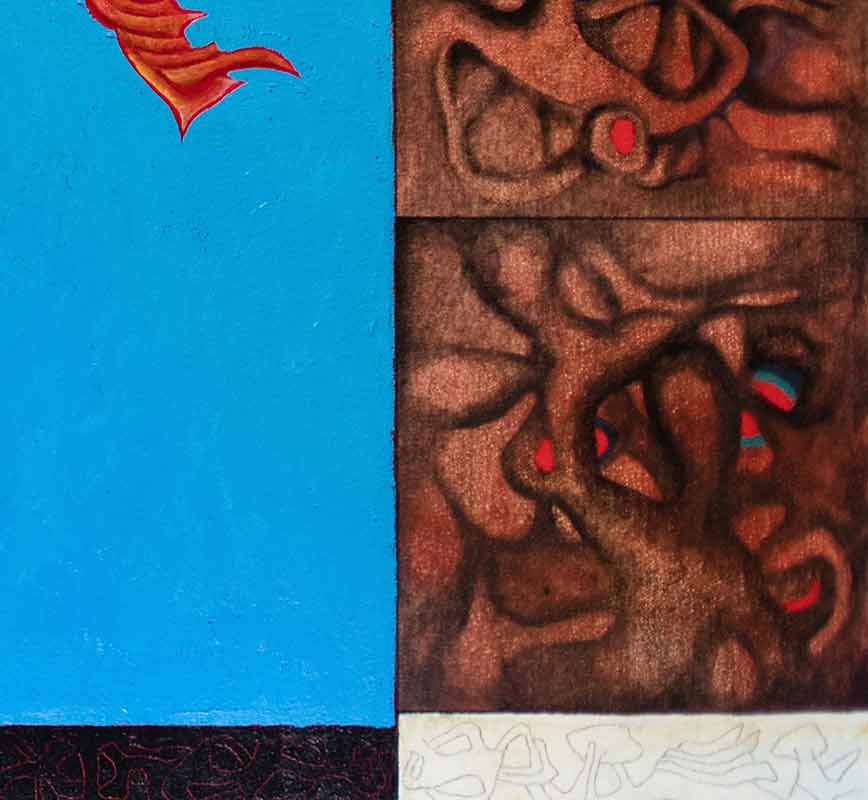
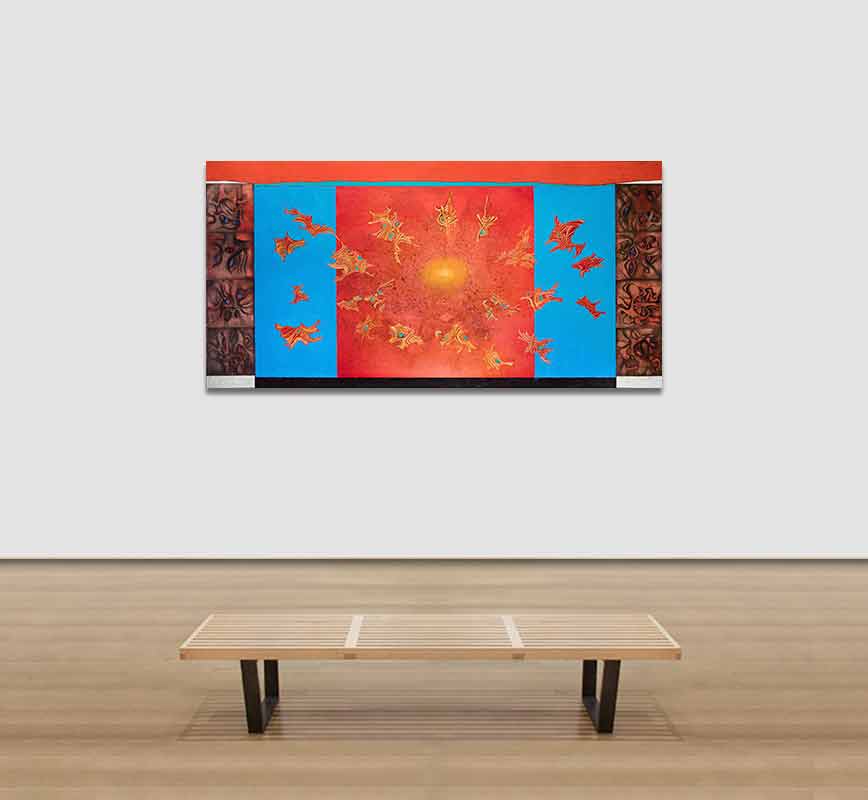
The surface of this 1993 canvas feels geological before it feels painted: dense, granular, pitted, built up the way rock builds up, not through a single gesture but through accumulation. Most of the field is warm brown to dark brown to near-black, the color of volcanic matter at different stages of cooling. But within this geological ground, at irregular intervals, concentrated chromatic events blaze: small biomorphic forms in iridescent blues, greens, and reds, each suggesting cellular life at the moment of its emergence.
The surface of this 1993 canvas feels geological before it feels painted: dense, granular, pitted, built up the way rock builds up, not through a single gesture but through accumulation. Most of the field is warm brown to dark brown to near-black, the color of volcanic matter at different stages of cooling. But within this geological ground, at irregular intervals, concentrated chromatic events blaze: small biomorphic forms in iridescent blues, greens, and reds, each suggesting cellular life at the moment of its emergence.
The bio-geomorphic vocabulary developed in Vanni's New York period draws on two sources that his formation made available to him: the volcanic geology of Kythira, where the island's physical character is inseparable from its mythological depth, and the parasitological training absorbed in childhood through his father's laboratory at the University of Rome, where hours at the microscope watching micro-organisms in continuous metamorphosis gave him a visual grammar in which the biological and the geological are interchangeable registers of the same underlying process.
The chromatic events blazing within the geological field do not carry the weight of catastrophe and its aftermath: they carry the opposite pressure, the first biological assertion within a continuum that would otherwise remain inert. This is an inversion of the philosophical orientation that Anselm Kiefer brought to surfaces of comparable geological and organic density, building matter as a bearer of historical weight. The biomorphic events here are not marks of aftermath but marks of emergence, specific rather than symbolic, biological rather than memorial. This specificity also separates them from the surfaces of Antoni Tapies, in which marks emerge from rough ground but remain symbolically open, available to multiple interpretations. Here they suggest actual phyla, as though the geological continuum is generating the first organisms rather than commemorating the last.