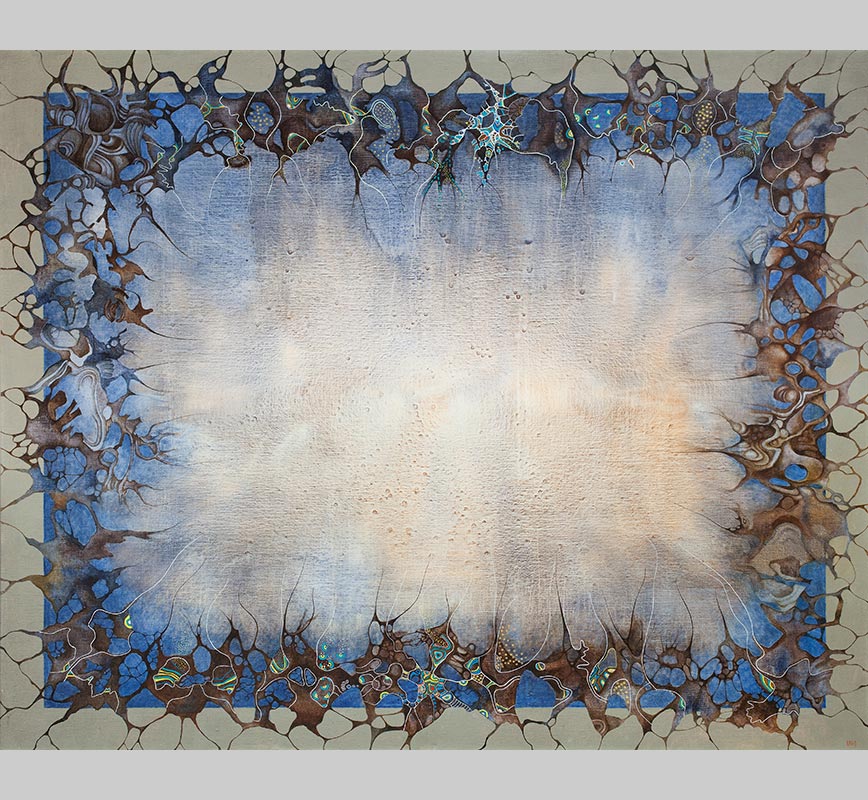
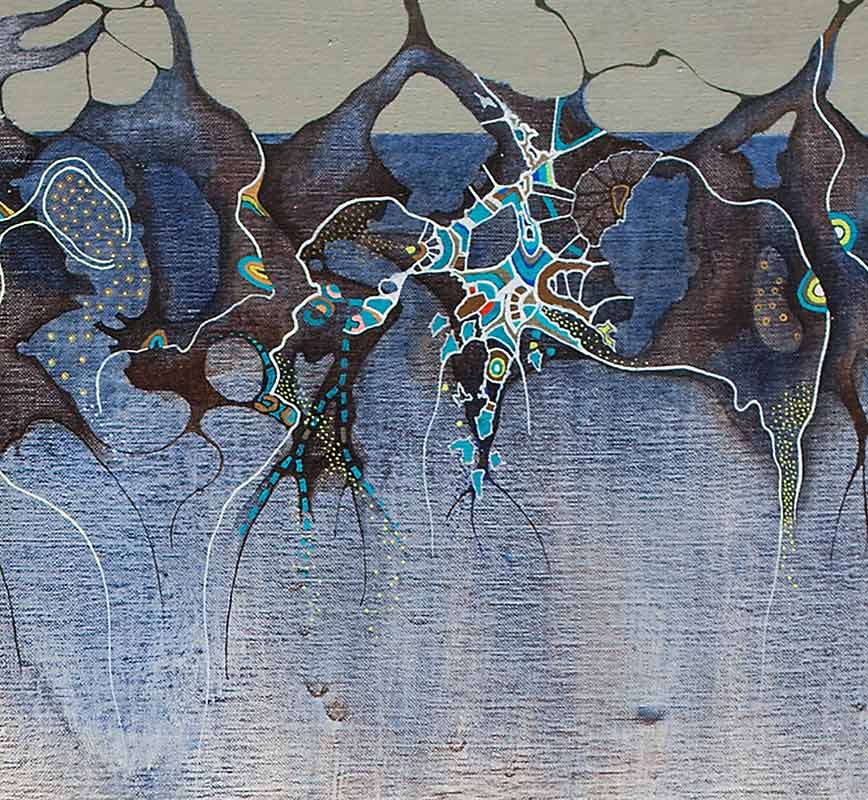
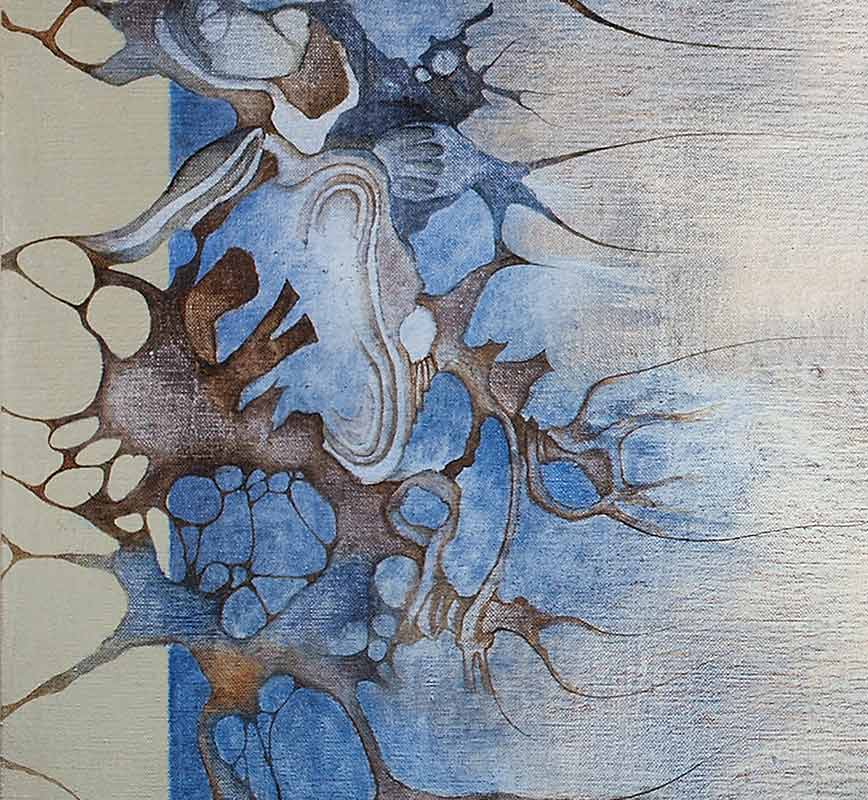
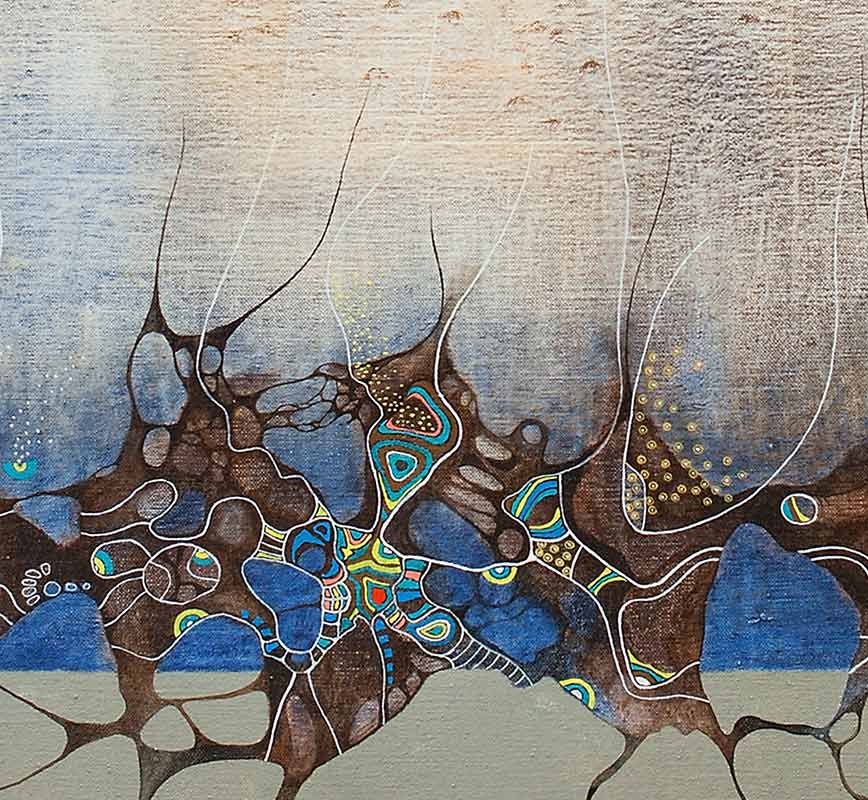
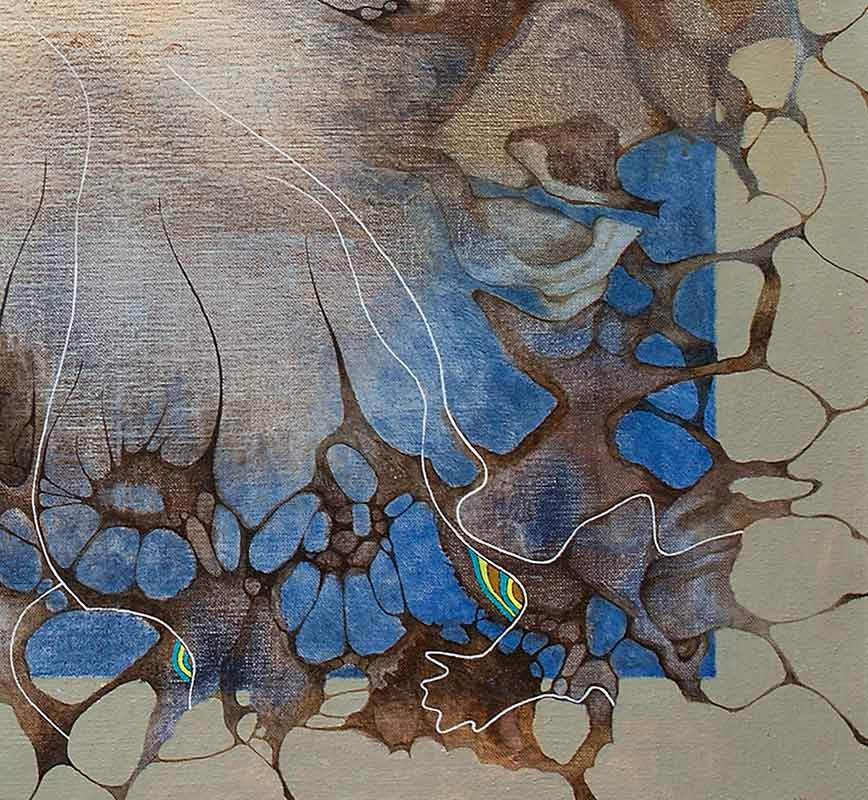
The center of this painting is a darkness surrounded by fire. A near-square field of deep brown-black, intricate with cellular and tectonic marks, occupies the middle of the canvas; around it, defined by a cornice-like painted border, a field of rich red carries dense biological forms in turquoise and teal. White shapes at the edges of the dark interior, stark and portal-like, interrupt the chromatic intensity with sudden clarity. The result is a painting that draws you in before you understand what you are entering.
The center of this painting is a darkness surrounded by fire. A near-square field of deep brown-black, intricate with cellular and tectonic marks, occupies the middle of the canvas; around it, defined by a cornice-like painted border, a field of rich red carries dense biological forms in turquoise and teal. White shapes at the edges of the dark interior, stark and portal-like, interrupt the chromatic intensity with sudden clarity. The result is a painting that draws you in before you understand what you are entering.
The painted inner frame, developed from the mid-1980s onward, is the structural mechanism of the composition: not a decorative border but a formal device that simultaneously defines a spatial field and undermines it. What is in front and what is behind? The cornice appears to place the dark interior behind the red surround, but the white portal-shapes at the dark interior's edge make it clear that behind is fully inhabited: richly complex, formally operational as a world.
The cellular bio-geomorphic forms that populate both registers carry a specific lineage. Vanni spent his childhood observing micro-organisms through his father's microscope at the University of Rome, watching cells in continuous metamorphosis. His later encounter with Ernst Haeckel's structural analysis of natural forms confirmed that biological and mineral structures share the same deep visual grammar.
The cellular marks carry their own structural intelligence, neither representational nor purely abstract: each one is complete, weighted, precise. This is the same investigation Paul Klee pursued across a lifetime, the organic form as a self-sufficient visual unit. But it is conducted in different material conditions: where Klee worked with the delicacy of watercolor on paper, these marks are built in impastoed oil on large canvas, carrying the weight of geology rather than the transparency of the watercolor sheet.