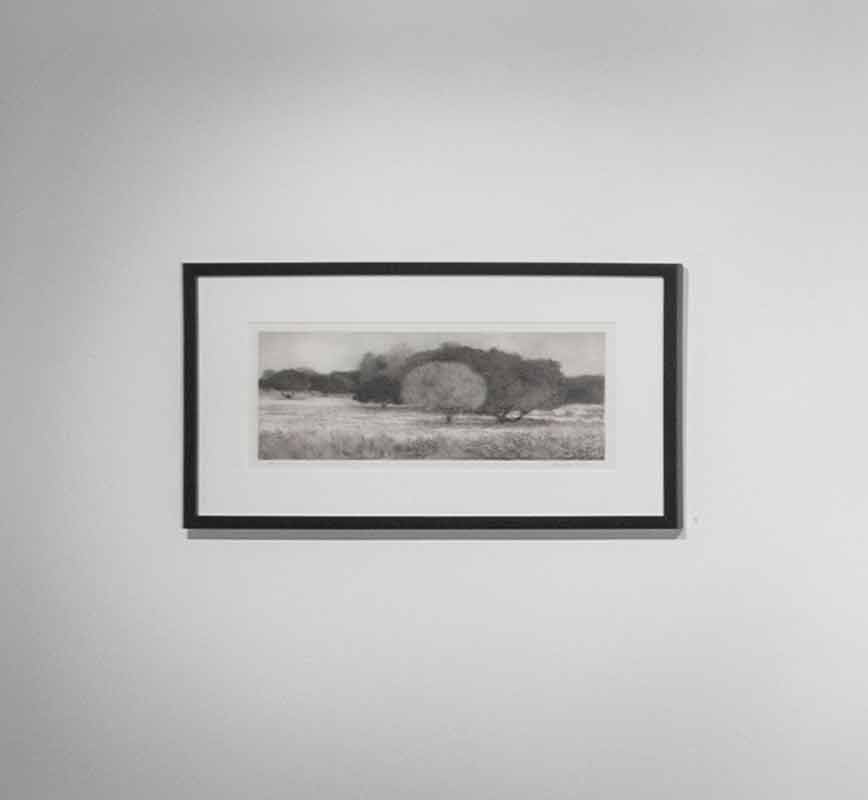
A tall cypress stands in the foreground, its dark vertical mass at the center of the composition, the hill and distant landscape receding in layers of grey and ochre behind it. Tzannes made this in acrylic, charcoal, and chalk on canvas, and the addition of acrylic introduces a warm ochre tone to the middle-distance hill: a single note of color, restrained and specific, giving the recession a depth and warmth the monochrome register alone could not achieve.
A tall cypress stands in the foreground, its dark vertical mass at the center of the composition, the hill and distant landscape receding in layers of grey and ochre behind it. Tzannes made this in acrylic, charcoal, and chalk on canvas, and the addition of acrylic introduces a warm ochre tone to the middle-distance hill: a single note of color, restrained and specific, giving the recession a depth and warmth the monochrome register alone could not achieve.
Caspar David Friedrich used solitary trees as surrogates for his back-turned figures: the lone vertical at the threshold between foreground and recession, intercepting the viewer's gaze before transmitting it outward. The cypress here operates in precisely that way, axial and dark. The mythology it carries, funereal, the vertical between the living and the dead, is what it holds.
The cypress has been the Mediterranean's funereal tree since antiquity, vertical and dark, associated with mourning and the threshold between the living and the dead. Tzannes's treatment carries that resonance without announcing it. The tree is formal first: a compositional hinge. Vija Celmins, whose graphite drawings reduce ocean and desert to pure tonal field, pursues a related discipline: the fewer descriptive facts, the more the surface of the world comes forward. The mythology here is what the form already holds.