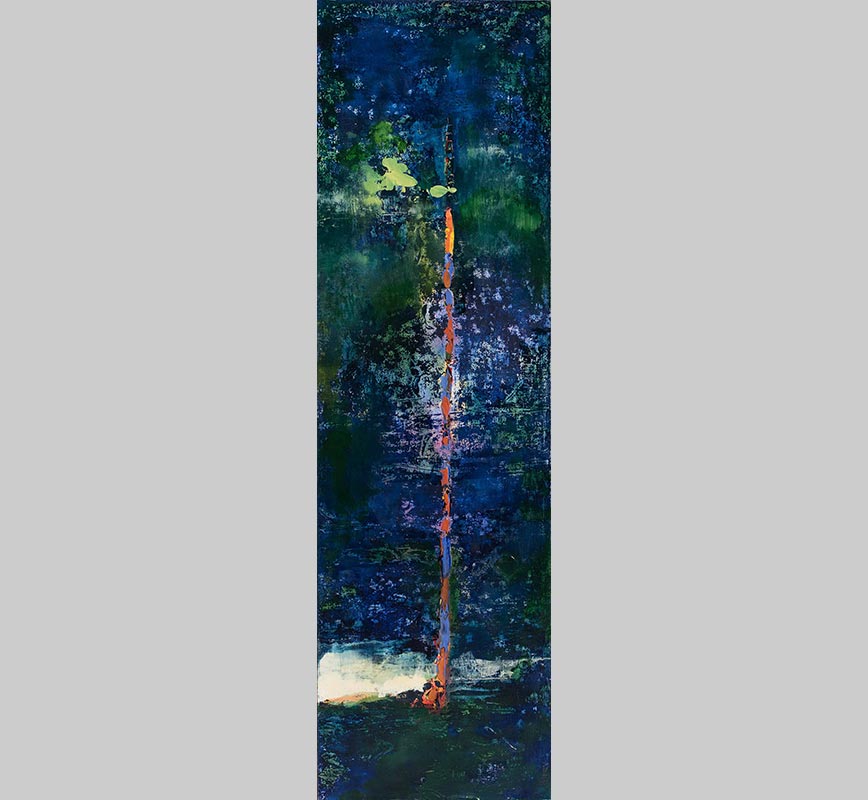
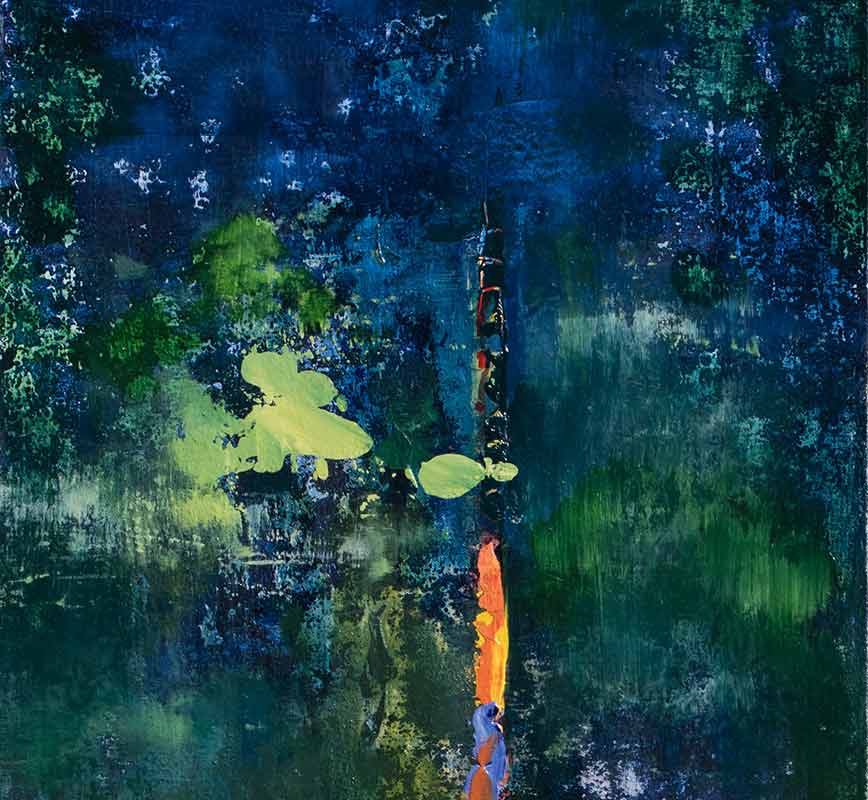
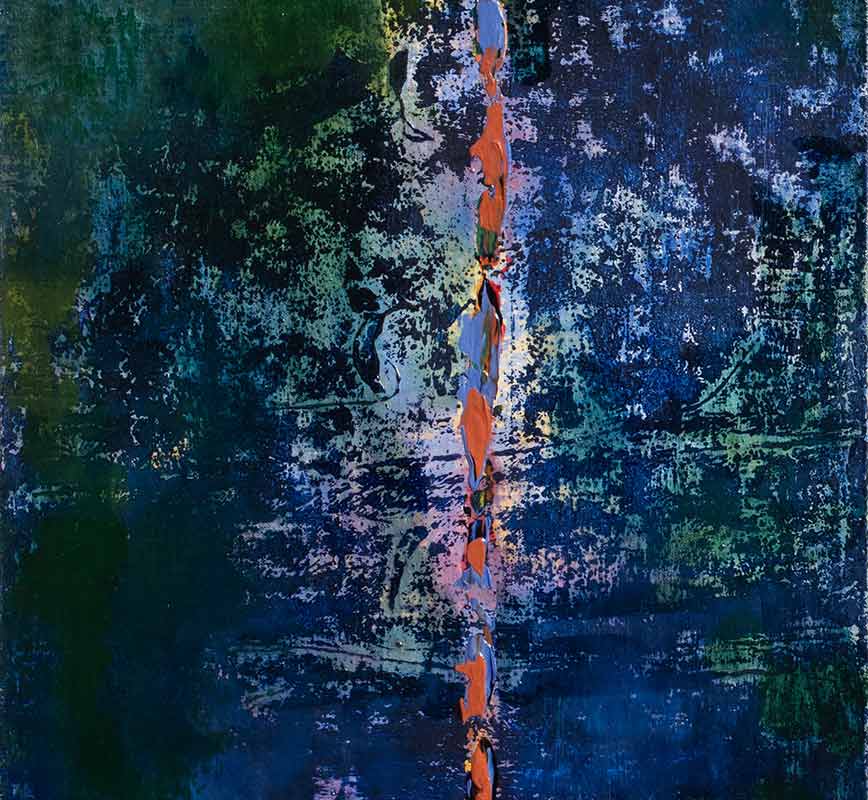
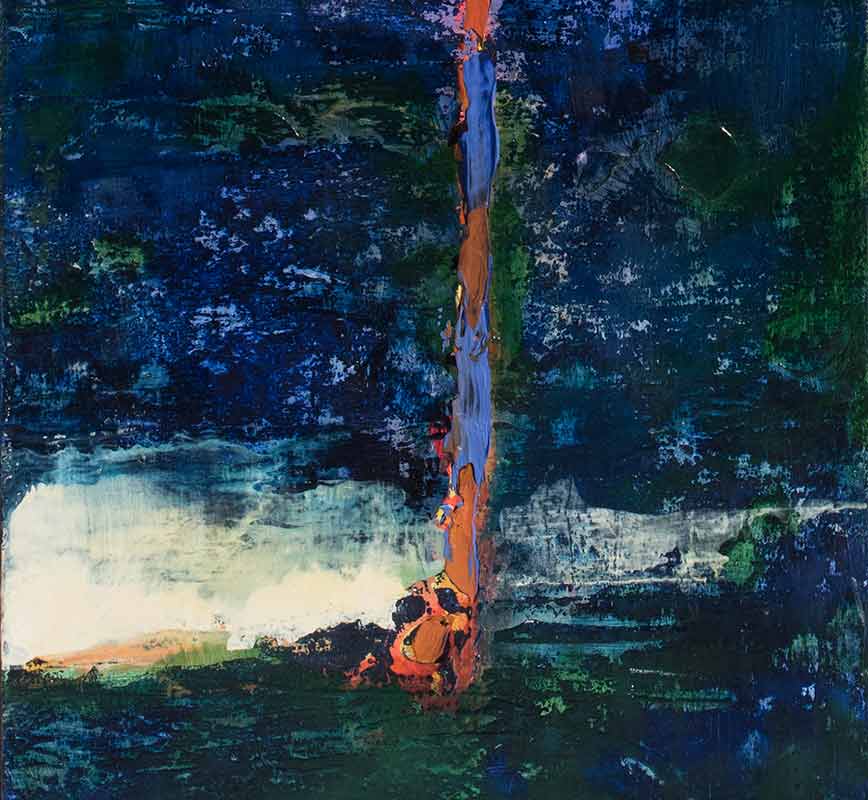
The figures in Brighter Days extend across nearly the full width of the canvas, a low procession of silhouettes advancing toward a horizon where orange and pale yellow light breaks through the gray. This is a painting about collective forward motion: no individual faces, no diverging directions, only the pressing onward into a space that remains, despite the warmth opening above, genuinely uncertain. The dark vertical passages rising behind the figures could be architecture or weather: they offer no resolution in either direction.
The figures in Brighter Days extend across nearly the full width of the canvas, a low procession of silhouettes advancing toward a horizon where orange and pale yellow light breaks through the gray. This is a painting about collective forward motion: no individual faces, no diverging directions, only the pressing onward into a space that remains, despite the warmth opening above, genuinely uncertain. The dark vertical passages rising behind the figures could be architecture or weather: they offer no resolution in either direction.
Petrov uses monumental, undifferentiated space and faceless figures to generate emotional force that is collective rather than individual, a register Anselm Kiefer established as central to postwar European painting. But the differences are clarifying: Kiefer’s figures move through spaces whose historical and mythological freight is specified, named, written on the canvas. Petrov’s environment carries no such designation, only weight, distance, and a spatial condition that resists narrative anchoring.
The chromatic logic is telling: the warm traces of orange and yellow in the upper field are not decoration but argument. Where the palette holds monochrome, the figures have no promise; where it begins to warm, something is withheld rather than granted. The paint handling throughout is consistent with Petrov’s abstract work: the figures themselves are not delineated but atmospheric, as if assembled from the same layered material as the environment they move through.