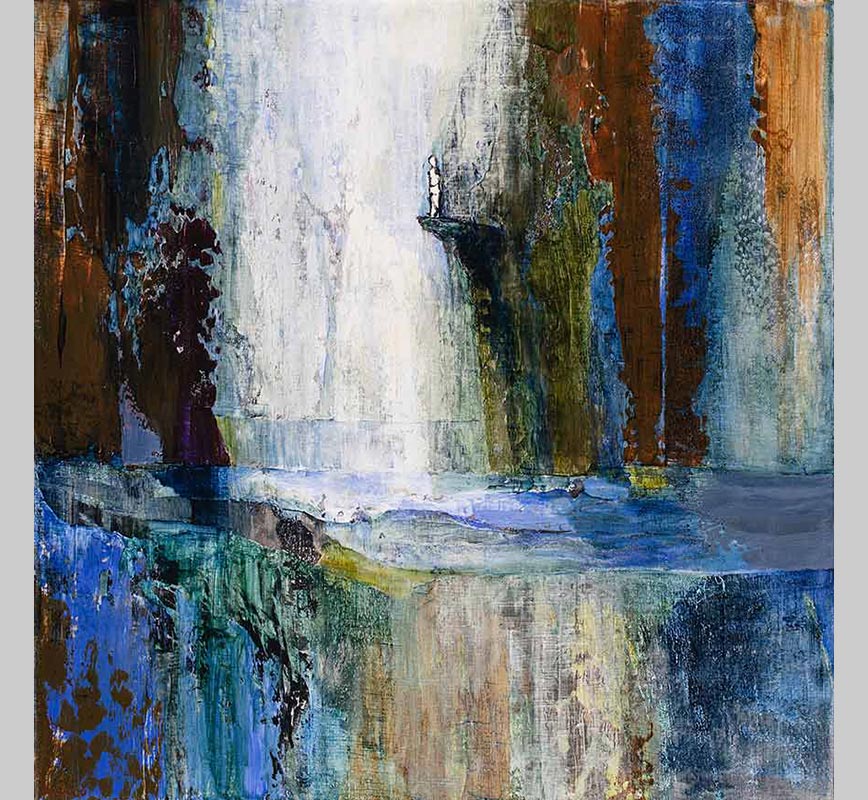
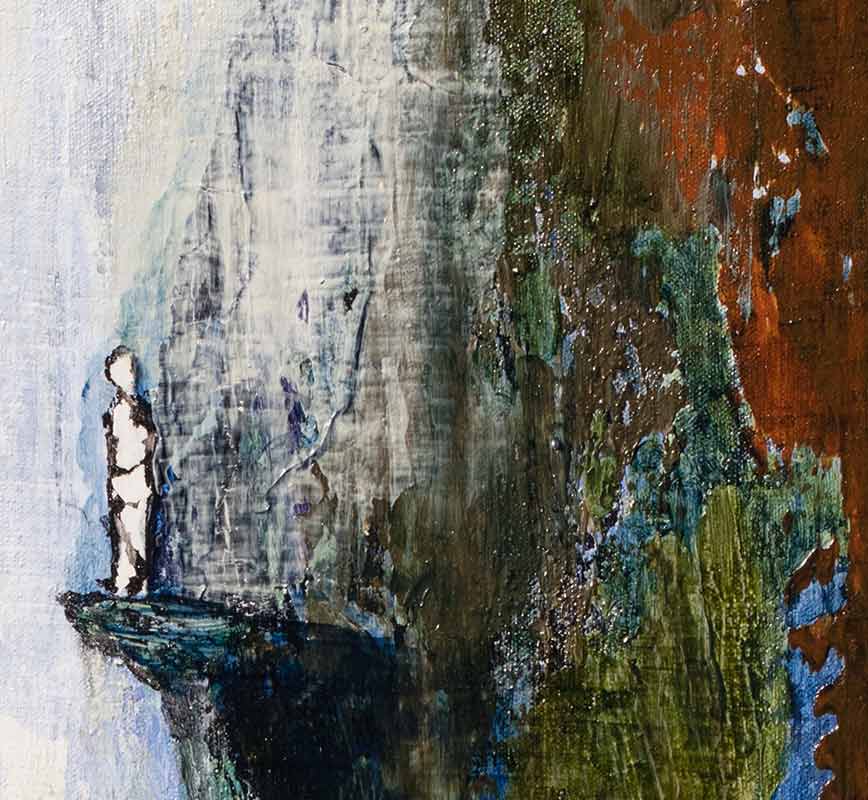
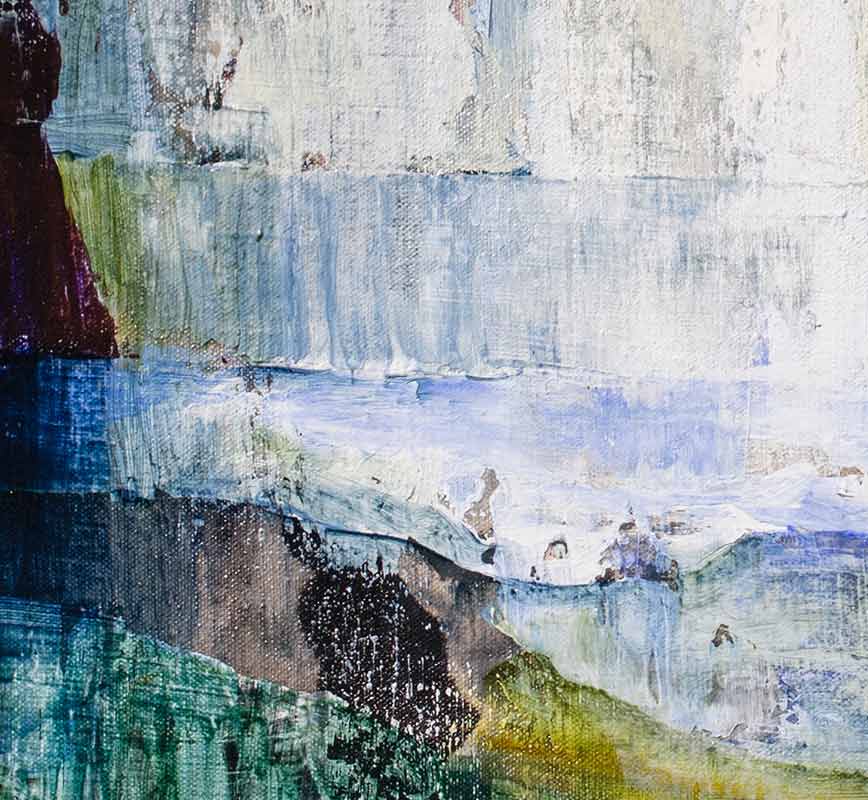
Gates of Memory introduces a compositional structure unique in Petrov’s work: the canvas is organized as a grid, four large quadrants divided by deep crack-like marks, their edges neither perfectly straight nor arbitrarily broken. Within each quadrant, soft blues, grays, and ochres accumulate in the atmospheric way characteristic of Petrov’s surfaces, but the grid imposes a different logic, one of compartmentalization, of memory as filed rather than continuous. Through the cracks, orange and red intrude.
Gates of Memory introduces a compositional structure unique in Petrov’s work: the canvas is organized as a grid, four large quadrants divided by deep crack-like marks, their edges neither perfectly straight nor arbitrarily broken. Within each quadrant, soft blues, grays, and ochres accumulate in the atmospheric way characteristic of Petrov’s surfaces, but the grid imposes a different logic, one of compartmentalization, of memory as filed rather than continuous. Through the cracks, orange and red intrude.
Gates of Memory invites comparison to Sean Scully’s stripe paintings, where repetition carries emotional weight, but the comparison clarifies what Petrov is doing differently. Scully’s grid is architectural and assertive, built to endure. Petrov’s is already damaged: the crack-marks read as formal elements that introduce sharpness into the atmospheric surface, and as content proposing that memory’s architecture is fissile, subject to forces it cannot anticipate.
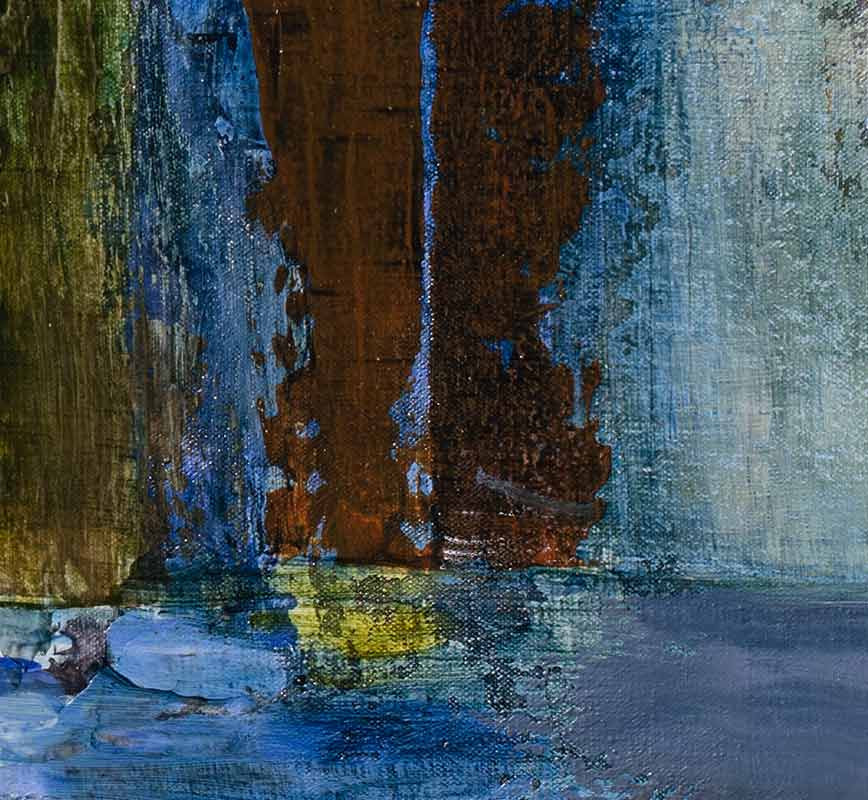
The orange and red showing through the cracks are not decoration: they are the warm substrate glimpsed through the cool surface, the emotional temperature of what lies beneath the organized field. The title’s gates are not open but breached, thresholds crossed under pressure rather than passed through by invitation.