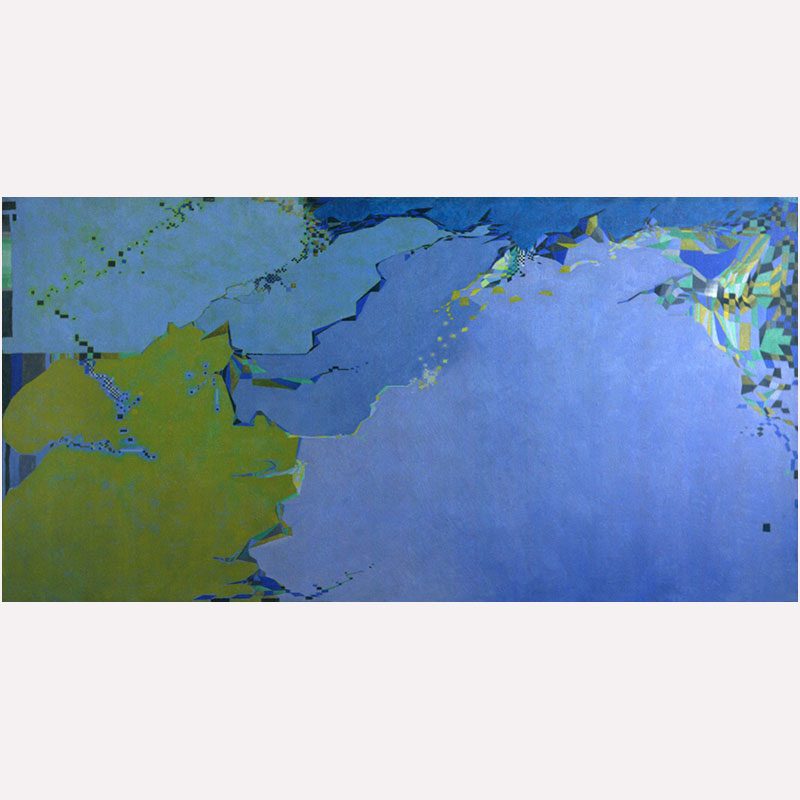
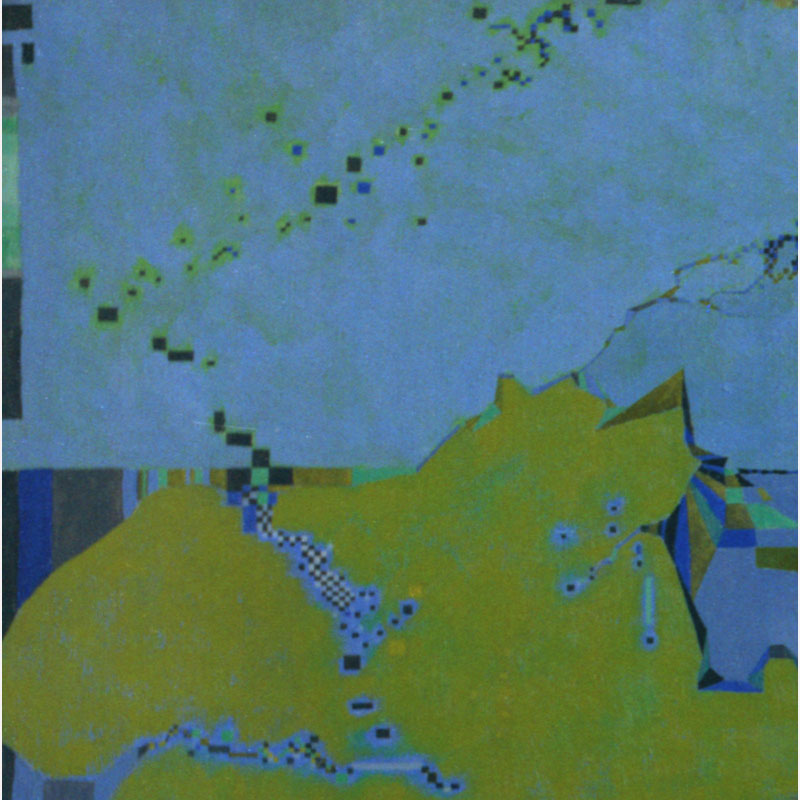
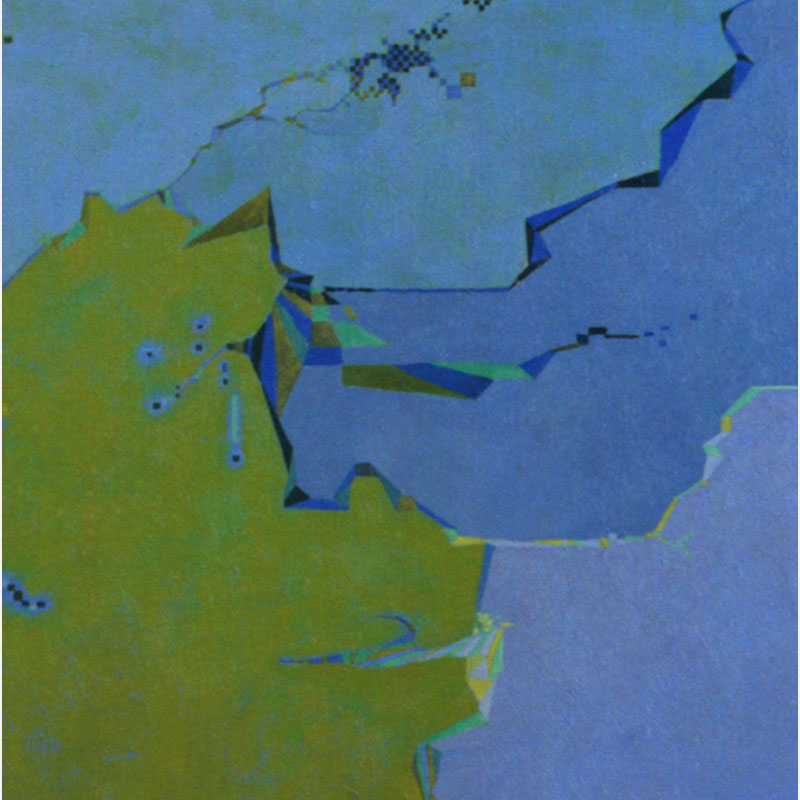
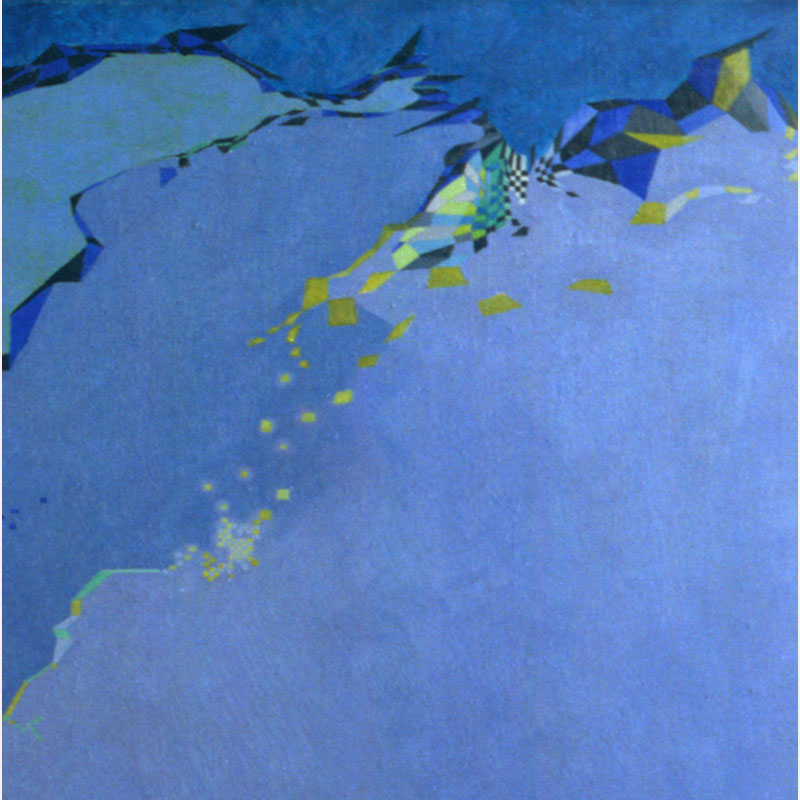
In Coste [Coasts], Vanni extends the principle of spatial dispersion developed in the preceding years, with a new emphasis on horizontal sweep and compositional openness. A vast field of desaturated periwinkle blue spans the right half of the painting, not as backdrop but as an autonomous surface, subtly inflected by tonal modulations. The periphery bristles with activity: clusters of green, yellow, and aquamarine tesserae gather along the top, left, and right borders, forming lattice structures and pixelated arcs.
In Coste [Coasts], Vanni extends the principle of spatial dispersion developed in the preceding years, with a new emphasis on horizontal sweep and compositional openness. A vast field of desaturated periwinkle blue spans the right half of the painting, not as backdrop but as an autonomous surface, subtly inflected by tonal modulations. The periphery bristles with activity: clusters of green, yellow, and aquamarine tesserae gather along the top, left, and right borders, forming lattice structures and pixelated arcs.
These small chromatic events operate as zones of rupture, as if the plane were being peeled or frayed outward. At the margins, color intensifies, gaining in saturation and contrast. Toward the center, the blue softens into pale lavender and lilac, evoking a zone of suspension, like a sky between storms or a sea at rest.
While Vanni's luminous fields recall the chromatic expanses of Color Field painting, his approach differs fundamentally: scale and precise, pixel-like articulations create tension within the dialogue between form and field, rather than relying on immersive color alone. The title, Coste, frames the painting as a meditation on thresholds: not land or water, but the place where the two meet and influence each other. It is a painting of transition, where solidity gives way to atmosphere, and structure dissolves into radiant stillness.