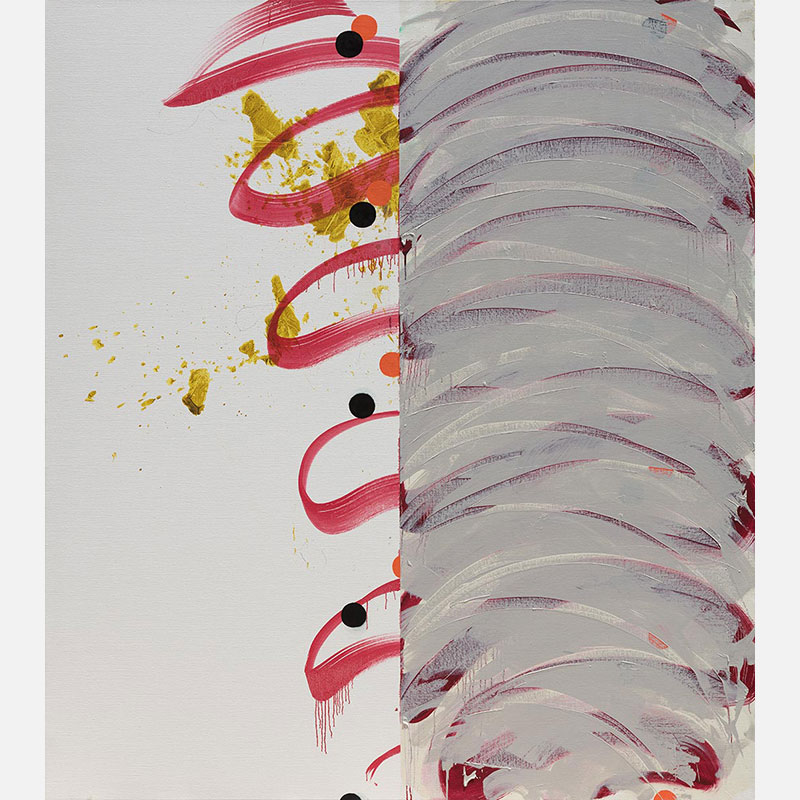
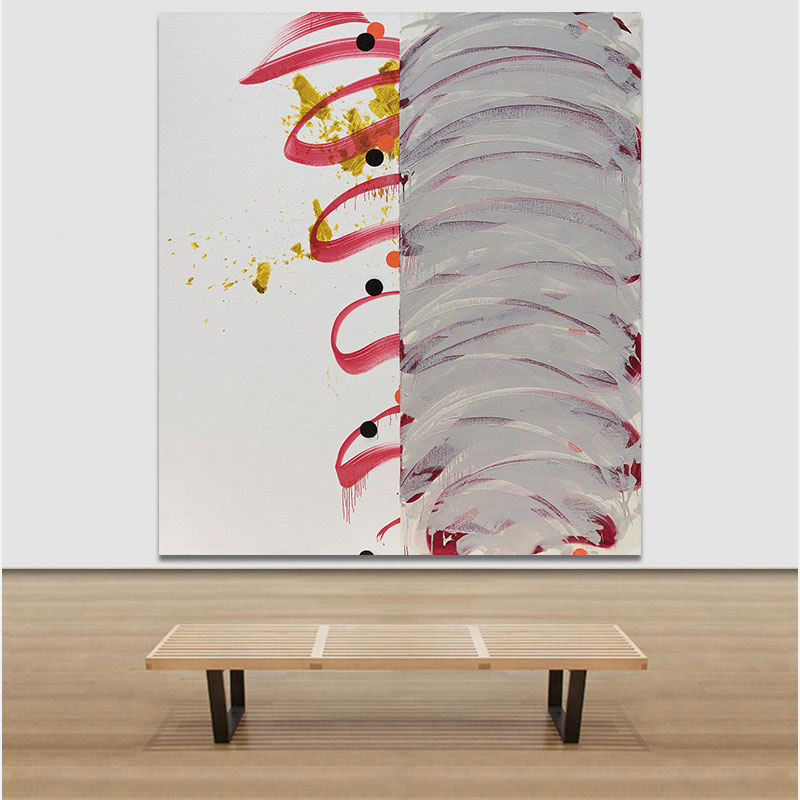
A seam divides this large canvas into air and weather. On the left, bare white holds crimson ribbons that loop and turn over like a brush caught mid-flight, trailing drips and a spray of gold flecks. On the right, grey paint is dragged in stacked arcs, thick enough to ridge, with maroon glowing through the gaps. A column of black and orange dots stitches the join. There is exhilaration, and some recklessness, in the way one half stays open and the other packs tight.
A seam divides this large canvas into air and weather. On the left, bare white holds crimson ribbons that loop and turn over like a brush caught mid-flight, trailing drips and a spray of gold flecks. On the right, grey paint is dragged in stacked arcs, thick enough to ridge, with maroon glowing through the gaps. A column of black and orange dots stitches the join. There is exhilaration, and some recklessness, in the way one half stays open and the other packs tight.
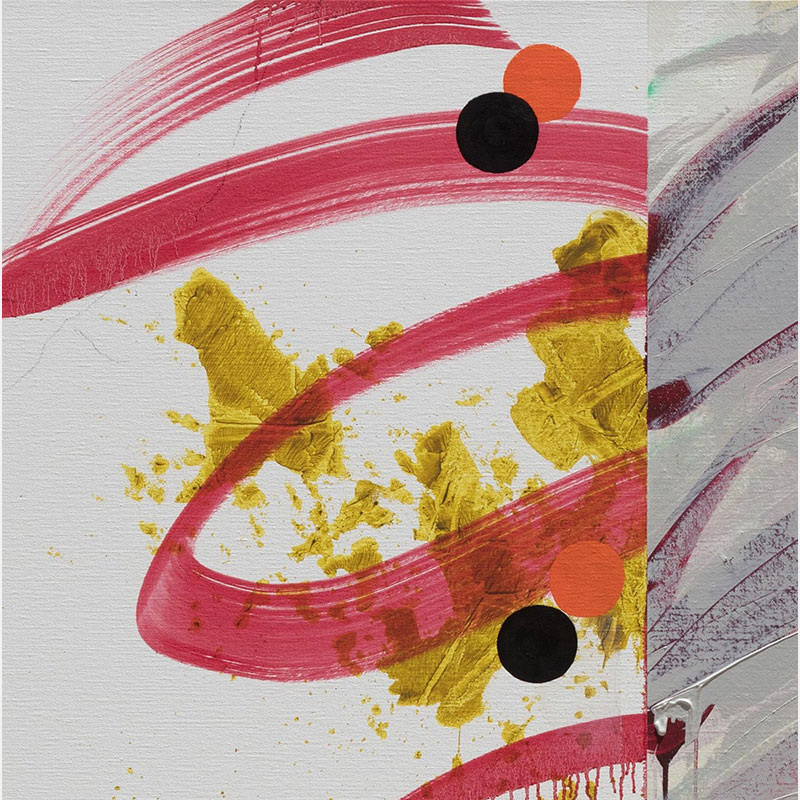
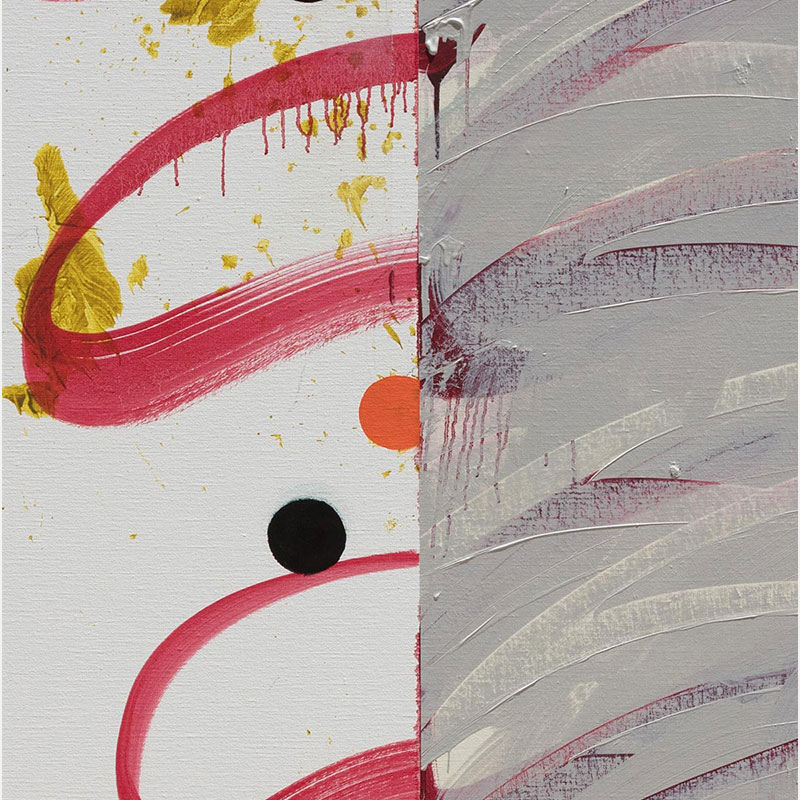
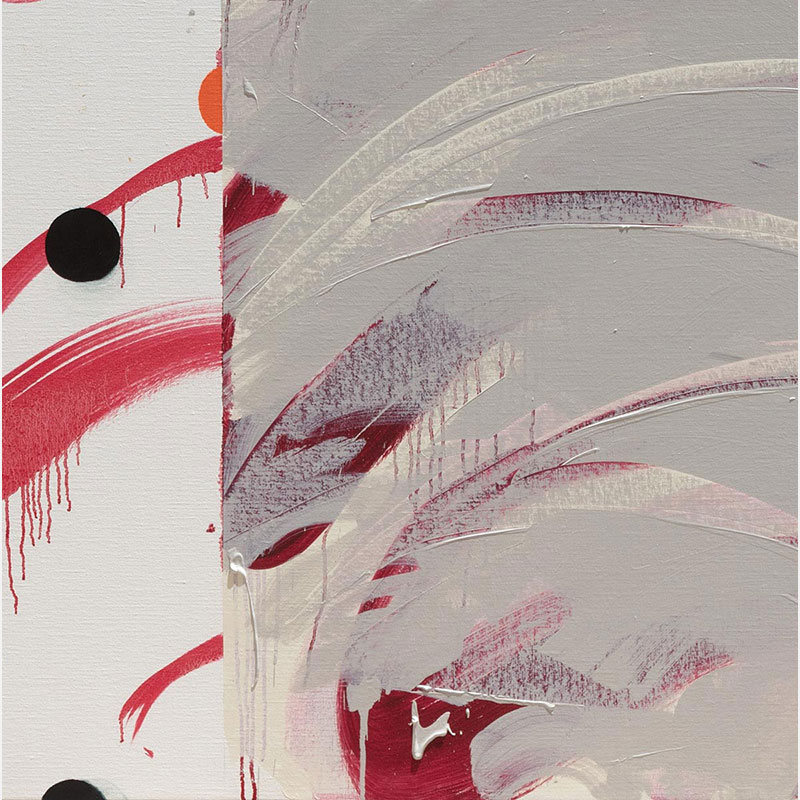
The ribbons are single wide-brush strokes. Each swells and narrows where the brush turns over, and the lower ones trail drips. The gold lands in thick flung clots and thins to a spray that runs back toward the left, so the direction of the throw stays legible. On the right the arcs stack from top to bottom, each overlapping the last, and the grey reads as strata, a history of strokes lying flat. The dots hold their column against all of it.
The join sets two durations against each other, a few decisive turns on white and a long layering on grey. The gold and the dots are spread over the ribbons, so the left half is made of distribution as much as of line. Alongside the floor distributions of the American artist Barry Le Va, where scattering across a surface is itself the form, the left half reads as an event arrested at the seam. The right half records its strokes one by one.