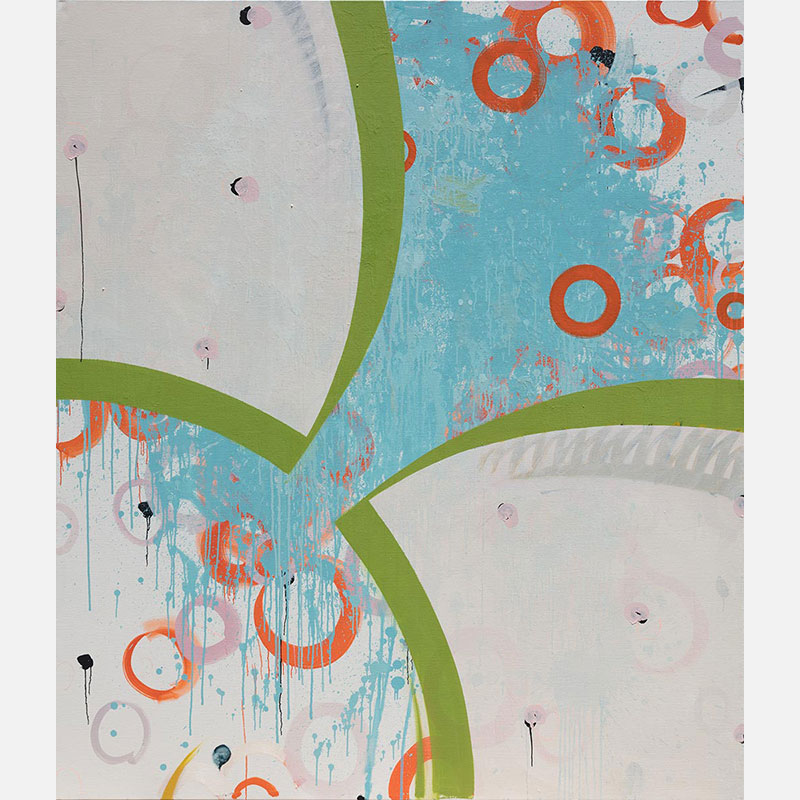
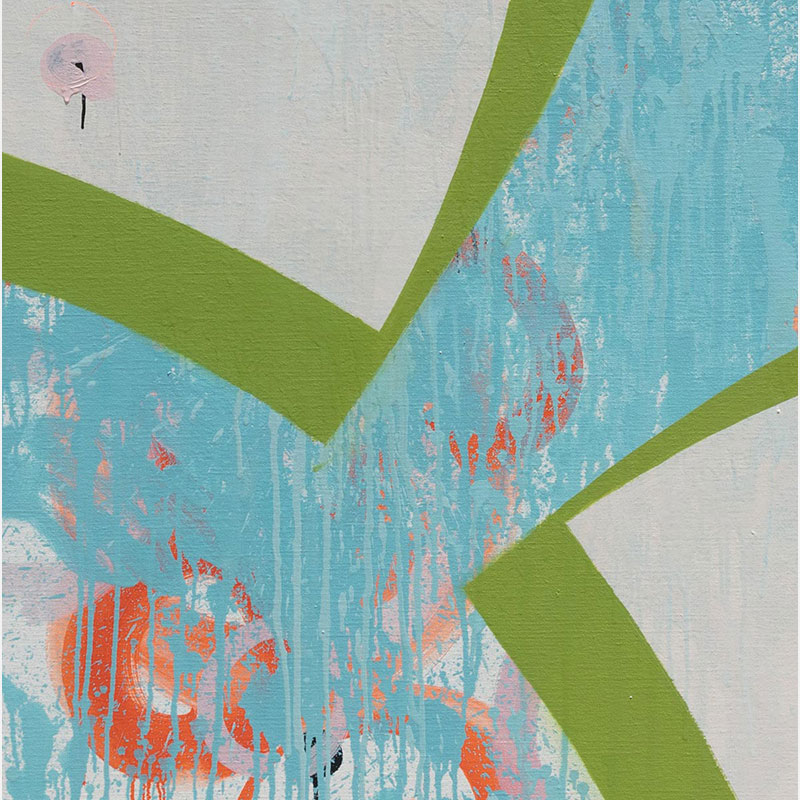
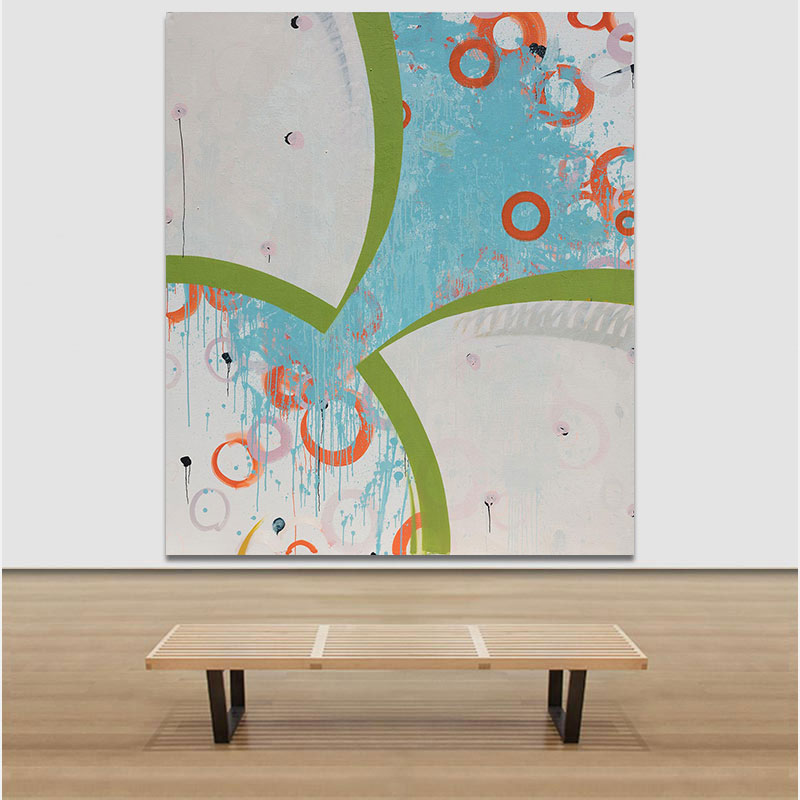
Three pale fields meet at a hard olive junction, and turquoise breaks across the join in a pour that runs and spatters down the canvas. Orange rings pile up like thrown hoops, with paler lilac ones hovering behind them, while small pink dots hold thin black threads in the open white. Edge and spill share the surface, bright, wet and precarious. Only the olive node holds it together, and the mood is festive and unsteady.
Three pale fields meet at a hard olive junction, and turquoise breaks across the join in a pour that runs and spatters down the canvas. Orange rings pile up like thrown hoops, with paler lilac ones hovering behind them, while small pink dots hold thin black threads in the open white. Edge and spill share the surface, bright, wet and precarious. Only the olive node holds it together, and the mood is festive and unsteady.
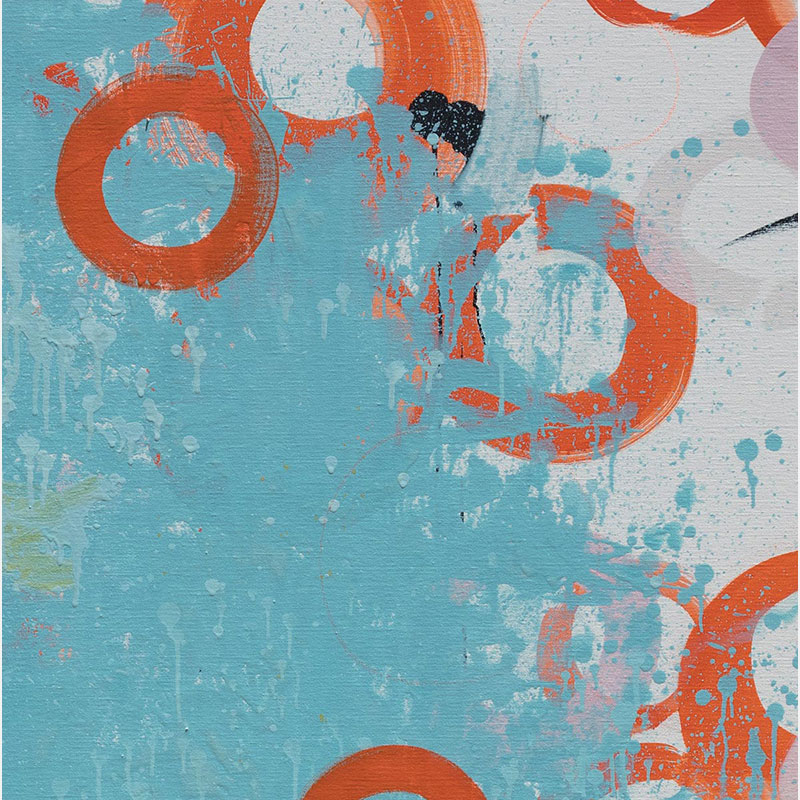
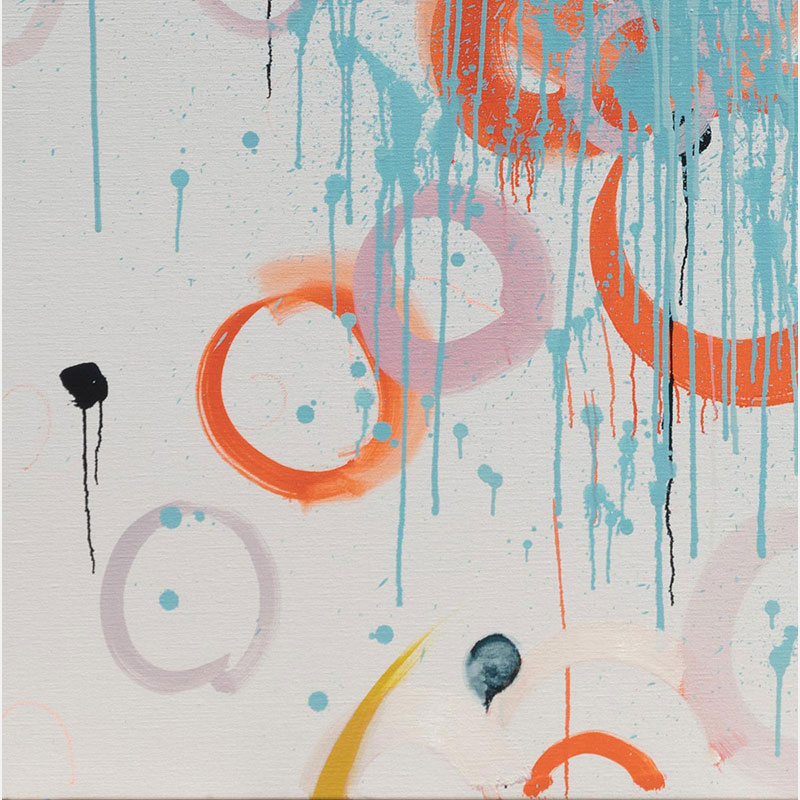
The olive arcs are the firmest decisions here, broad strokes of uniform width that stop against one another at a point. The turquoise behaves differently. It lands as a heavy mass in the middle and hangs long drips below, while fine spatter crosses the rest of the surface. The orange rings read as a loaded brush turned in place, some doubled, some broken. A comb of grey hatching sits at the top of the lower right field, where a stroke becomes a ladder.
The pour lands heavy near the middle and drags its drips downward in long threads, so the picture has a top and a bottom that cannot be swapped. Next to the paintings of Robert Slutzky, the olive junction holds still while the paint falls. Slutzky treated dripping as the sign of gravity and compared the pull of his top-heavy forms to "pulling down a window shade."