Seven individuals sit beneath a glossy billboard advertising Vogue eyewear, each absorbed in a private ritual of waiting. Above them, models gaze outward with poised detachment. Below, one man returns our gaze, staring directly at the camera, sitting just beneath a model whose expression mirrors his own and forming a quiet and unsettling dyad. A boy beside him, clad in a Michael Jackson sweatshirt, becomes the hinge between these two realms.
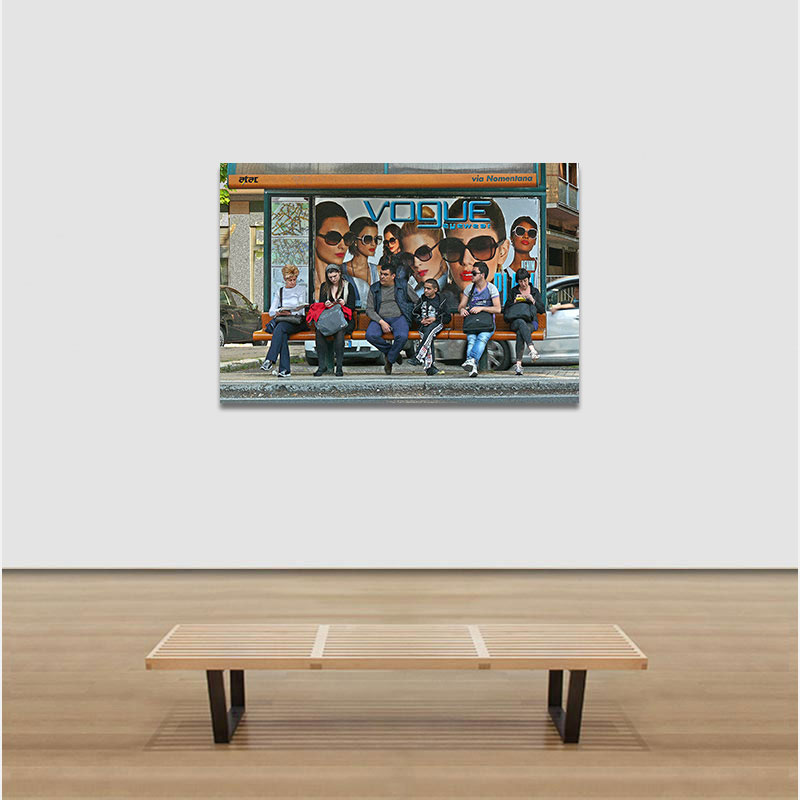
Seven individuals sit beneath a glossy billboard advertising Vogue eyewear, each absorbed in a private ritual of waiting. Above them, models gaze outward with poised detachment. Below, one man returns our gaze, staring directly at the camera, sitting just beneath a model whose expression mirrors his own and forming a quiet and unsettling dyad. A boy beside him, clad in a Michael Jackson sweatshirt, becomes the hinge between these two realms.
Ragazzini captures a fragile balance between reality and illusion, orchestrating a tableau where presence and projection collapse into a single pictorial surface. The glamour of fashion and the weariness of routine coexist without resolving: neither diminishes the other, and the image refuses to declare a winner.
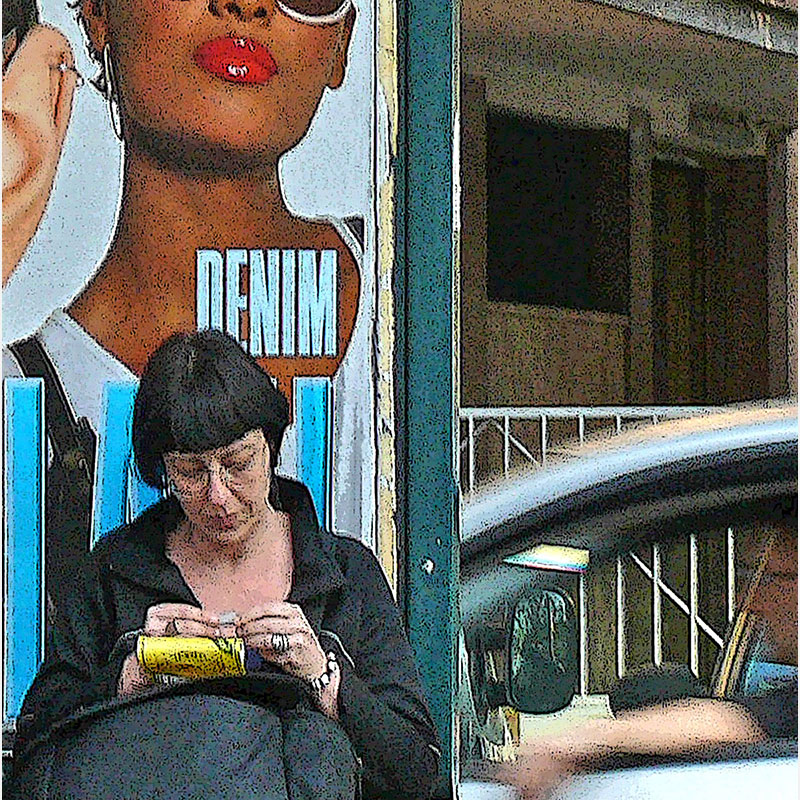
By extracting linear detail and emphasizing tonal contrast, the artist gives the composition a tactile strength that recalls the stark graphic power of Expressionist woodcuts. The blunt frontal framing and emotional restraint carry the legacy of New Objectivity: an unflinching aesthetic that resists sentiment and refuses to beautify the awkward. The man staring into the camera from beneath his advertising double is not a symbol; he is a person who happened to be sitting there when the world arranged itself into meaning. Cesare Zavattini argued that the most powerful subject was the twenty-four hours in the life of an ordinary person, observed without mediation or dramatic punctuation. This image is that argument in a single frame.
In Waiting for Godot, Enzo Ragazzini reveals the quiet dramas of urban life, where public spaces become stages of fatigue, isolation, and longing. Turning his lens on people waiting in Rome, he captures the collision between real bodies and glossy fantasies; moments where individuals remain disconnected beneath advertisements promising beauty, success, and a life just out of reach.