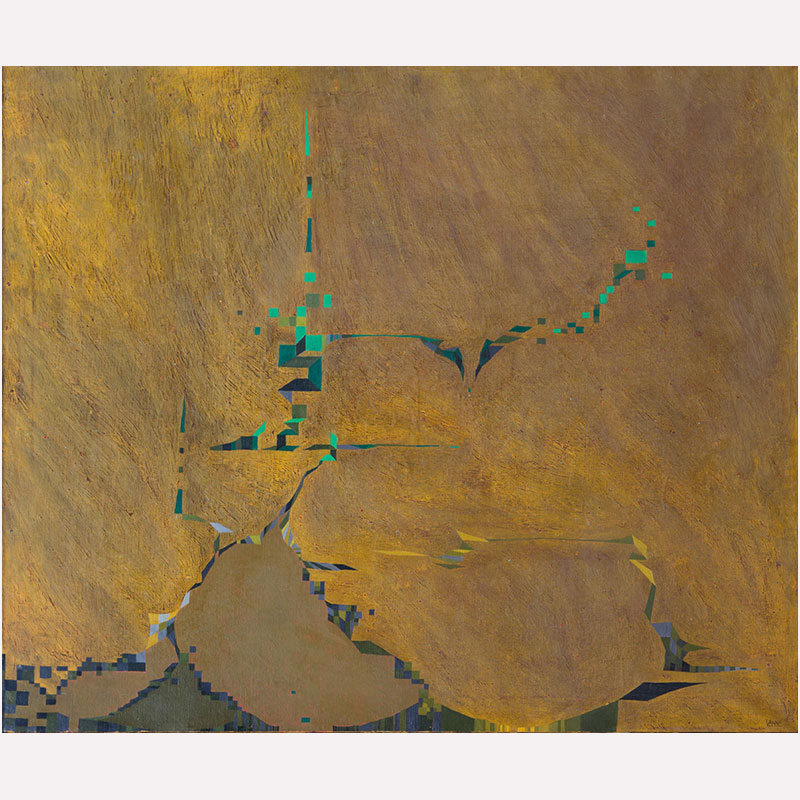
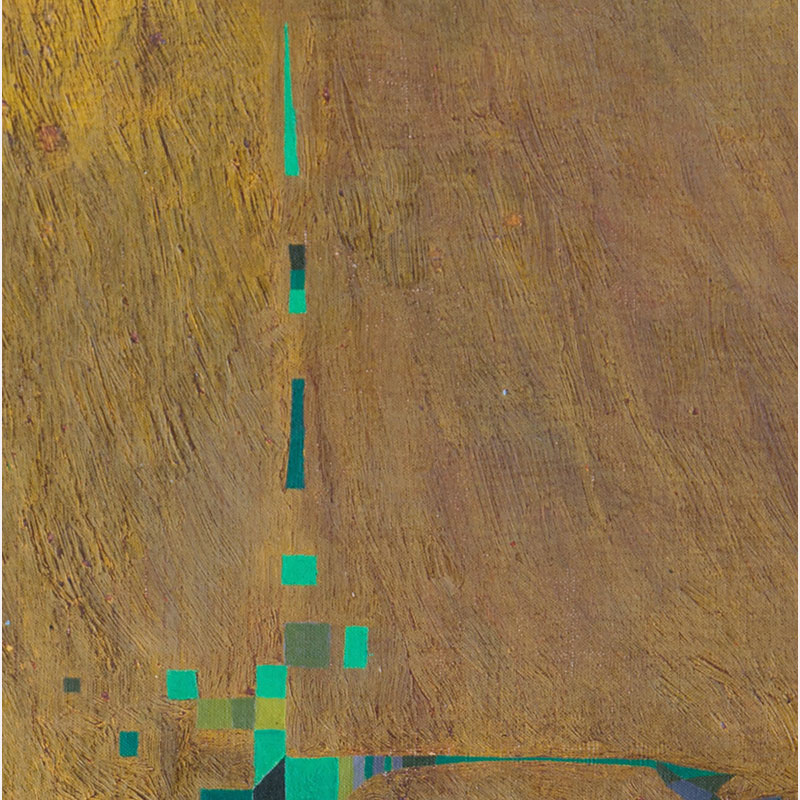
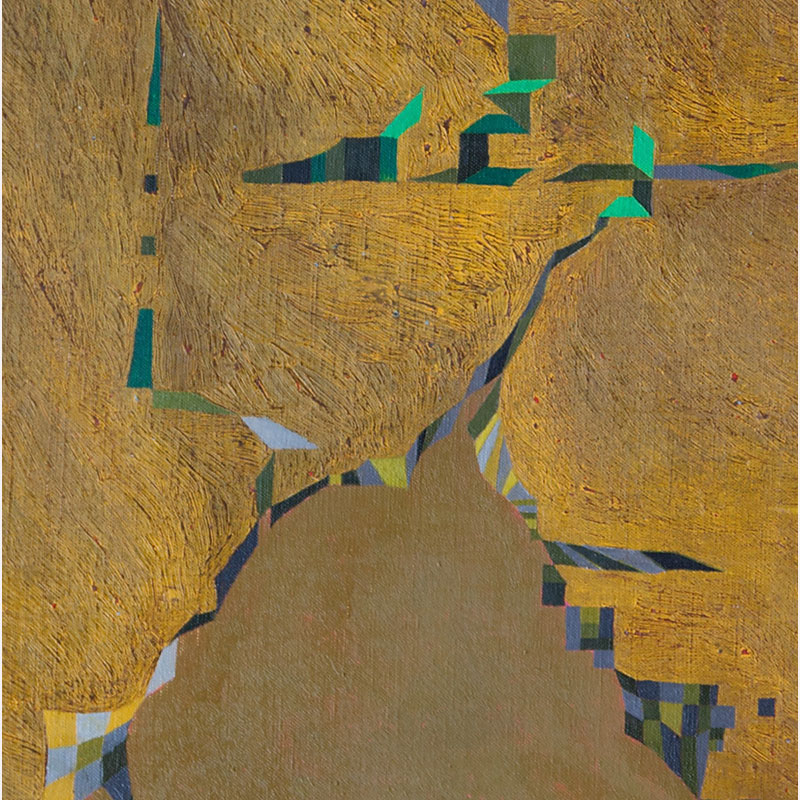
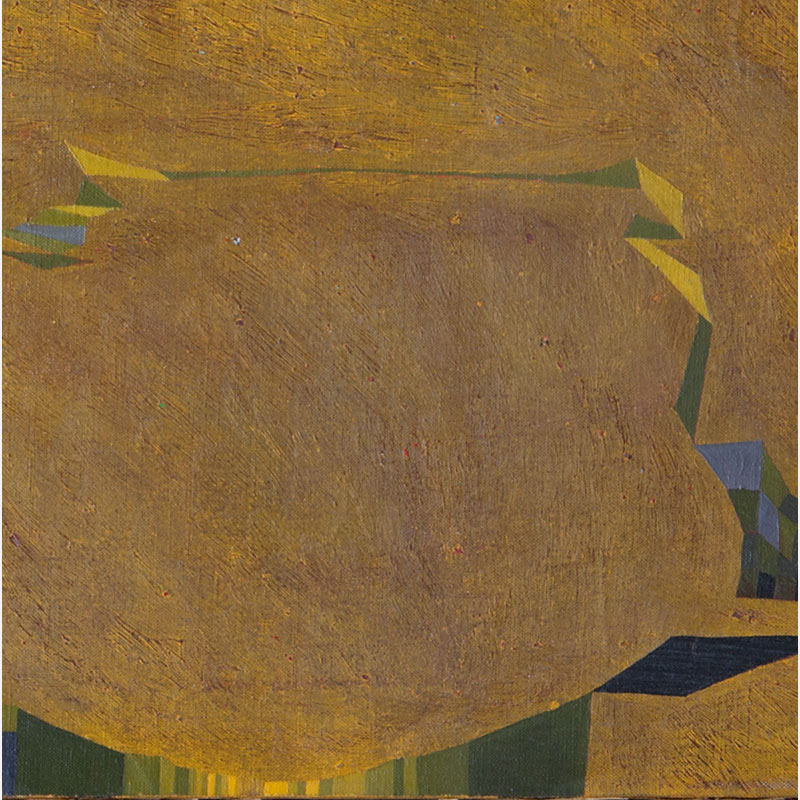
In New Haven, frammento [New Haven, fragment], color fields are separated not by hard contours but by fissures and seams that appear to pull the surface apart. The zones of ochre and yellow are no longer flat chromatic expanses but painterly fields where underlayers emerge through visible brushwork, lending the surface a new tactile warmth. Within this quiet expanse, a constellation of sharply defined fragments asserts its presence with unmistakable energy, holding their own as protagonists in fragile equilibrium with the surrounding fields.
In New Haven, frammento [New Haven, fragment], color fields are separated not by hard contours but by fissures and seams that appear to pull the surface apart. The zones of ochre and yellow are no longer flat chromatic expanses but painterly fields where underlayers emerge through visible brushwork, lending the surface a new tactile warmth. Within this quiet expanse, a constellation of sharply defined fragments asserts its presence with unmistakable energy, holding their own as protagonists in fragile equilibrium with the surrounding fields.
Small squares, triangles, and directional clusters do not merely decorate or activate the surface; they hold their own as protagonists, suspended in a state of delicate equilibrium with the surrounding fields. Their rhythmic spacing, angular momentum, and internal cohesion give them a sense of latent motion, as if caught mid-expansion or in the process of coalescing into larger systems.
This balance between stasis and impulse, between the stillness of layered fields and the tension carried by geometric detail, animates the composition. The increased textural interplay, and the way fields of color rest upon underlayers, suggests the lingering effect of Vanni's exposure to painters like Clyfford Still in New York. But in contrast, Vanni's forms remain quiet, poised, and pictorially articulate.