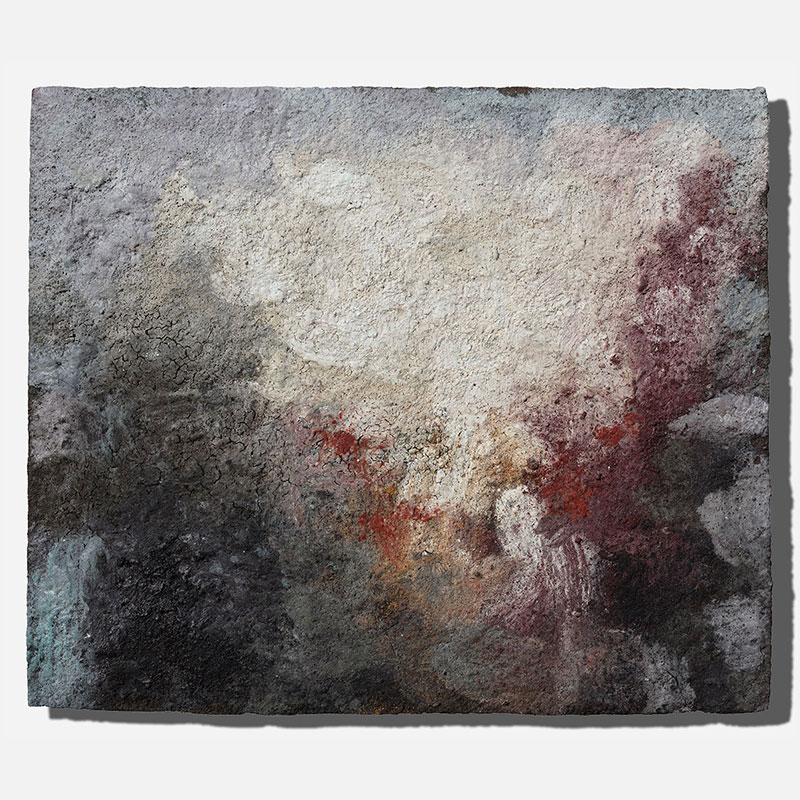
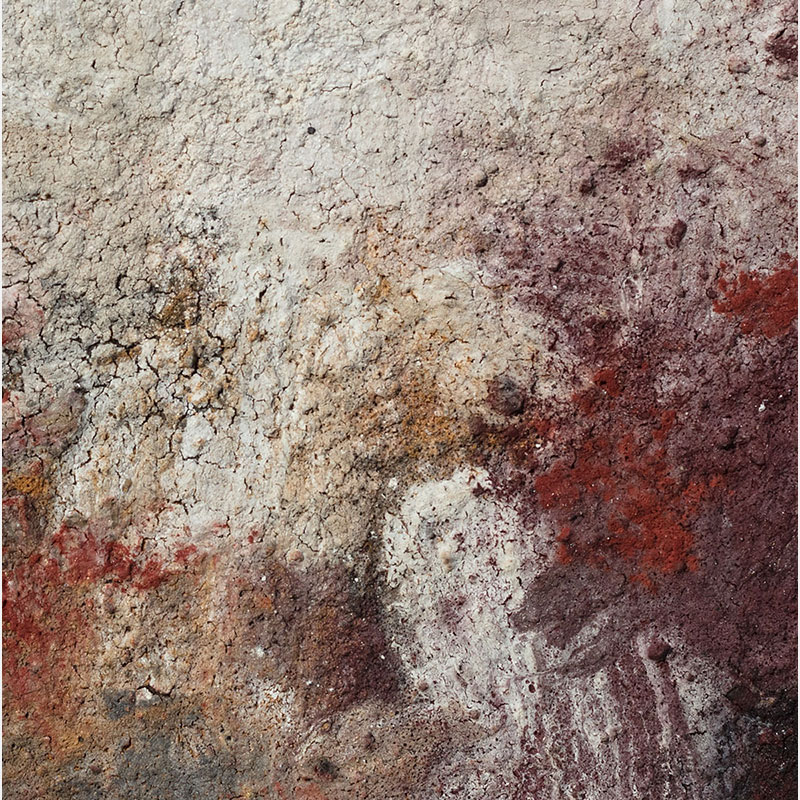
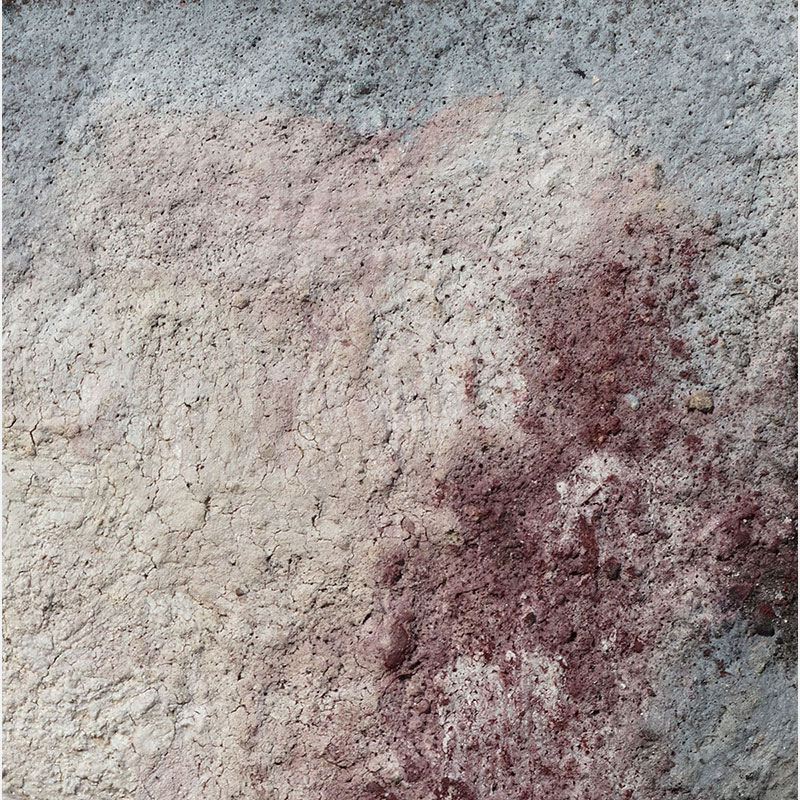
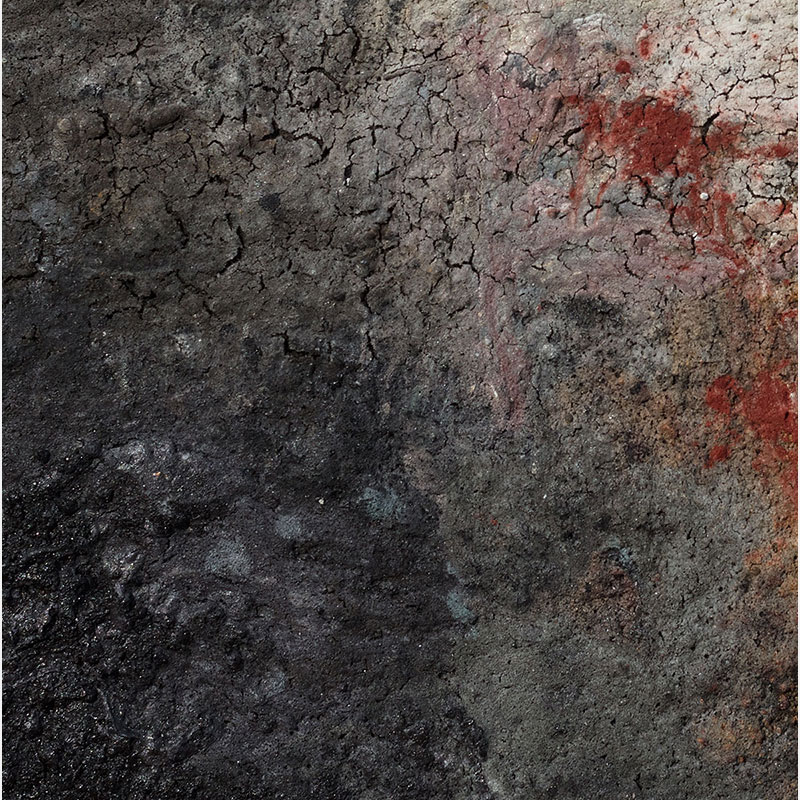
Dark ashen grays and deep crimsons hold the lower and peripheral field of Terra Bruciata 48 while a luminous white center seems to breathe outward from within the composition, as if what was scorched had burned through to something incandescent on the other side. The surface, built from lime, marble dust, mineral pigment, and actual fire, bears its evidence plainly: cracks, burns, and accretions that read as geological rather than painterly, the record of a process more patient than any brushstroke.
Dark ashen grays and deep crimsons hold the lower and peripheral field of Terra Bruciata 48 while a luminous white center seems to breathe outward from within the composition, as if what was scorched had burned through to something incandescent on the other side. The surface, built from lime, marble dust, mineral pigment, and actual fire, bears its evidence plainly: cracks, burns, and accretions that read as geological rather than painterly, the record of a process more patient than any brushstroke.
The white center of Terra Bruciata 48 is one of the formally decisive moments in the series. It arrives not as negative space or as a gesture of compositional restraint but as a material event: ash and lime, the residues of combustion, accumulating into luminosity. The Pompeiian frescoes that De Gennaro has cited since his earliest accounts of his formation survive as they do precisely because fire preserved as much as it destroyed: the walls of Pompeii hold color because the eruption sealed them. The Terra Bruciata works carry this double logic, destruction as the condition of preservation, in every surface.
The Arte Informale tradition provides the most precise critical frame for the Terra Bruciata series, particularly in its Italian variant, where the theoretical argument insists that matter carries historical and existential weight that the gestural mark alone cannot sustain. The key distinction drawn by Italian critics between pittura materia and the gestural Tachisme of the French mainstream is directly relevant here: De Gennaro's surfaces are not records of the speed of a hand but records of the duration of a fire. Time is not indexed by gesture but deposited as sediment. Terra Bruciata 48 is one of the clearest expressions of this logic in the inventory: what the fire left behind is the painting.