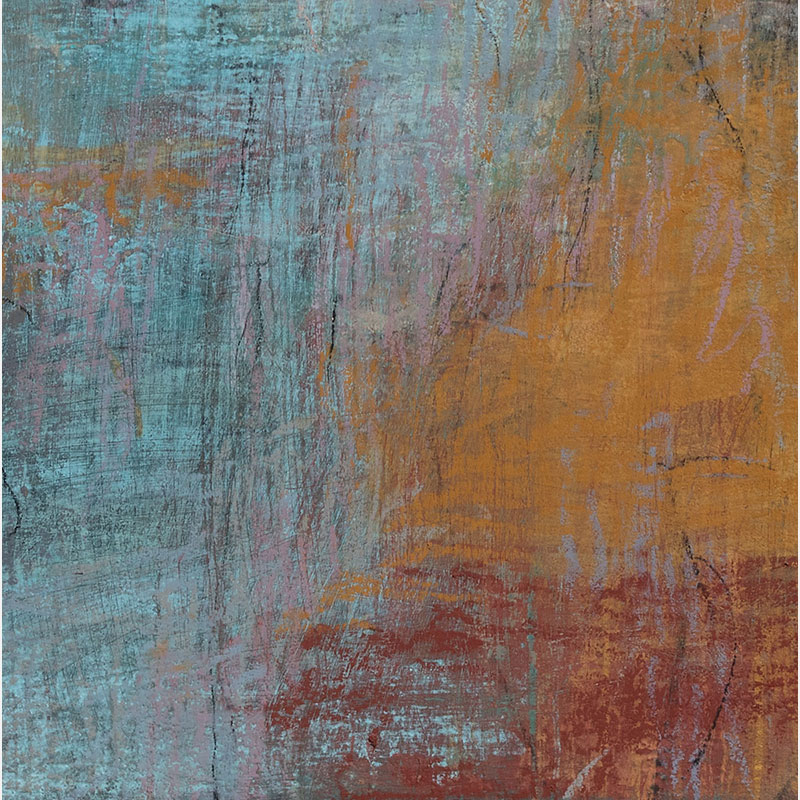
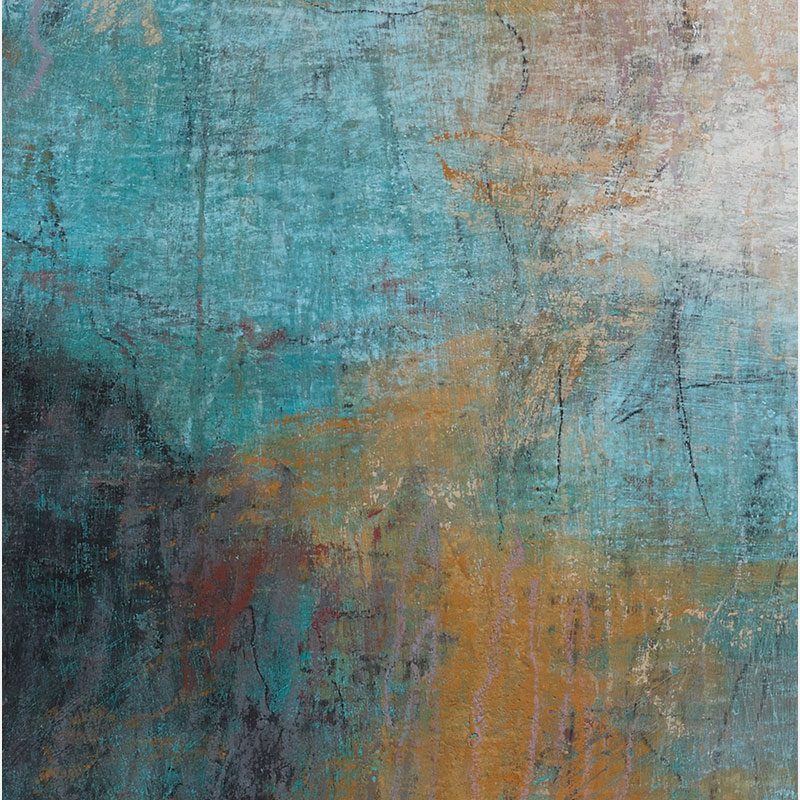
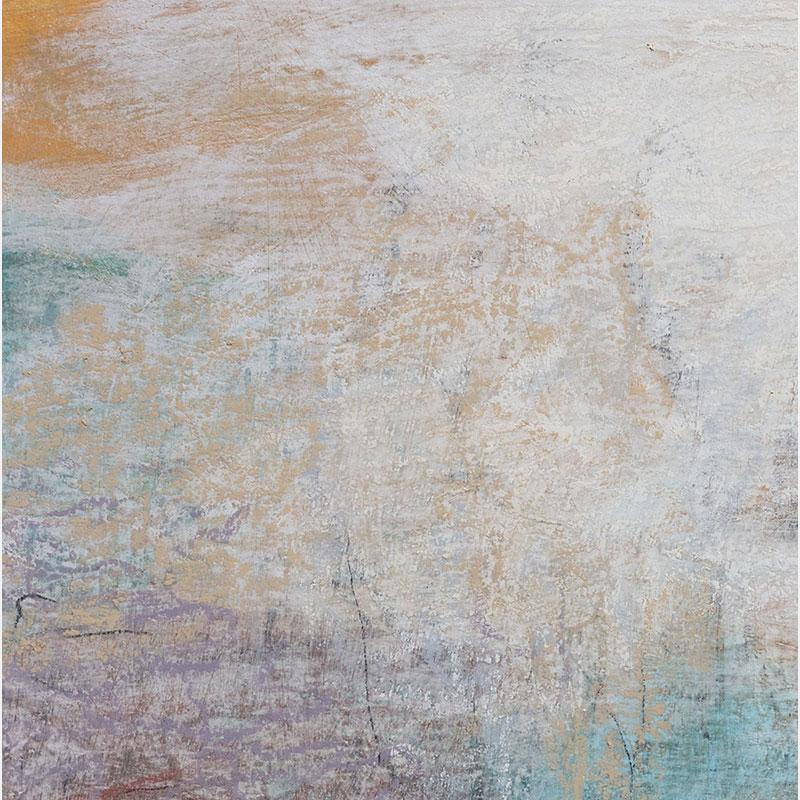
Terra Incognita III [Unknown Territory III] works as a kind of layered cartography: turquoise veils bleed across dense blacks and warm ochres, the whole surface alive with the visual logic of erosion and discovery, as if pigment and lime were recovering something that had been buried. Graphite marks trace vertical paths through the field, insistent but inconclusive, the record of a hand that moved through the surface without arriving at a destination. The composition charts not a place but the experience of searching for one.
Terra Incognita III [Unknown Territory III] works as a kind of layered cartography: turquoise veils bleed across dense blacks and warm ochres, the whole surface alive with the visual logic of erosion and discovery, as if pigment and lime were recovering something that had been buried. Graphite marks trace vertical paths through the field, insistent but inconclusive, the record of a hand that moved through the surface without arriving at a destination. The composition charts not a place but the experience of searching for one.
De Gennaro builds these surfaces from earth pigments, lime, graphite, and handmade oil pastel, working a thick impasto of lime and sand before applying, scraping, and reapplying color until the layers carry the history of their own making. The title series — Terra Incognita — frames the canvas as territory rather than image, the painting as a map of what cannot be mapped. This is an old ambition in Italian painting: the land's resistance to being named is as much a subject as the land itself.
The layered cartography of Terra Incognita III perates through a material logic specific to De Gennaro's process: semi-translucent strata of lime and pigment that carry traces of earlier states through later ones, each layer of discovery also a record of what preceded it. Nicolas de Staël's late Mediterranean canvases offer a useful point of triangulation. His Agrigente and Sicile series dissolved Sicilian light and terrain into dense, opaque passages of saturated color hovering between abstraction and place. Terra Incognita III works the same zone but through an inverse material approach: where de Staël builds with a palette knife, De Gennaro scratches through accumulated strata. Both arrive at the same conviction, that landscape is most honestly rendered when it is allowed to resist depiction.
![Abstract painting by Orazio De Gennaro. Turquoise veils bleeding across dense blacks and warm ochres, graphite verticals through layered lime and pigment impasto. Terra Incognita III [Unknown Territory III], 2012.](../paintings-orazio-de-gennaro/images/artwork20a.jpg)
![Room view of abstract painting Terra Incognita III [Unknown Territory III] (2012) by Orazio De Gennaro, 44 x 48 inches. Turquoise and ochre on canvas.](../paintings-orazio-de-gennaro/images/artwork20e.jpg)