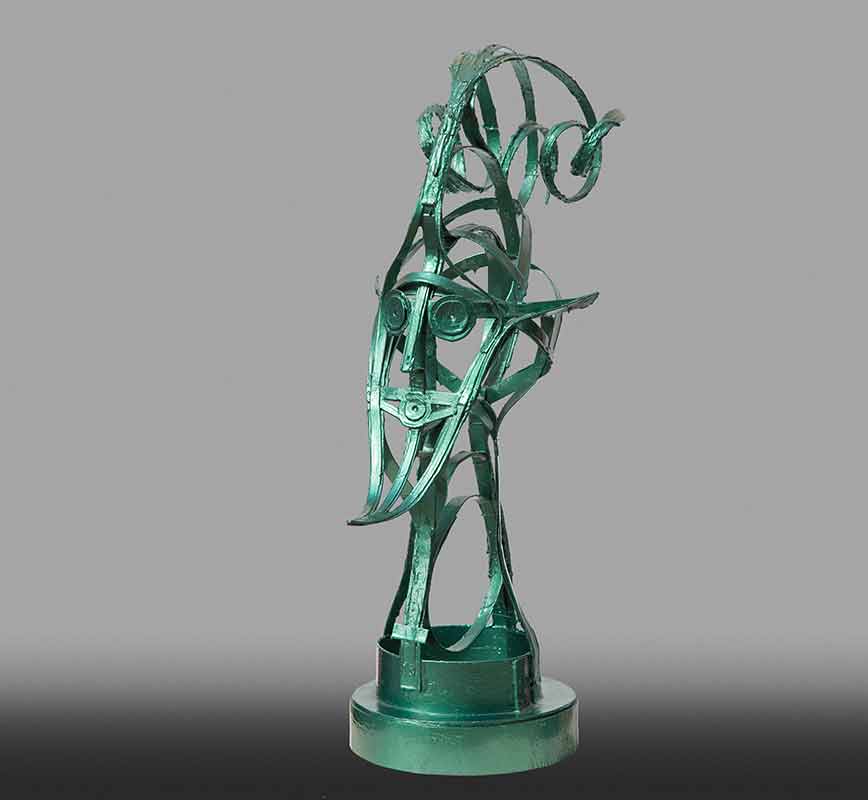
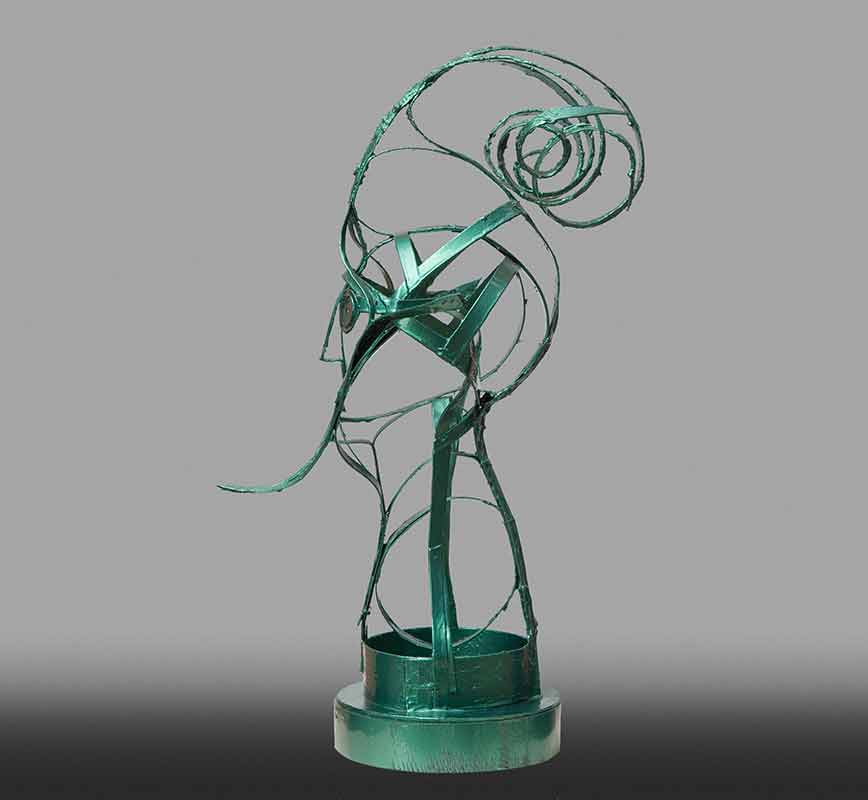
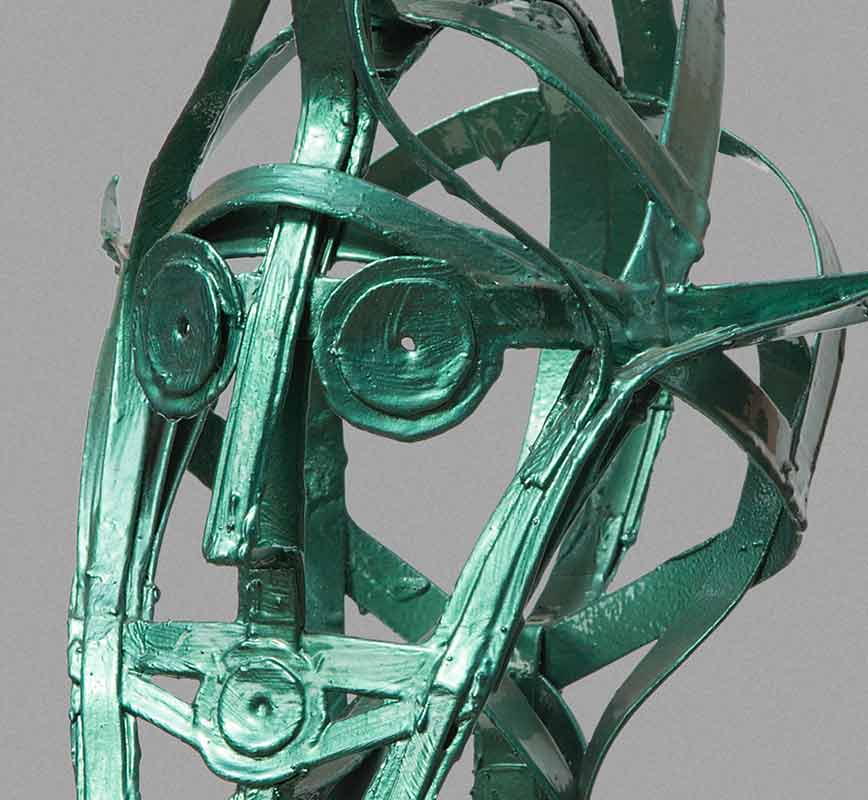
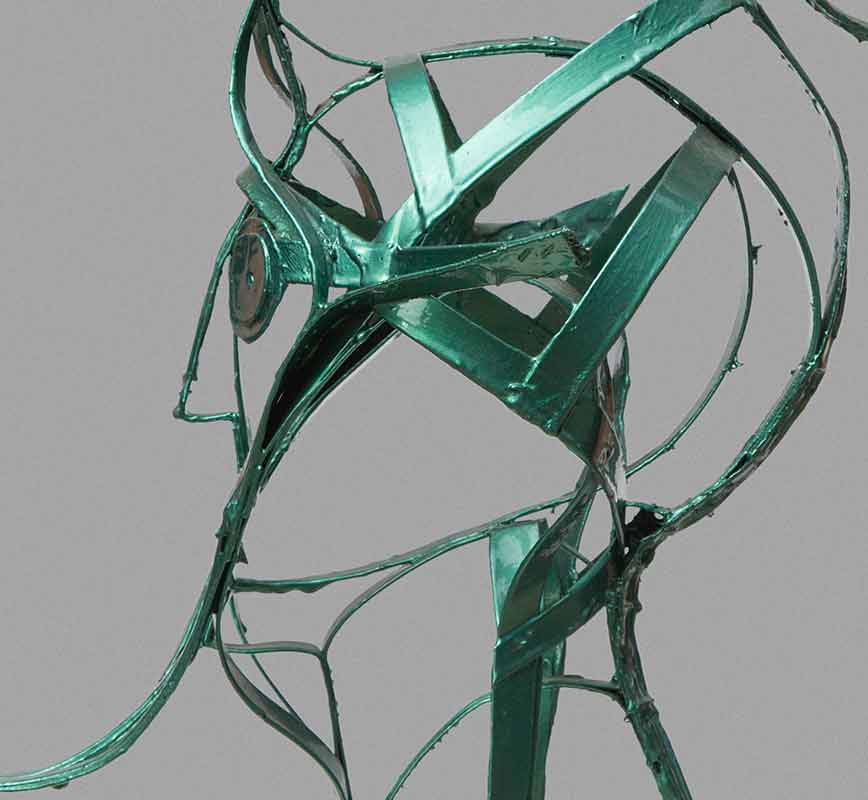
Built in deep navy blue, Senora Rodriguez is a tall open cage-column: the lower body a large open armature of interlaced strips rising from a dark circular base, the primary physical volume of the work. The head sits atop it, constructed from interwoven planar bands held together by a loose orbital tangle. A single red eye is set precisely into the face, the chromatic shock of it sharpening the whole composition into attention.
Built in deep navy blue, Senora Rodriguez is a tall open cage-column: the lower body a large open armature of interlaced strips rising from a dark circular base, the primary physical volume of the work. The head sits atop it, constructed from interwoven planar bands held together by a loose orbital tangle. A single red eye is set precisely into the face, the chromatic shock of it sharpening the whole composition into attention.
The title is a small, deliberate provocation: a Spanish surname with a social honorific, belonging to the world of ordinary bourgeois life, attached to a sculpture that refuses everything domestic in its presence. The contrast between the formality of the name and the energetic, improvised construction creates a productive irony. Identity arrives through social convention alone, while the form insists on its own structural logic.
The head as the sufficient container of identity has a continuous history in Western sculpture from the Greek portrait herm through the Roman bust to the medieval reliquary head. But this work holds that tradition in productive tension: the head is the named subject, but the cage-column below it is the dominant physical event. The interlocking bands bear the same relationship to a human head that a wireframe bears to a solid model: everything implied, nothing stated. Art historian Enrico Crispolti traced Canevari's analytical approach to a Roman formation lineage through Cagli and Mirko: a tradition that treats the figure as a field of signs to be decoded rather than a body to be depicted. Julio González, working in welded iron in Paris in the late 1920s and 1930s, arrived at the same territory through different means. The open-armature portrait is a persistent formal proposition, and Canevari's version of it carries the full weight of that history while remaining entirely specific to its subject.
The Strutture were Canevari's last series, made in his Amelia studio between 2001 and 2007. They were built in the same years he was producing illustrated editions of Don Quixote and Orlando Furioso, dense ink drawings in which the same chivalric subjects returned with renewed urgency. The Italian art critic Alfio Coccia wrote in 1971 that his drawing was not preparatory work but a work in which the poetic message unfolds in its totality. In Senora Rodriguez, the drawn line becomes a cage, the cage becomes a column, and the column becomes a portrait: the ordinary honorific carrying more structure than it knows.