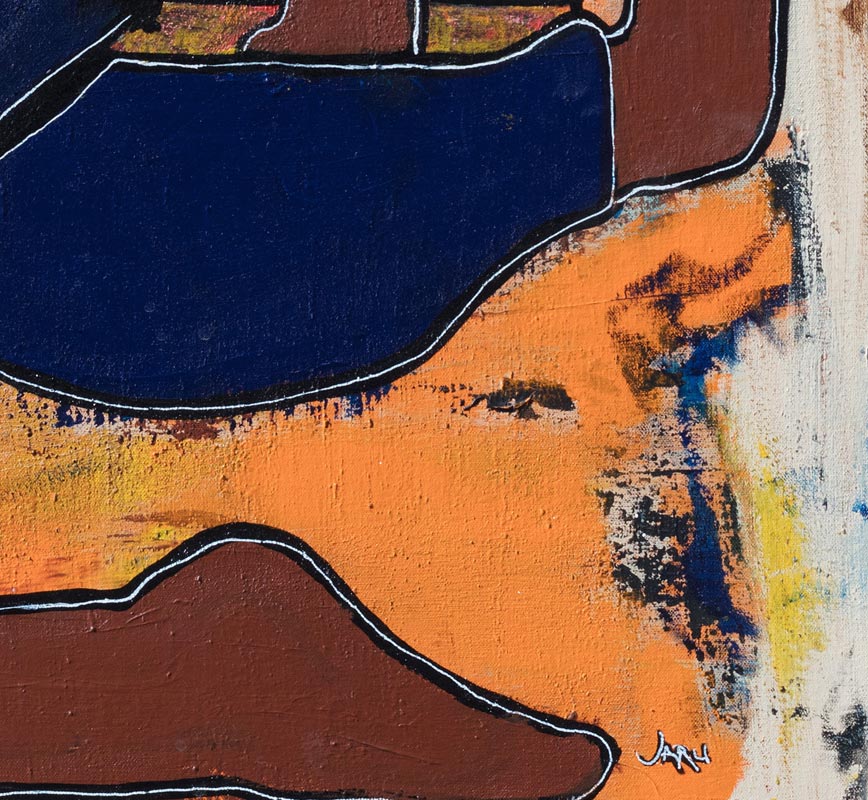
A single figure stands in Rites of Passage, holding a spear, its dark segmented body outlined in white against a ground of textured yellow and beige where patches of raw canvas show through. The figure does not advance or retreat; it occupies its space with the complete stillness of something that has arrived at a moment it has been moving toward for a long time. The posture is slightly turned, not quite frontal, as if caught in the instant between preparation and action.
A single figure stands in Rites of Passage, holding a spear, its dark segmented body outlined in white against a ground of textured yellow and beige where patches of raw canvas show through. The figure does not advance or retreat; it occupies its space with the complete stillness of something that has arrived at a moment it has been moving toward for a long time. The posture is slightly turned, not quite frontal, as if caught in the instant between preparation and action.
The simplicity of the formal language is not a limitation but a choice: one figure, one ground, one implement. The segmented body, divided into organic interlocking forms, gives the figure its physical weight without requiring anatomical precision. The exposed canvas in the background, the raw material showing through the yellow and beige, grounds the image in the material act of painting even as the figure reaches toward something beyond the material: initiation, transformation, the threshold between one state of being and another.
The figure in Rites of Passage carries ritual weight without being ethnographically contained: the spear is not a weapon in a specific conflict but an implement in a specific ceremony, and the ceremony is universal enough to be anyone’s. The dignity and solitude of the figure, standing alone in its warm ground, produce this authority, and it is Wifredo Lam’s stylized figurative work, which navigated the space between Caribbean spiritual traditions and European modernist formal vocabulary with precisely this kind of openness, that provides the sharpest critical parallel.