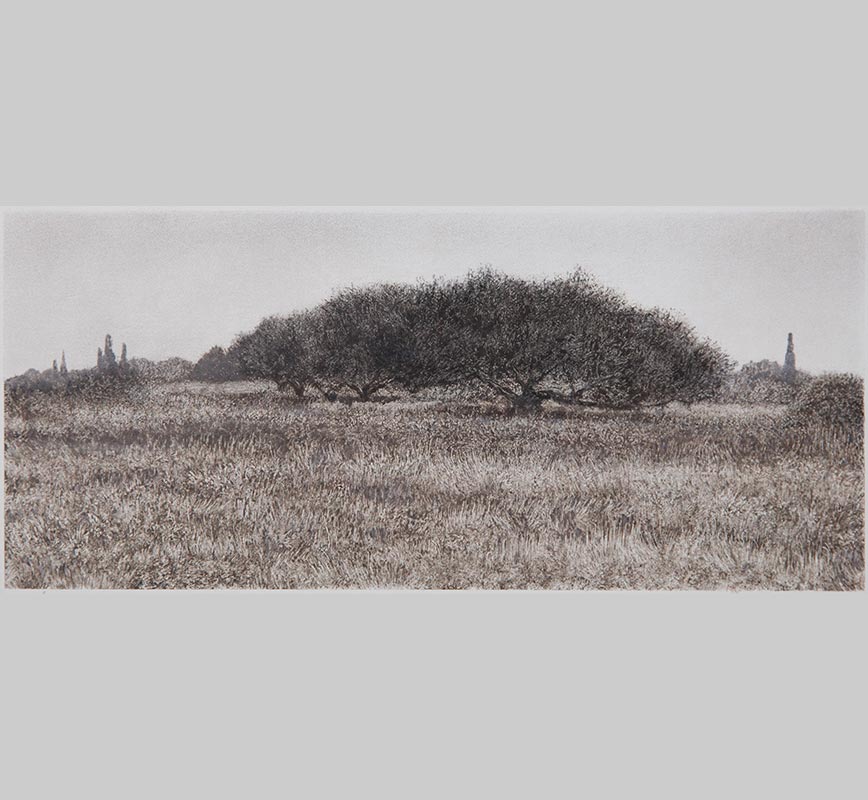
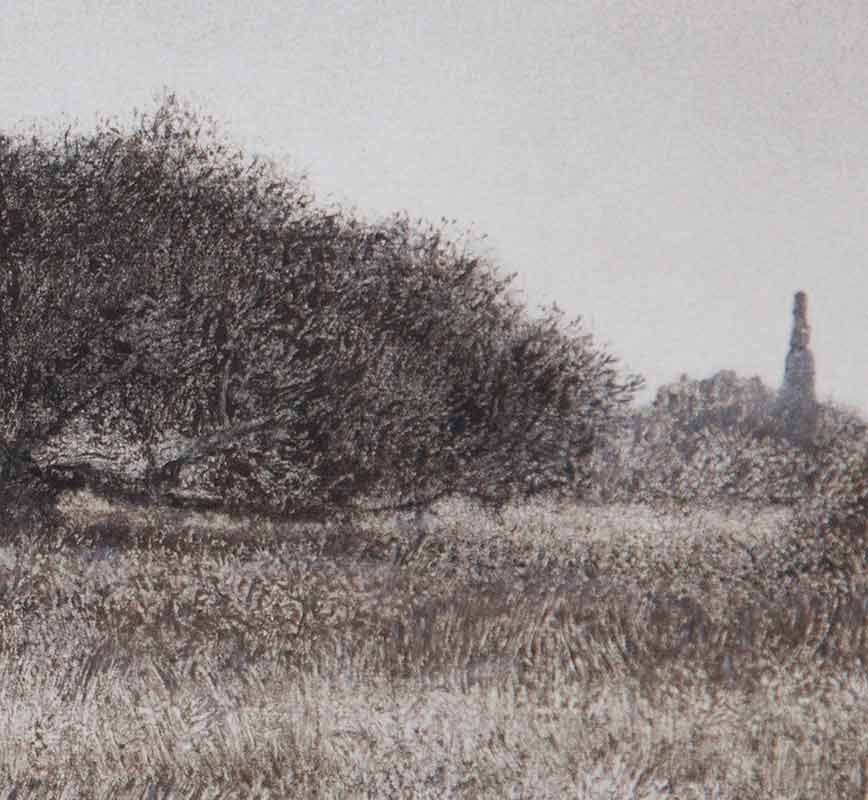
The landscape opens across a wide horizontal format: dark olive trees in the foreground, a long pale field between them and the hills, the hills themselves soft and grey against the sky. Three registers of recession, each distinguished by a shift in tone rather than a hard edge, the transition from one to the next as gradual as the actual movement between field and slope on a still morning on the island. Chalk and charcoal on archival paper give the scene a quiet, sustained presence.
The landscape opens across a wide horizontal format: dark olive trees in the foreground, a long pale field between them and the hills, the hills themselves soft and grey against the sky. Three registers of recession, each distinguished by a shift in tone rather than a hard edge, the transition from one to the next as gradual as the actual movement between field and slope on a still morning on the island. Chalk and charcoal on archival paper give the scene a quiet, sustained presence.
Whistler wrote that the evening mist clothes the riverside with poetry, and the poor buildings lose themselves in the dim sky, and the tall chimneys become campanili, and the warehouses are palaces in the night. The mechanism he identified was tonal reduction: strip back the descriptive facts and what remains is not generic but more intensely itself, because what survives the reduction is the essential atmospheric signature of that place, that hour. The Thames warehouses become more present as they become less specific; the Kytheran hills become more present as the charcoal dissolves their edges into the sky.
Tzannes intended landscapes like this one to operate as sites of associative memory: the olive grove as a place the viewer feels they are walking, the hills in the distance as the measure of how much of the island is still out there, beyond what the eye can resolve. The work does not describe Kythera; it recreates the experience of being there, of standing in such a grove and looking out toward such hills on such a morning.