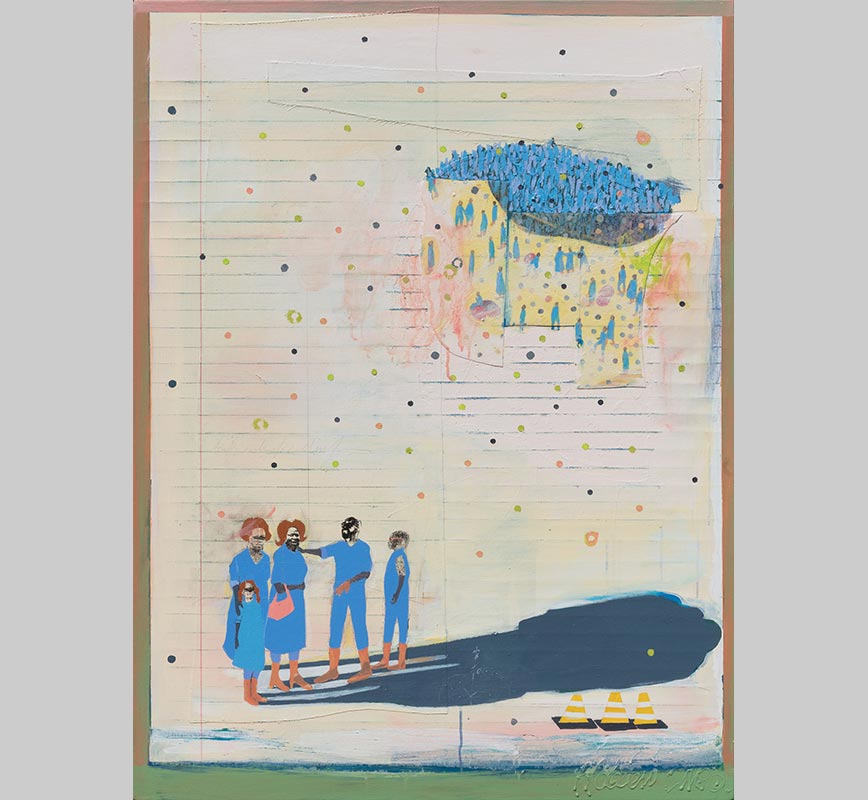
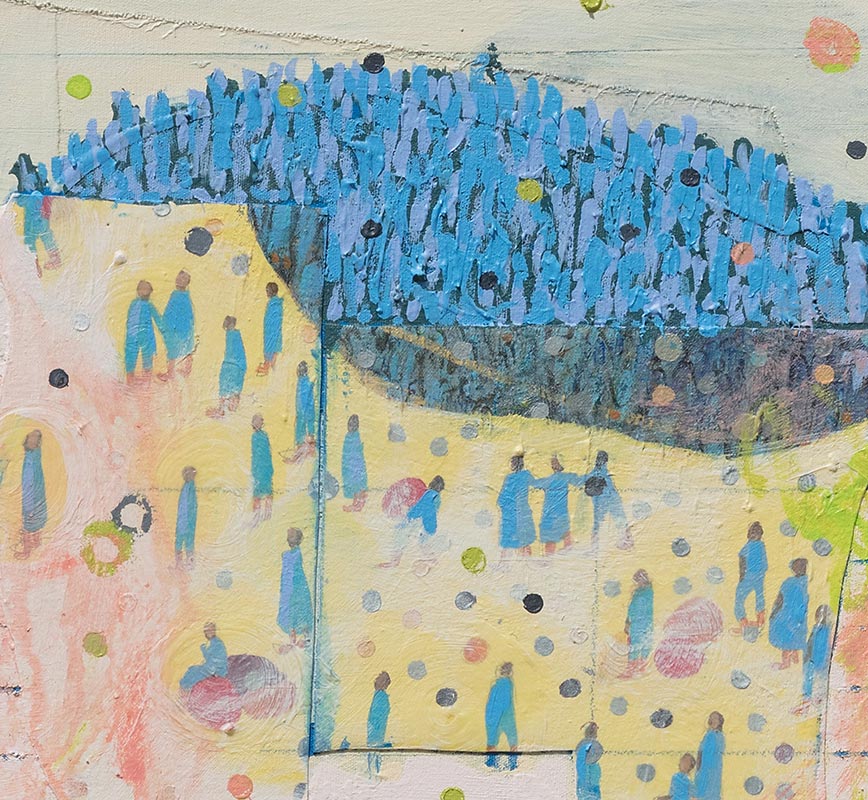
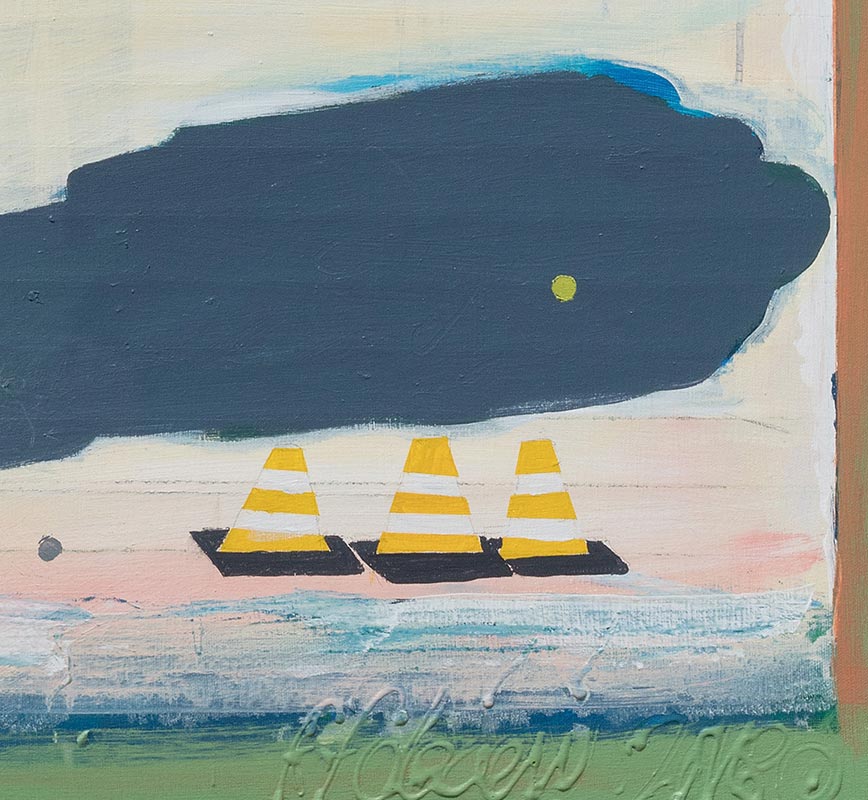
The life rings here are not ornamental: each one contains a small painted figure, making the entire field simultaneously a pattern of circles and a collection of individual portraits. Hundreds of them drift across the blue ground, the rings tilted and turning at different angles, their occupants anonymous at this scale but present. The orange-and-white construction barrier at the bottom anchors the composition to the street, the only reminder that all this floating takes place above a specific ground.
The life rings here are not ornamental: each one contains a small painted figure, making the entire field simultaneously a pattern of circles and a collection of individual portraits. Hundreds of them drift across the blue ground, the rings tilted and turning at different angles, their occupants anonymous at this scale but present. The orange-and-white construction barrier at the bottom anchors the composition to the street, the only reminder that all this floating takes place above a specific ground.
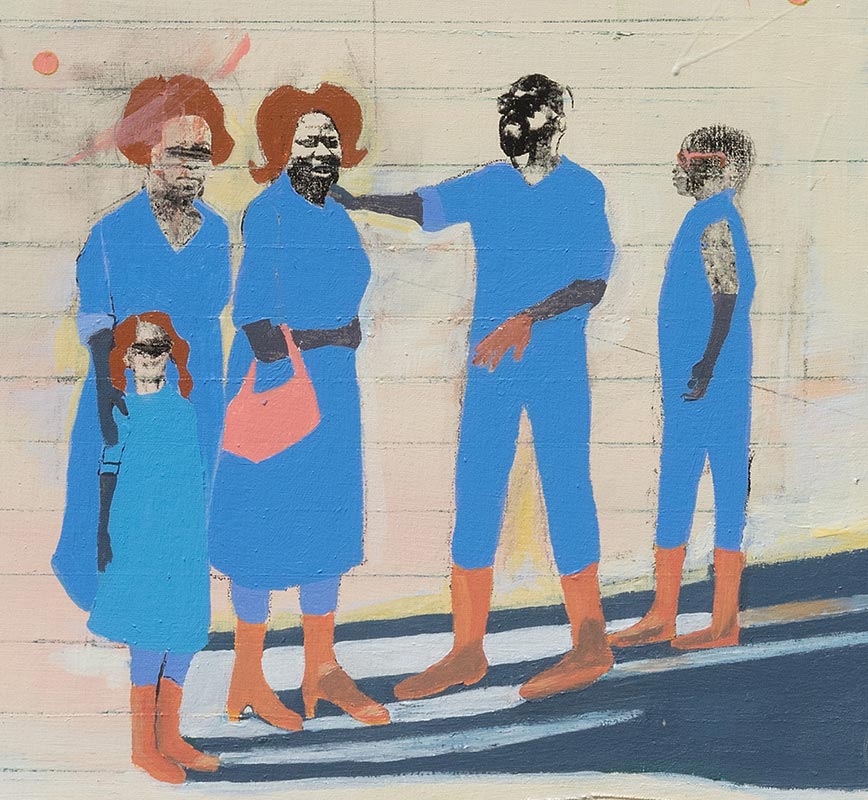
This is the most abstract canvas in the Spring Break series: no figure in the foreground, no centered presence, only the all-over field of rings and their tiny occupants. The formal logic is complete dispersal, the eye moving continuously across the surface without finding a hierarchy or an anchor. The painting refuses the centered compositional logic of both the Mumbo Jumbo series and the other Spring Break works, opting instead for a truly all-over structure where the crowd is the only protagonist and the individual is visible only at close range.
Each ring carries a human presence within the repetition, the crowd distributed across the canvas as both pattern and population: the repeated unit refusing hierarchy, the surface complete without a focal point. This is the formal and political argument the Pattern and Decoration movement made through pure ornament; Deceus makes it through a crowd, each unit inhabited. The individual is visible at close range.