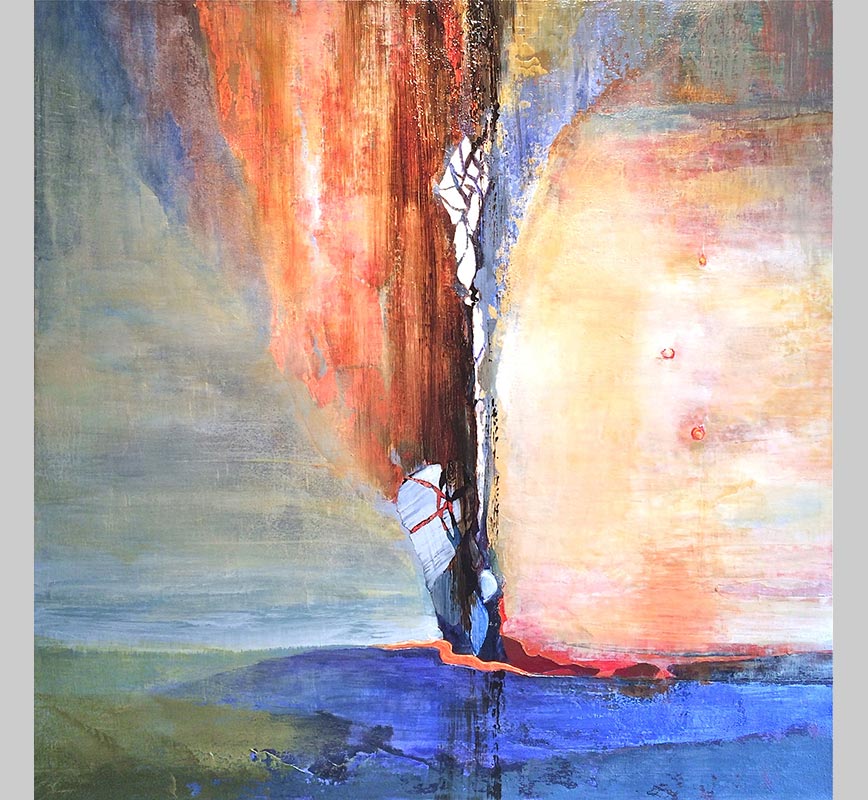
The surface of Ancient Aperture reads like a wall that has survived several centuries: soft greens and warm yellows layered in passages that suggest plaster, fresco, moss, and lime, the kind of accumulation that happens not by intention but by time. Vertical strokes organize the field into something architectural without specifying architecture; horizontal cracks and color breaks suggest the structure has shifted. Against this layering, a single small red form near the lower center announces itself with the specificity of a living thing.
The surface of Ancient Aperture reads like a wall that has survived several centuries: soft greens and warm yellows layered in passages that suggest plaster, fresco, moss, and lime, the kind of accumulation that happens not by intention but by time. Vertical strokes organize the field into something architectural without specifying architecture; horizontal cracks and color breaks suggest the structure has shifted. Against this layering, a single small red form near the lower center announces itself with the specificity of a living thing.
Ancient Aperture operates on a geological analogy Per Kirkeby, painter and geologist, established in European abstract painting: surface-as-stratigraphy, the eye reading down through the paint, inferring what lies beneath from what subsequent events have exposed. The technique makes the metaphor available; it is not imposed from outside.
The small red form at the lower center carries disproportionate weight within a surface so committed to the palette of mineral accumulation: it reads as discovery, as something always there but only now uncovered. The title’s aperture may refer precisely to this: not an opening in a wall but a window in time, the brief moment when what was hidden becomes visible.